DÉFENSE ZONE

Welcome to Défense Zone, the podcast that covers defence and security issues through interviews with military personnel, members of law enforcement, politicians and entrepreneurs.
The aim of this audio programme, available on every online podcast platform, is to open the doors of a usually rather secretive world to the general public, in order to prompt reflection on questions that concern us all, whether political, geopolitical, economic or, more broadly, societal.
Today, we set out to discover a new profession: that of municipal police officer. If you are on Instagram, you probably know Lalou Croft, a municipal police officer in a dog unit. On this social network, the young woman, originally from Toulouse, shares her daily life with Jeriko, her four-legged colleague. In this episode, she talks to us about her career and about how this institution, which is in fact little known to the general public, works.
Introduction
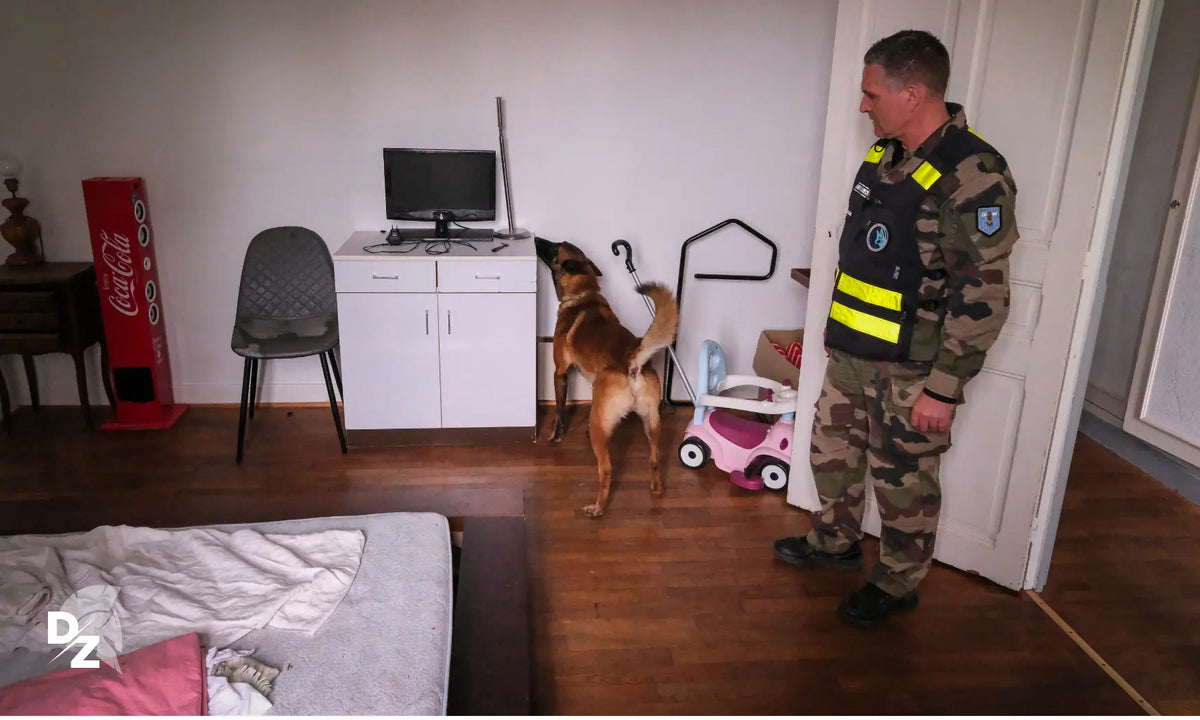
Lalou Croft, the pseudonym the young woman uses on social media, is 28 years old and has been working in Burgundy as a municipal police dog handler for two and a half years, accompanied by her Belgian Malinois shepherd, Jeriko. Before entering police school, Lalou was a high-level athlete and played football for 18 years. She began her career in a small town near Toulouse, and stresses the versatility of this post, in which the officer on the ground must be competent in every code (forestry, criminal, highway…). She then received a job offer in Burgundy, on condition that she become a dog handler. “I dropped everything to give it a go!” explains the officer. Although she had no experience with animals, she had always loved dogs. “When I was 12, I was at a football tournament in Metz,” she recalls. “On the next pitch, a handler was training his German shepherd, which obeyed his every command. When I got home I had the cup, but all I wanted was a dog!” She also remembers the Brittany spaniel inherited from her great-grandfather when he died, which kept going back to his old home, without understanding that its master would never open the door again. “Even though I was small, I understood the unbreakable bond between a dog and its master,” says the woman who saw her dream come true a few years later, with Jeriko.

The municipal police
The differences between the national and municipal police
As Lalou Croft points out, the municipal police answer to the mayor of the town. The officer is an assistant judicial police officer and does not have the same powers as a national police officer. They can arrest an individual and take them to the police station, but must then hand over, because they cannot, for example, place people in police custody. As for weapons, the issue may include a baton or tonfa, tear gas, a less-lethal launcher, an electroshock weapon and a 9 mm handgun (or a revolver for the oldest posts). The national police, for their part, can be more heavily equipped, up to long guns. However, the circumstances in which a weapon may be used are identical and must fall under self-defence, which consists of reacting to a “real, present and unjust threat, with a response that is necessary, proportionate to the attack, immediate, justified and intentional.”

The requirements for joining the municipal police
There are various competitive exams for joining the municipal police, through internal or external routes. The category A exam is for municipal police directors; the category B exam is for heads of service; and the category C exam is required to become a gardien brigadier (constable) in the municipal police. This last exam includes a written assessment (text comprehension and expression, and a practical case with a scenario and report writing) and a sports test (a 100-metre run, then one event chosen from the 50 m freestyle swim, high jump, long jump or shot put).
Lalou Croft believes that more and more people want to join the municipal police. This trend is helped by the institution’s good communication, and it also offers several advantages, such as more flexible transfers, specialisations, and improving weapons and equipment: “the profession is booming; it’s nothing like the municipal police of 20 years ago.”

Municipal police training
The officer insists that each mayor decides on the resources allocated to their police (funding, equipment, kit, staff…). Lalou Croft works in “a very well-equipped town”, with weapons, vehicles, a motorcycle unit, a dog unit… whereas some municipal police forces are still not armed, because it depends on the mayor’s wishes. In her posting, the young woman benefits from two GTIP sessions a month (professional intervention techniques), which cover handcuffing techniques, getting out of vehicles, positioning with the dog and so on. Group sports sessions also take place twice a month, notably to perfect hand-to-hand combat. Scenario-based exercises, supervised by a firearms instructor, are also organised to get as close as possible to reality and prepare officers as well as possible. Finally, Lalou Croft stresses that each officer must then “take responsibility and train on their own”, whether by joining a shooting or sports club (CrossFit…) or by getting in shape at home, as she does with her own training equipment. “I can see the difference on call-outs: I’ve gained explosiveness, strength and speed,” she says. “It’s important to stay physically ready, but mentally too, to talk to your colleagues and your family.”

Lalou Croft’s Instagram account
Lalou Croft had never had a social media account before signing up to Instagram when she entered police school. Her number of followers grew quickly, which encouraged her to carry on. Her aim is to “promote a positive image of the municipal police”, but also to give advice on joining the police or, more generally, on doing workouts.
A supportive community
The young woman gives a lot of advice on her account, which has almost 34,000 followers, and in return receives a huge amount of congratulations, thanks and encouragement. She is very proud to have a “great community” and says she has received very few negative messages. “I don’t know whether it’s Jeriko or me who scares people most!” she jokes. She does, however, remember a private message she received from a man who wrote to her: “you see, I’m typically the kind of guy who shouts ACAB at demonstrations.” The officer replied, without losing her cool: “and I’m typically the kind of woman who, 10 hours a day, puts her own life in danger in the service of the public. Because the day someone breaks into your home or your parents’ home and wants to rape your mother or your sister, I’m the one who will put my life in danger to save them, to stop an offence or a crime.” Following their conversation, the man eventually changed his mind about the police.
Opportunities
Her presence on social media has enabled the young woman to take part in “extraordinary courses”: a parachute jump in Austria in September 2019 with the Austrian military, a five-day tactical training course with the Liège anti-banditry platoon in September 2020, a particularly tough survival course in French Guiana with Max Well, a course with SWAT… For the latter, an American instructor travelled to the Dordogne for a week. The officer was able to fire a 9 mm for the first time, but also trained with a long gun and put tactics into practice. This exceptional experience, of which she is proud, now allows her to work with greater confidence on patrol: “You feel more seasoned for your daily missions, and even if you don’t draw your weapon every day, tactics are important for staying safe.”

Dog handler
Police dogs fall into two specialisations: either patrol and protection (bite work and muzzle strikes) or detection (of banknotes, weapons and ammunition, or explosives). Jeriko, Lalou Croft’s dog, is a patrol and protection dog.
Meeting Jeriko
When she was offered a dog handler post, Lalou Croft had to find a dog. In the municipal police, the officer has two options: either they already own a dog and make it available to the town, or the town assigns them one. The young officer had to find her own, so she began looking for her companion. After unsuccessful searches, she came across Jeriko, a four-year-old dog (seven today). The Malinois was already trained in ring sport, a discipline involving obedience, agility and bite work. Trained by a GIGN operator, he was intended for a Belgian specialist unit, but eventually ended up with a police officer, who then sold him to Lalou Croft.
Since then, Jeriko has lived with his mistress at all times, following her on her missions, her workouts and even at home. “People tell me he’s my best friend, but actually I’d compare it more to a couple!” exclaims Lalou Croft. “Sometimes we sulk, sometimes we laugh together; I get up, he’s there, I go to bed, he’s there, we’re inseparable.”

The Malinois is of course very present on social media too, appearing in photos, videos and stories. So he has his own fans too: “What makes me laugh,” says the young woman, “is when people ask me, ‘if I see him in the street, can I give him a cuddle?’… Well, no! He’s still a protection dog, so logically, if you get too close, he may react,” the officer warns.
A working dog
The dog handler explains that the dog is trained and “coded”: as soon as he is wearing his muzzle and harness, he knows he is at work. Lalou Croft illustrates this with an anecdote: “One day I arrived at work, Jeriko was off the lead and played with a colleague. But as soon as I put his harness on and he was in his transport cage, he barked at that same colleague, because he was in work mode. The Malinois is very intelligent and clever; he knows how to tell things apart.” Likewise, the dog does not attack unless ordered to; but he can alert his handler if his instinct detects something suspicious.
A working dog retires between the ages of 8 and 10 on average. The handler must be able to read their four-legged teammate and understand when he is unwell and no longer fit. Lalou Croft explains that the question of a successor then arises, and here too the officer has two options: either take an adult dog that is already trained, or take a puppy and train it yourself. The officer chose the second option, so that she could train the puppy to meet her needs. She points out that the problem with adopting a dog that is already an adult is that you do not necessarily know its past and do not always understand its reactions, as she experienced with Jeriko. A few months ago, the young woman adopted Rafale, a Malinois puppy, and is training him to take over from Jeriko.

Helping retired dogs
When Jeriko retires, the officer wants to keep him by her side as a pet. Not all police dogs are so lucky; sometimes their handlers can no longer keep them at home. The dogs then face euthanasia, because they are hard to place with foster families owing to their past as protection dogs. With this in mind, the association “Un toit pour Erros” (A roof for Erros) was founded by the national police in Marseille and takes in around ten retired dogs. Lalou Croft is keen to do her bit, and recently became patron of the association “Soutien forces de l’ordre” (Support for law enforcement). She proposes developing a specific branch for police dog handlers to help them rehome the dogs. The idea would be a platform connecting police officers and families. “Thanks to my Instagram, I’ve already managed to rehome three dogs,” the young woman adds. “They deserve a good retirement; they’ve worked hard, they’ve saved lives, and it’s unthinkable to put them down because they can’t be rehomed.”
Balancing work and personal life
For Lalou Croft, the line can sometimes be thin between her professional life as a dog handler and her personal life as an athlete and Jeriko’s owner. Her relationship could also have been hard to keep separate from social media and work… But the young woman considers herself lucky because “Benoît is a former special forces operator, from the 1st RPIMa,” she says. “So he knows his stuff about weapons and so on, and he trains me. He understands the difficulties of wearing the uniform, knows what it’s like to go out on call-outs, to get home late, to come home frustrated, angry or in tears.” Today, her fiancé is a high-level MMA competitor, something she experienced in football. “In fact, we’ve swapped roles!” exclaims the officer. Each of them understands the other’s stress and feelings, and the couple support each other every day.
Being a woman in the police
Women make up 27% of the national police. Lalou Croft looks back on her career. First, her early days in football, a sport she started very young and never gave up, even though it was a rather male-dominated world. Then came her many courses, notably the SWAT one, on which she was the only woman. “I’ve never had a problem fitting in. I think it’s the attitude you give off. On social media, my nickname is T-rex; it’s neither masculine nor feminine, it’s just T-rex. In uniform I’m not a woman, I’m not a man, I’m a police officer.” The officer admits, however, that in certain specific situations she takes on a slightly more female role, to reassure a victim of sexual assault, or children during a family dispute. “That’s why it’s important to have women in the police; there are lots of situations where they matter.” Lalou Croft nonetheless stresses that a woman has to make twice as much effort to be accepted and has to prove herself both physically and mentally. She sometimes receives messages from women who hesitate to join the police “because they know they’ll be watched and judged, that people are waiting for them to slip up.” You also have to accept that some men are misogynistic and will always come and give advice, even when the results are good.

A final piece of advice
Lalou Croft advises preparing well, physically and mentally. Always keen to do things properly, she explains that she is as strict with Jeriko as she is with herself. She also says: “there’s always a starting point; if you don’t go to the starting line, you’ll never cross the finish line!” The officer attaches great importance to pushing herself, to determination and to courage, and says: “every challenge I’m offered, I take it on. In life, you have to dare and take the plunge.”
Read Lalou Croft’s portrait in the third issue of our magazine! Subscribe to our magazine to receive the next issues, access exclusive content and benefit from our partners’ offers on kit and equipment.