DÉFENSE ZONE

Welcome to Defense Zone, the podcast that covers defence and security issues through interviews with service personnel, law enforcement officers, politicians and entrepreneurs.
The aim of this audio programme, available on all online podcast platforms, is to open the doors of a usually rather secretive world to the general public, in order to prompt reflection on questions that concern us all, whether political, geopolitical, economic or, more broadly, societal.
This week, we meet Captain Thibault. This French Foreign Legion officer was a young lieutenant in 2014 on his first overseas operation. He was sent to the Central African Republic for Operation Sangaris. On that occasion, a French photojournalist, Édouard Elias, followed his platoon for several months to document the tense moments in the field, but also the daily life of the young soldiers during this mission, where conditions were often very basic. In issue 4 of Défense Zone, we devoted the portfolio to the work of this talented photographer.
Introduction
Thibault is currently commanding officer of the 1st company of the 2nd Foreign Infantry Regiment (2e REI) in Nîmes. After studying business, he decided to join as a contract officer (OSC) on the “leadership” track. After general training at the Saint-Cyr Coëtquidan schools and specialisation at the infantry school, he chose the French Foreign Legion. For four years he served as a platoon leader before being promoted to captain. Today the young officer is in his second year of command. He will “hand back” his company in the summer.
His first OPEX
For his first deployment, the young lieutenant decided to keep a logbook. He shares his first notes. “2014, 2 July, damn, this is it, I’m off on OPEX. Mixed feelings. Coach from Nîmes to Paris Charles de Gaulle. 3 July, 8.30 a.m. Boarding the plane, destination Bangui, a departure into the unknown. Clearly I have a heavy heart. I’m going to a war zone, I who two years and seven months ago knew nothing of the military world. I’m leaving on a complex mission. Texts from my loved ones, touching. I realise it is an important mission, a mission from which I may not come back, or come back completely different. I arrive in Bangui. Life in the M’poko shanty town near the airport and the French camp puts me in the mood. I take another small plane, bound for Bria, stronghold of the ex-Séléka. Settling into a camp in the east of the CAR to relieve a platoon of the 92nd Infantry Regiment. The compound is guarded by Congolese soldiers of MINUSCA. The evening brief seems complex to me; I will have to understand, and fast: in three days my platoon will be here. I am responsible for my 32 legionnaires, for their life, for their death. The situation is calm, but two months ago the lieutenant I am relieving was held at gunpoint by rebels. Through his composure, he managed to calm the situation…”

For Thibault, the situation had to be understood quickly so that he could then give orders to his legionnaires. “My men are not there to do analysis. It is up to me to do it, to understand and to translate all of that into clear orders. I have to make a complex situation simple in their eyes.”
Feeling ready? The weight of responsibility?
“Even if you can never say you are completely ready, it is for moments like these that you join up. Training, exercises, the intellectual journey of enlisting and then of preparation make you feel ready to carry out the mission. We place a great deal of trust in our physical and tactical preparation. Everything should go well, because we have been trained for this.” For Thibault, for whom it was his first stay in Africa (apart from a two-week visit to Djibouti with the lieutenants’ application division), a leader must not ask himself questions once on the ground. They arise, and must arise, before departure, because “once you are there, it is too late”. The leader must live up to what is expected of him, for his men and for his chain of command.

What was the mission?
In this area, the scene of numerous atrocities, the French troops had to prevent clashes between the two rebel factions (ex-Séléka and anti-balaka), which had already claimed many victims. It also meant protecting the population so that they could return to as “normal” a life as possible. In these conditions, the first interventions are always memorable: “you have to take weighty decisions, with the lives of your men at stake”, says Thibault.

Living conditions on the ground?
“We lived very rough, but as all soldiers know how to. Our training had prepared us for that. The big difference is the climate. It is a tropical environment with intense heat and a lot of rain. To cope with these difficult conditions, we could count on very strong cohesion.

Legionnaires are already used to living together for much of their time. For the first 5 years, they all live in barracks, in the same rooms. Weekends, Christmas: all these moments create a very powerful bond with each of them. They are not colleagues, they are brothers in arms. The relationship with the leader is also special, because, like the soldiers, we spend most of our time with our men. Respect for the leader is written into the legionnaire’s code of honour; it is a very special relationship. All this gives the platoon exceptional cohesion and makes it possible to face any situation with much greater strength.”
How do you command legionnaires your own age or older than you?
For the captain, when you arrive as a young platoon leader, you have to know how to listen to the old hands. The NCOs were previously enlisted men and have real experience, especially the deputy platoon sergeant. You have to learn from them, in all humility. It also means listening to the men, respecting them and understanding them in order to command them better. For them to follow you to war, they must trust you, and that trust is earned first in barracks, day to day, but also in the field during training. For a legionnaire, the leader is sacred. They trust him instinctively, because he has been trained. That creates an obligation to be worthy of that trust and always to do everything to take the right decisions.

A photographer arrives on operations
“With Édouard Elias everything happened very naturally. He is a humble person who fitted into the platoon straight away. We had talked a little about his past and I knew he had already been through very difficult things in the field on his previous assignments, but he remained discreet about it. He immediately understood the particular nature of this operation and of being with legionnaires. There is something extraordinary about following soldiers aged 20 to 30 who have come from the four corners of the planet to serve the French armed forces in a remote corner of Central Africa. Édouard’s strength is that he managed to capture this in these superb photos. He managed to put into images the human relationships and the intensity of the gazes, during operations of course, but also day to day, during rest periods, waiting, and so on. These images are rare, but they truly reflect what we went through. Today I have a real friendship with him. It came about thanks to his personality and the fact that he stayed with us for many weeks; he really wanted to become part of the platoon. We built very strong bonds of trust between us.”
Do the media show the army in a good light?
For the officer, his work is not dictated by how the media see him. But it is always hard to convey for an outsider. Édouard Elias’s photos were not taken for sensationalism and the press received his work particularly well (it was rewarded a few months later with the Sergent Vermeille prize, an annual competition for the best photographs of French Army missions). Édouard’s work was then exhibited at the Pont du Gard. “It was a fine tribute to all my legionnaires; this exhibition highlighted their commitment, and we were touched by this gesture and by the magnificent photos shown to the public.”

Any advice for a future officer?
“First of all, choose the French Foreign Legion! It is an extraordinary command. I do not regret my choice. What you give a legionnaire, he gives back a hundredfold! You must not count your time, whether in training and drilling them, or in guiding them, understanding them and simply listening to them. They came to give their lives structure and meaning, but also to find a leader. As a platoon leader, you become the link between them and France, quite simply. That is why the young officer is so respected. There is great satisfaction in living alongside these exceptional soldiers in the field. Eight years later, I would go to the other side of the world without hesitation with those who were under my command during Operation Sangaris.
You can find all our podcasts on our YouTube channel
Édouard Elias’s full photo story in issue 4 of Défense Zone
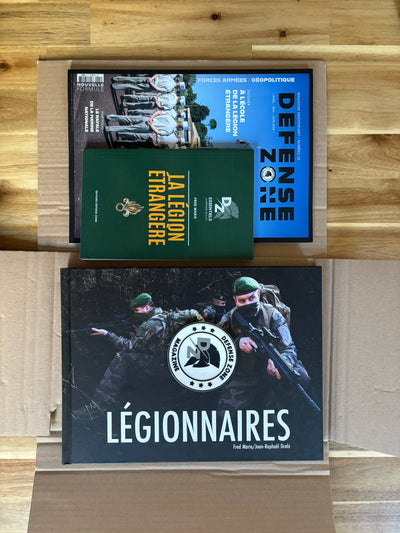
Issue 6 of Défense Zone devotes its main feature to the French Foreign Legion
You can also subscribe to our magazine, receive the next print issues, access exclusive content and benefit from our partners’ equipment and gear offers.