DÉFENSE ZONE
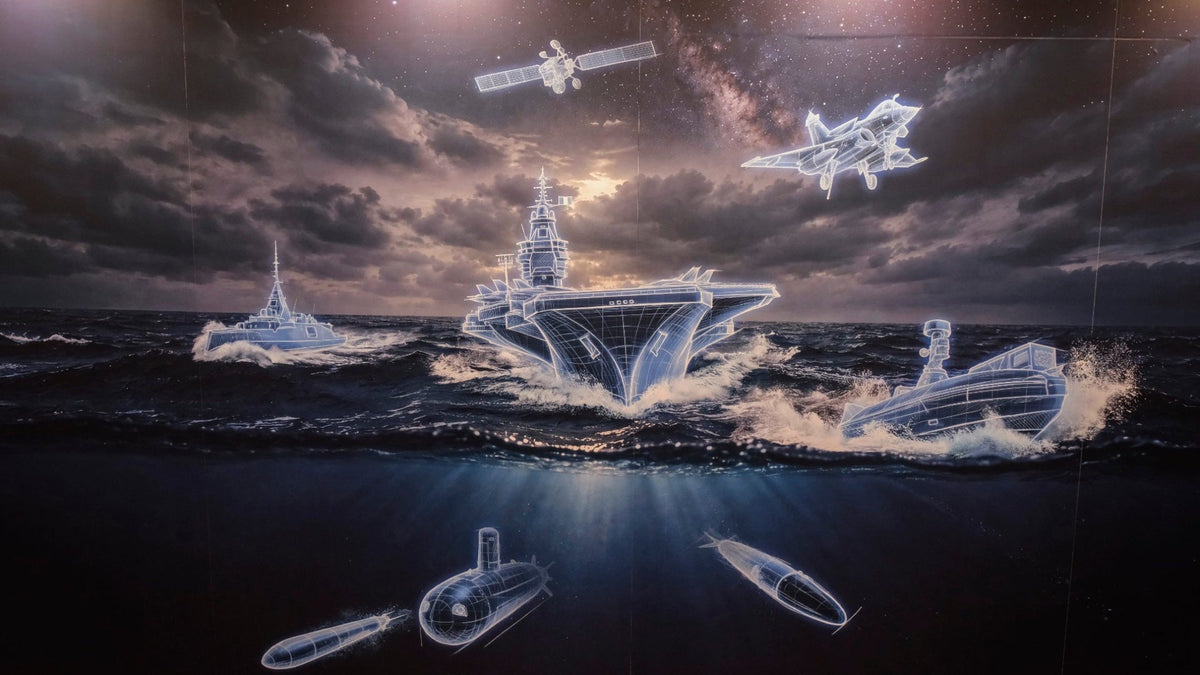
From 3 to 6 November 2026, Hall 6 at Paris Nord Villepinte hosted the thirtieth edition of Euronaval, the largest in decades according to its organisers. Over four days, the State and industry signed a pact on naval drones, the DGA doubled the air defence of the FDI frigates and Naval Group unveiled the combat ship it envisages for the future. Here is what to take away from the week.
A record edition
The report published by the organiser on 6 November leaves no doubt about the turnout. The show brought together 713 exhibitors of 41 nationalities, compared with 483 in 2024. It recorded 28,000 trade visits and received 204 official delegations from 71 countries, as well as 400 accredited journalists.
Drones took up an unprecedented place. According to AFP, some sixty specialist companies exhibited this year, compared with 17 two years ago. The SEAnnovation area, for its part, hosted 30 start-ups, twice as many as in 2024.
Held under the theme “Towards high intensity”, the edition devoted each day to a particular issue: information superiority and control of maritime spaces, then resilient and scalable platforms, then the new dimensions of naval warfare brought by drones and autonomous systems, and finally the shift from innovation to operational capability. On the last day, 21 French companies also took part in a day dedicated to recruitment.
A booming market
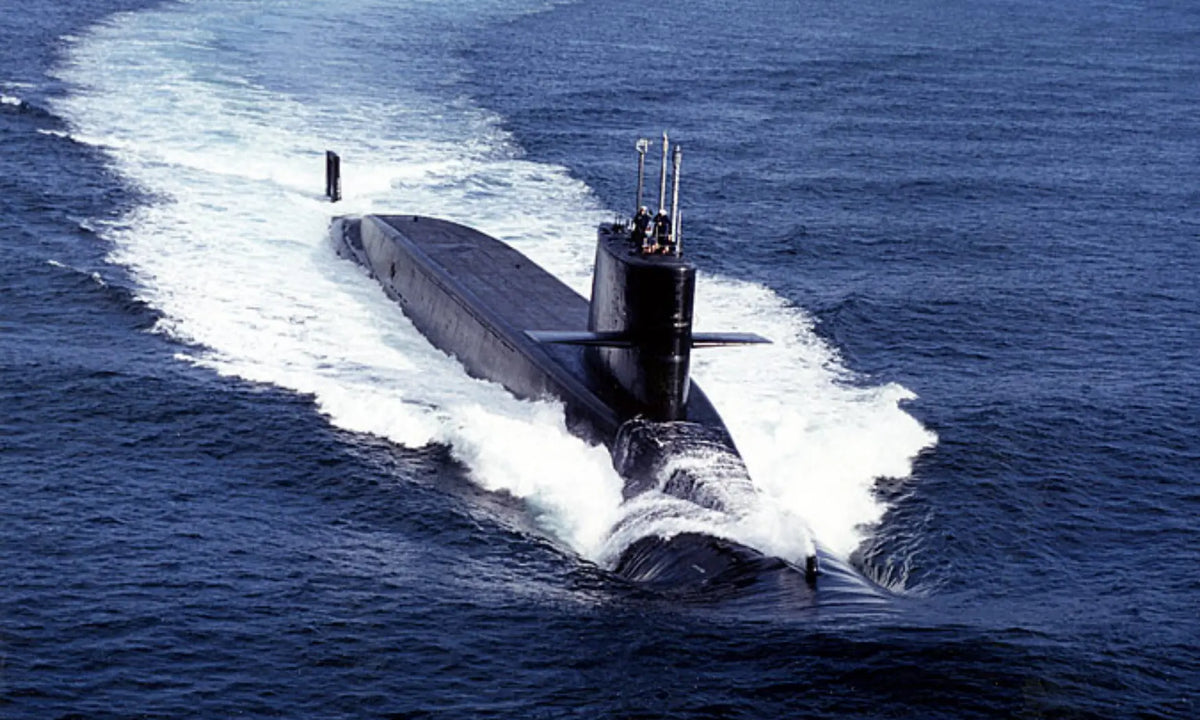
This turnout reflects the state of the market. A Naval Group study presented at the opening and reported by Reuters puts global naval military production at 122 billion dollars in 2024-2025, compared with 82 billion two years earlier. China is now ahead of the United States. According to figures reported by AFP, 17 nuclear attack submarines are currently launched or under construction worldwide, compared with 6 previously.
Pierre-Éric Pommellet, chairman of the show and CEO of Naval Group, summed up the spirit of the moment in a phrase: “In naval combat, you have to see first and act first.”
The time of rearmament
Catherine Vautrin, Minister of the Armed Forces and Veterans, opened the show on 3 November with a clear message: “We have moved from a logic of repair to a logic of rearmament.” She announced a draft 2027 budget of 63.4 billion euros, 6.5 billion more than in 2026, new orders for Aster and Exocet missiles, and a naval drone programme from 2027. She also confirmed the continuation of the French Navy’s major programmes: the aircraft carrier France Libre, the third-generation ballistic missile submarines, the last Suffren-class attack submarines and the modernisation of maritime patrol.
The minister pointed out that the naval industry comprises more than 770 companies and 59,000 direct jobs, before addressing industry directly: “Yes, ladies and gentlemen of industry, more than ever, we need your commitment.” She summed up the stakes in a phrase: “To be feared, in order to be free.”
European cooperation took up a large part of her speech. “Our first weapon is our ability to produce as Europeans,” she declared. She cited Sweden, Belgium and the Netherlands for mine warfare, the European AQUILA/HYDIS project, which brings together more than thirteen states, and Indonesia, where two Scorpène Evolved submarines are under construction at PT PAL in Surabaya.
The next day, Minister Delegate Alice Rufo spoke about Operation Aspides and the coalition for international law in the Strait of Hormuz. She praised a year of “great demonstration of naval availability”, which “can only happen if industry delivers, and it does”. She concluded on an optimistic note: “The sea has a future.”
The DGA sets the course
At the opening conference, Alexandre Lahousse of the DGA indicated that a second aircraft carrier was “under discussion”, according to Naval News. He noted that two of the four Jacques Chevallier-class replenishment ships have been delivered, that the first of the seven offshore patrol vessels was launched in February 2026 and that a counter-drone programme was set up in two months.
In an interview with Mer et Marine, François Watteau, head of naval combat at the DGA, put the agency’s commitments at 7 billion euros in 2025 and around 5 billion in 2026. He sees the naval drone as “one of the major revolutions of our time”.
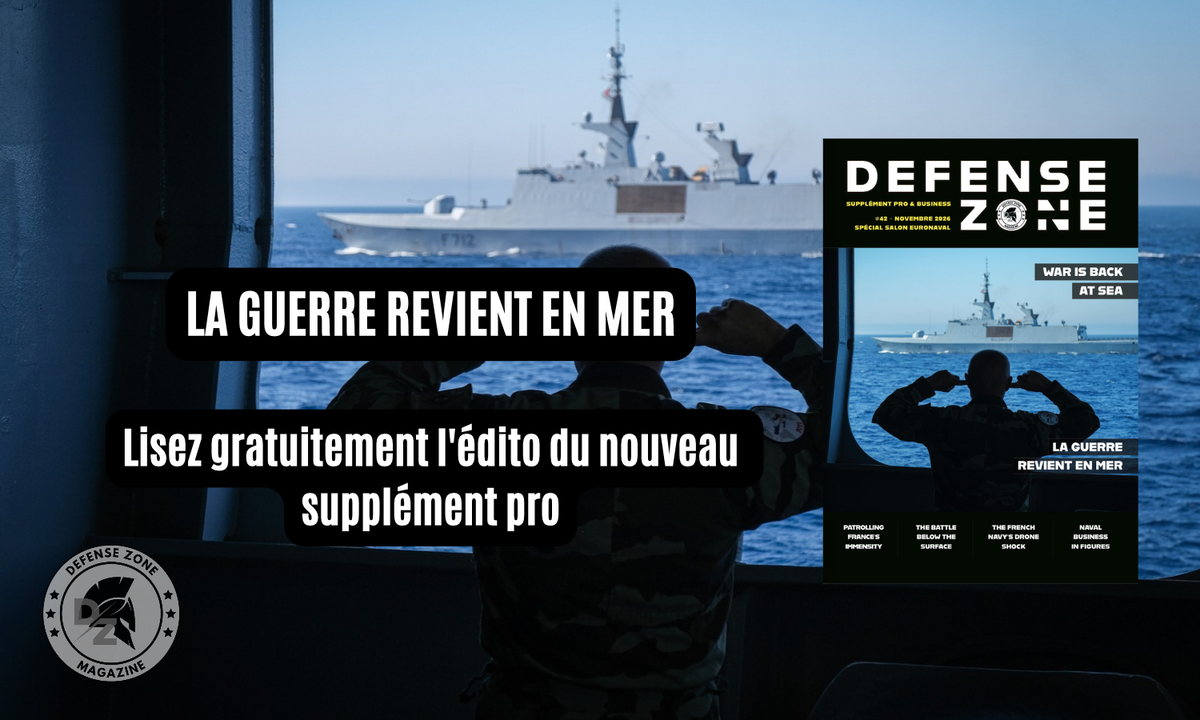
Admiral Christophe Cluzel, Chief of Staff of the French Navy since July, set the common thread of the week: the hybridisation of fleets, in which crewed ships and drones fight together. This is the “drone shock” we discussed in Euronaval 2026: war returns to the sea.
A pact for drones
The most symbolic signing of the show took place on the very first day. On 3 November, Catherine Vautrin signed the defence naval drones pact with GICAN. Steered by the DGA with the Armed Forces General Staff and the French Navy, this forum brings together the State and industry to share requirements, identify key technologies and anticipate calls for tender. It covers surface drones, underwater drones and remotely operated munitions.
The pact builds on programmes already under way, such as SLAM-F, CHOF, MFM and DANAE, as well as the “naval drones” programme opened in June 2026. The CeRDAN centre, created at the same time, is in charge of the SMOKERS remotely operated munition. To better understand these programmes, read our article on the stakes of naval dronisation.
On the same day, the Defence Innovation Agency (AID) and Naval Group signed an agreement to build the UCUV, a demonstrator of a large unmanned combat underwater vehicle. According to Naval News, the vehicle will be more than 10 metres long and transportable by A400M. Its sea trials will begin in 2028. According to the AID, France thus joins the “very small circle” of countries developing this capability. We had covered the study contract that preceded this demonstrator.
Better-armed frigates
The DGA finalised an order with Naval Group and MBDA that raises the capacity of the defence and intervention frigates (FDI) from 16 to 32 Aster missiles. The five FDIs ordered by France will thus double their air defence. The Aster 15 has a range of more than 30 km and the Aster 30 more than 120 km. The first of the class, the Amiral Ronarc’h, was delivered in October 2025. See our overview of the French Navy’s frigates.
Three missile announcements
MBDA was one of the big winners of the week. The DGA announced the forthcoming signature of a contract for the MdCN Mk2, the new standard of the naval cruise missile fitted to the FREMMs and the Suffren-class submarines. Its range will exceed 1,000 km, it will be stealthier and it will resist GNSS signal jamming. The first deliveries are expected from 2030.
The DGA is also preparing a framework agreement with MBDA for the Exocet MM40 Block 3C, with a range of more than 200 km. This agreement will be open to partner countries thanks to European SAFE funding, and deliveries will begin in 2029. According to Opex360, the quantities are not being published “for reasons of operational security”.
Finally, Cyprus, France and Sweden signed a framework agreement to jointly purchase MBDA’s Akeron MP missile, again under SAFE. Other European countries will be able to join.
Mine warfare on the high seas
On 4 November, the DGA selected the consortium formed by Chantiers de l’Atlantique and Abeilles International for a new high-seas mine warfare capability. Two 80-metre, 4,000-tonne civilian “Protée” vessels will be chartered and made available to the French Navy by 2028. Each will carry out 320 mission days a year and operate SLAM-F surface drones and underwater drones.
Innovation and employment
Also on 4 November, the AID, ISL and HEMERIA formalised the SPALE project, devoted to the high pulsed power that drives electromagnetic guns. On the same day, Apec and the DGA signed a three-year agreement to help the roughly 4,500 companies of the defence industrial and technological base recruit managerial staff.
On the eve of the show
Several announcements came before the opening. On 29 October, the DGA ordered RP30NG harbour tugs from Piriou: four as a firm tranche, to be built in Concarneau, and twelve as options. On 30 October, Naval Group delivered its second FDI frigate to Greece, the Nearchos, in Lorient. On 2 November, Safran announced three inertial navigation contracts for the third-generation ballistic missile submarines (SNLE), the M51.4 missile and the Rafale F4.
Industrial agreements
Industry also signed deal after deal. Fincantieri, Navantia and Naval Group signed, in the presence of OCCAR, the consortium agreement for the second phase of the European Patrol Corvette, EPC2. Opex360, however, questions whether French participation in the programme will be maintained.
Thales and Italy’s ELT Group are creating a 50/50 joint venture, Thales ELT Naval EW Solutions, dedicated to naval electronic warfare for export. Naval Group signed an agreement with Abu Dhabi’s Technology Innovation Institute on autonomous underwater technologies, and entrusted the Greek Salamis shipyards with building blocks for the future Swedish FDI frigates. For these same frigates, Saab received an order worth around 2 billion Swedish kronor.
KNDS, the land armament specialist, is teaming up with SeaOwl to develop TRACUS Combat, an armed uncrewed surface vessel that reaches 35 knots, carries a 30 kg payload and has a range of 200 km. The two partners promise “strict and permanent” human control. MBDA and Denmark’s Terma, for their part, presented SPIMM, a self-protection module housed in an ISO container, which integrates the Mistral 3 missile and requires only a power supply. It can equip a ship with no combat system, then be moved from one vessel to another or installed ashore.
Other announcements followed. Fincantieri concluded a series of agreements, including a letter of intent with Leonardo and a joint venture with Navantia. Germany’s RENK finalised its acquisition of Britain’s David Brown Defence, a specialist in quiet submarine propulsion, and received a third order for Stirling systems from Saab. Exail will fit its Marins inertial navigation systems to the entire uncrewed surface vessel fleet of a “leading navy”, whose name has not been disclosed. Finally, the Dutch company Optics11 signed with the Netherlands Ministry of Defence for ASWINABO, a fibre-optic towed array capable of detecting ships up to 100 km away.
Tomorrow’s ships
Naval Group’s SCX26 concept was the star of the show. It is not a programme but a vision of future naval warfare: a 170-metre, 8,000-tonne ship with more than 100 missile silos, an electromagnetic railgun, a 100 kW laser, an anti-ballistic radar and a stern bay for drones and helicopters.
Naval Group also presented a stretched FDI of around 131 metres and 5,400 tonnes, which would carry 50 vertical launch cells, up to 16 Exocets and more than 300 loitering munitions. No order has been placed at this stage. The group also exhibited Seaquest M, a 37-metre steel-hulled uncrewed surface vessel designed for ten-day patrols.
Fincantieri unveiled the MMMV, a 50-metre modular ship crewed by six sailors, which carries its capabilities in containers. Constructions mécaniques de Normandie, for its part, presented the CMN 10 corvette as an alternative to the European corvette.
Drones and decoys
Exail presented the Oryx family, the military version of its DriX drones, the largest of which measures 15.75 metres and can stay at sea for 30 days. Its Neptis system coordinates five to ten surveillance drones. SEAir, a Lorient-based SME specialising in foils, unveiled as a world first the SP40, a 4-metre drone designed for intelligence, electronic warfare and deception. The company is one of the three consortia selected for the second phase of the DANAE programme.
The DAUPHIN project, led by the DGA, Thales and Lacroix, takes a different approach: this flying decoy draws the seekers of anti-ship missiles towards itself to protect the ship. The first flight of a prototype is scheduled for 2027.
Weapons and self-protection
On its stand, MBDA presented the MdCN Mk2 as well as its STRATUS and DELUGE concepts. ArianeGroup unveiled the concept of a naval version of its B-Strike 1000 ballistic missile, with a range of around 1,000 km, although no purchase decision has been made.
FN Herstal launched the M3M ENDURANCE .50-calibre machine gun. Its service life rises from 40,000 to 60,000 rounds and preventive maintenance is now needed only every 15,000 rounds, compared with 5,000 previously, for a rate of fire of 1,100 rounds per minute. MC2 Technologies exhibited its MAJES DFB6 counter-drone jammer on the DGA stand, while Turkey’s ASELSAN presented its GÖKDENİZ close-in weapon system and its GÖKSUR vertical launcher. Our feature on counter-drone warfare takes stock of these threats.
Sensors and AI
GPS-free navigation was one of the major themes of the show. Exail is launching Marins M1, a compact inertial navigation system for patrol boats and drones, whose drift does not exceed one nautical mile after three hours without external aid. Eviden presented the SMX electromagnetic log, which weighs less than 2 kg, operates down to a depth of 300 metres and is made in Aix-en-Provence, as well as ASTRA-LAS, a decision-support tool for above-water warfare.
Artificial intelligence has become central to sensors. HGH received the French Navy’s PERSEUS label for SPYNEL-F, a 3 kg infrared camera designed for uncrewed surface vessels, and showed how AI is turning surveillance cameras into genuine intelligence aids. SEA.AI, Exavision and Cambridge Pixel also presented AI-based detection solutions. Kinéis unveiled its new satellite AIS data platform, together with a solution against signal spoofing. Finally, LD Travocean’s ROV-DeepSea robot, qualified to 6,000 metres, was tested beyond 5,000 metres off Greece.
Interceptors and propulsion
Sillinger unveiled two world firsts. The ALURAID INTERCEPTOR is a 12-metre rigid-hulled inflatable boat that reaches 65 knots thanks to four 450 hp engines. The boat on display will be delivered to the French Customs coastguard in the French West Indies. The AF³ is an armoured float rated NIJ III+, which stopped Kalashnikov fire during trials. RENK, for its part, exhibited the T2RECS gearbox, capable of running for 90 days without human intervention.
The winners
The EURONAVAL Awards 2026 went to FLUIIDD (Sustain category), Gabler Group (Engage), Amphitrite (Transform), COSMA (GICAN prize) and Astraea Marine (SEAnnovation). The jury also gave a special mention to Globus Metal Powders. In addition, the French Navy’s PERSEUS label distinguished the FLY-R air-maritime loitering munition, with a range of 25 to 40 nautical miles.
On the show floor
According to AFP, the French authorities restricted the Israeli presence: non-governmental exhibitors were limited to air and missile defence. According to Euronews, several presidential election candidates visited the show: Raphaël Glucksmann on Wednesday, then Édouard Philippe, Bruno Retailleau and Marine Le Pen on Thursday.
See you in 2028
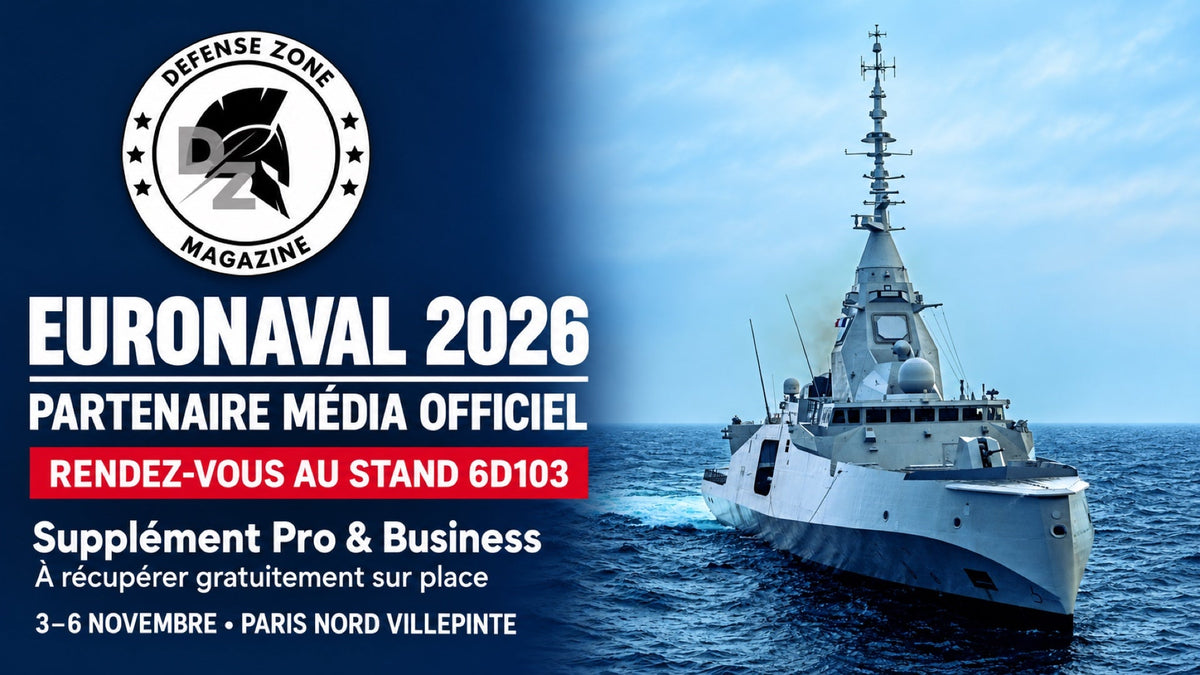
Défense Zone was an official media partner of this edition. We welcomed you on stand 6D103, where our Pro & Business supplement was distributed free of charge (see our preview of the show). The next edition of Euronaval will take place in 2028.
Key takeaways
- Euronaval 2026 broke its records, with 713 exhibitors, 204 official delegations and 28,000 professional visits.
- The naval drone pact and the UCUV demonstrator usher the French Navy into the era of hybrid fleets.
- The FDI frigates double their air defence, from 16 to 32 Aster missiles.
- MBDA is preparing the MdCN Mk2, with a range of more than 1,000 km, as well as an Exocet framework agreement open to European countries.
- Drones, artificial intelligence and GPS-free navigation dominated the new products at the show.
Sources: Euronaval closing press release (6 November); French Ministry of the Armed Forces, speech by Catherine Vautrin (3 November) and visit by Alice Rufo (4 November); DGA, naval drone pact, FDI, MdCN, Exocet, Akeron MP, mine warfare; Defence Innovation Agency; Naval Group; press releases from Eviden, Exail, FN Herstal, HGH, Kinéis, MBDA, MC2 Technologies, Optics11, RENK, Safran, SEAir, SEA.AI and Sillinger; Naval News, Opex360, Mer et Marine, AFP, Reuters and Euronews.