DÉFENSE ZONE
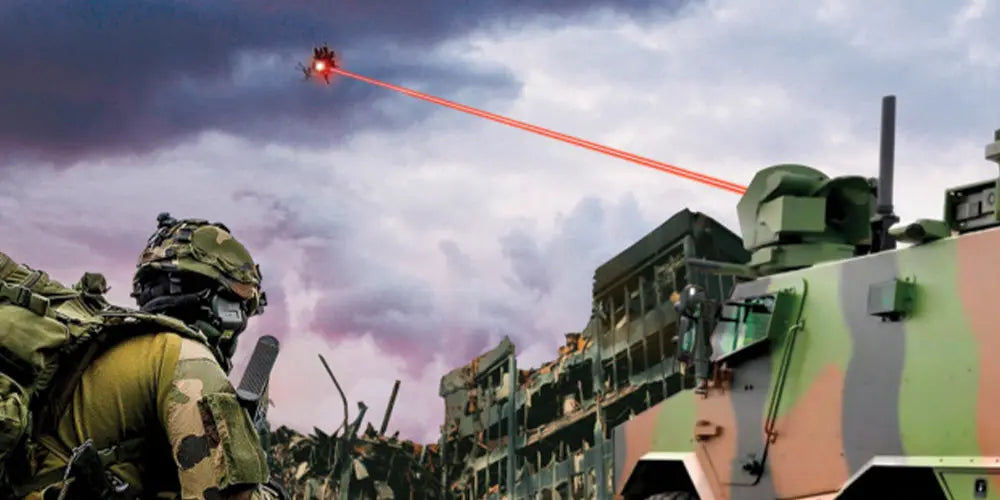
Counter-drone warfare has become one of the French Ministry of the Armed Forces’ priorities. The threat that drones pose, both in overseas theatres of operations and in France itself, keeps growing. With two major sporting events to be organised in the near future, the ministries are redoubling their efforts to be ready to protect civilians as well as infrastructure and the armed forces.
Drones: a threat to France
France has never yet been the target of an attack by a modified drone. But drones pose a growing threat to its armed forces, both at home and in overseas theatres, as well as to sensitive state installations and to individuals, at large gatherings for example.
-
An accelerating threat
A recent parliamentary information report on Operation Barkhane notes that “several intelligence sources suggest that in the [Sahel] theatre, armed terrorist groups are now able to carry out attacks using drones, as has already happened in other theatres, particularly in the Levant”.
For now, the proliferation of military drones that are armed, or could be, is seen mainly in the Middle East, and the use of booby-trapped civilian drones is seen mainly in the Levant.
The massive use of tactical drones and of small drones that are cheaper than those of the Western powers – including suicide drones – was observed during the fighting in Libya. It was also seen during Turkey’s campaign in northern Syria (where 60 coordinated drone attacks are said to have been carried out in 2019). In Yemen, the Houthi militias use Iranian drones (including the Abalil armed tactical drone). The same goes for Hamas in Gaza, Hezbollah in Lebanon, and militias in Sudan, Iraq and Syria…
These groups can thus carry out highly effective targeted attacks at low cost. In 2019, in Saudi Arabia, Aramco’s refineries suffered attacks, attributed to Iran, by some twenty low-cost drones. As a result, the refineries were unable to produce for six months. On 5 July, in Baghdad, Iraq, a booby-trapped drone flew over the US embassy and was shot down by the troops guarding the building.
In 2020, during the conflict in Nagorno-Karabakh, Azerbaijan used swarms of unsophisticated drones against Armenia. A first in an inter-state conflict. This conflict showed how vulnerable ground units are to drones that are hard to detect by conventional means.
Drones may well revolutionise future wars. And, according to the report on drone warfare published on 7 July 2021 by the French National Assembly, France is not sufficiently prepared to deal with this threat.
-
Malicious or terrorist use of hobby drones
In Europe, incidents involving drones are increasingly frequent. In 2019, some 2,000 drone-related incidents occurred in European skies, according to the European Union Aviation Safety Agency (EASA). In 2018, dozens of drone overflights at London’s Gatwick airport led to the cancellation of more than 1,000 flights. Similar incidents occurred at Madrid and Frankfurt airports in 2020. A year before the Euro 2016 football championship, drones had flown over nuclear power stations.
“Large”, potentially armed drones used by state powers represent the most dangerous threat. But according to a French Senate report published at the end of June, the drones representing the most likely threat are smaller civilian drones, used for intelligence gathering, filming, criminal or terrorist acts.
It is against these, the rapporteurs believe, that “air defence must be coordinated with the various counter-drone systems deployed by multiple actors, first and foremost the internal security forces, government departments and operators of vital importance”. But no system will be infallible against these drones. “It will be impossible to ensure that no terrorist, criminal or malicious act is ever committed using drones,” the rapporteurs note. And distinguishing a small drone for civilian use from a small criminal or terrorist drone is proving increasingly difficult. They are barely detected, if at all, by conventional ground-to-air defences, because they fly at low speed and have a small radar signature.
Small so-called hobby drones therefore pose a threat to France. And their number in the country has risen in recent years, from 400,000 in 2017 to 2.5 million in 2021. These figures will increase in the years to come. The air transport gendarmerie also recorded a significant rise in reported incidents in the first months of 2021, with around a hundred overflights of sensitive sites or prohibited areas.
These drones, which fly at low or even very low altitude, can fall accidentally but, above all, can be diverted from their original purpose and used for other ends. These threats fall into two categories: malicious use of drones, including criminal use, and use of drones for terrorist purposes.
Seven scenarios could therefore arise in France: invasion of privacy; undermining the credibility of the public authorities; the organisation and commission of criminal acts, including a specific threat to the prison service (preparing escapes, delivering packages of all kinds, etc.); disruption of air traffic; the search for, theft and acquisition of protected information, notably through industrial espionage; terrorist acts against senior figures; and attacks on sensitive installations.
Measures have been taken in recent years to protect infrastructure and civilians in France. The law of 24 October 2016 on strengthening the safety of civilian drone use requires “registration of commercially purchased drones and pilot training, which has helped to limit illegal flights, as well as the obligation, since 29 June 2020, to fit drones weighing more than 800 grams with electronic identification”.
In addition, the choice was made to focus on protecting the most sensitive sites and particular events (large crowds, presence of senior figures). Each operator is therefore responsible for protecting its own installations. For example, the Groupe ADP (Aéroports de Paris) is responsible for protecting the airport infrastructure at Roissy Charles de Gaulle, Orly and Le Bourget. And Électricité de France (EDF) is responsible for protecting the power stations.
However, only the internal security forces and the armed forces can neutralise a drone, and only in certain specific cases. Security company staff can detect a drone but not neutralise it. In addition, to deny a drone or a vessel access to a particular area, special air security measures (DPSA) or maritime safeguard measures (DPSM) can be activated to create temporary, planned protective bubbles.
-
Counter-drone warfare: a priority
Both quantitatively and qualitatively, France’s counter-drone capabilities appear limited, according to the National Assembly report of last July. For the rapporteurs, the priority is therefore to “put in place an ambitious equipment plan for both the internal security forces and the armed forces, aimed first at increasing the number of counter-drone capabilities of the various actors”. And the second priority is to “raise the quality of counter-drone systems” in order to deal with a constantly evolving threat.
In its latest report, the Senate notes that in counter-drone warfare, whether in France or in overseas theatres, “there is no fully suitable and satisfactory solution, in terms of either detection or neutralisation”. The rapporteurs therefore call for stronger detection and neutralisation resources and stress the need to “bring together all the resources and technologies (sensors and effectors) contributing to counter-drone warfare in an integrated system”. For the rapporteurs, this integrated system will need to be open and to work with short- and medium-range ground-based air defence (GBAD) through an agile command and control (C2) system. This system must also be able to withstand swarm flights and saturation attacks.
Setting up an air navigation and control system for very low-altitude airspace is also a priority, according to the report. So is adapting the current legal framework, particularly with regard to neutralising small drones.
The committee also considers it essential for the forces to have a mobile “close-in air defence capability” at unit level. It also recommends countering propaganda on social media.
-
Being ready for the 2023 Rugby World Cup and the 2024 Olympic Games
Faced with these multiple threats, France must speed up its research and quickly come up with counter-drone solutions, all the more so as two major events whose security will have to be ensured will soon take place in France: the Rugby World Cup in 2023 and the Paris 2024 Olympic and Paralympic Games, which will spread several events across 25 different sites.
By then, the Ministries of the Armed Forces and of the Interior will need to have the means to detect and neutralise malicious drones suited to these sporting events. Yet, as things stand, France is not sufficiently prepared to deal with a coordinated drone attack on its territory, stresses the National Assembly report published on 7 July 2021.
France’s counter-drone systems
To protect itself against the threat posed by drones, France has drone-jamming systems. These systems are deployed in particular in the Sahel-Saharan strip. In early 2021, to catch up, the armed forces adopted a counter-drone roadmap and a dedicated weapons programme was created.
The latest reports argue for acquiring more counter-drone resources for the armed forces and for the national police and gendarmerie, and for anticipating future developments in the sector.
Military counter-drone systems
In addition to the ongoing modernisation of conventional air defence (notably upgrades to SCCOA, the air command and control system), the armed forces have developed several systems to strengthen counter-drone warfare and cope with the growing drone threat in theatres of operations and in France.

The AR-LAD capability
The armoured vehicles of ground units are not sufficiently protected against the threat posed by small armed drones. So, at the request of the Barkhane force, the French Army’s technical section (STAT) developed the AR-LAD capability (rapid counter-drone adaptation).
It consists of giving a VAB (armoured personnel carrier) a counter-drone capability linked to its remotely operated turrets. The system first detects and identifies the drone at a distance of 2 km. Then, if necessary, the drone can be neutralised with a 12.7 mm machine gun.
In 2021, several of these systems are deployed in the Sahel-Saharan strip, and others will be put in place in the coming months. The French Army, which faces the drone threat directly in this area, therefore has an initial mobile capability, the forerunner of accompanying ground-based air defence.
The BASSALT system
For counter-drone warfare, the French Air Force has the BASSALT system, developed by Hologarde (a subsidiary of ADP). This system is the result of a partnership between the Air Defence and Air Operations Command (CDAOA) and Aéroports de Paris, with the support of the Defence Innovation Agency.
The BASSALT system can detect, identify, classify and neutralise the drone threat by jamming; it integrates an AI-based C2 and provides an overall picture of the low-altitude situation. The system’s open architecture means that different building blocks can be added or removed depending on the context of use. Various kinds of sensors can thus be combined: radar, surveillance camera, direction finder.
From 2019, this system was used in particular to secure the Paris Air Show at Le Bourget and the G7 summit in Biarritz, as part of the special air security measures (DPSA). During these events, the French Air Force coordinates all the inter-ministerial counter-drone systems to ensure air security right down to the very low layer. Temporary protective bubbles are set up for these events.
The BASSALT system has also been deployed as part of a trial in Gao. Only one unit is therefore in service, but the French Air Force plans to acquire two more.
The MILAD system
The MILAD system (joint counter-drone resources) relies on jamming. At the end of 2017, CS Group won this French armed forces contract to deploy its BOREADES counter-drone system to protect military bases in France and in theatres of operations in Mali. BOREADES is a multi-sensor, multi-effector system that works by jamming and spoofing. It is intended for all three services (for overseas operations and in France). Eighteen units have been acquired, and deployment is only just beginning.
The contract covers the acquisition of 500 systems over 15 years. The programme is still being certified, but the DGA believes it will soon be fully operational. Fixed sites could be equipped with the first MILAD systems during 2021.
The MILAD contract also enabled the acquisition of Nerod jamming rifles. Developed by MC2 Technologies, they are intended for the French Army. Around ten of these rifles had been delivered at the time, and 25 were expected in 2021. With this rifle, soldiers can jam communication between the drone and the pilot’s controller after detecting and identifying it using laser-equipped digital binoculars and an Aeroscope (a case that displays the threat on a map). If the threat is serious, soldiers can shoot the drone down with a Benelli Nova (12-gauge pump-action shotgun).
Yet the MILAD system is already partly obsolete. The reason: the evolving drone threat, with drones that are increasingly autonomous, pre-programmed and therefore able to move on their own. As a result, they no longer get lost when their radio links are jammed.
Representatives of the Armed Forces Staff have indicated that the MILAD system is not very mobile and therefore poorly suited to use as part of special air security measures. Hence the armed forces’ recent shift towards the BASSALT system.
Air and maritime defences
The threat posed by military drones is partly covered by the permanent air security and maritime safeguard postures.
The French Air and Space Force’s mission is to maintain the permanent air security posture (PPSA). It is the state’s ultimate tool for protecting the country and its inhabitants against any attack from the air. This air defence rests on a triad: detect and identify, classify, and intervene. If enemy drones flew over France, the conventional defence chain would be activated. The threatening drone could be neutralised by fire from a helicopter or by a strike from a fighter aircraft. But it is not certain that the system can detect small drones (low radar cross-section) or saturation attacks, even though the latest generations of radar perform well. As for France’s short-range surface-to-air missile, the Crotale NG, a major component of France’s air defence, the National Assembly report describes it as “ageing”. A new weapon system is due to succeed it from 2027.

The French Navy, for its part, maintains the permanent maritime safeguard posture (PPSM). Its aim is to prevent or combat threats linked to activities conducted at sea or from the sea, whether civilian or military, naval or airborne. It must therefore protect the maritime approaches to Brest in order to guarantee freedom of movement for the ballistic missile submarines (SSBNs). If naval or aerial drones posed a threat to the maritime approaches, strategic points or national maritime space, the French Navy would be responsible for detecting and potentially neutralising them.
According to the work of the National Assembly rapporteurs, “the naval domain will see the most disruptive developments in the years to come, particularly underwater”. Russia and the United States, among others, are currently developing underwater drones. The possibility of soon having to counter spy underwater drones coming to observe the activity of the naval base that is home to the four SSBNs off the Île Longue, or the potential deployment of drones in the deep sea to gather intelligence or sabotage undersea cables, could quickly become reality, the rapporteurs warn. Hence the need for France to develop counter-drone solutions quickly.
Police and gendarmerie counter-drone systems
Drawing on the operational experience of the military, and faced with the increasing use of drones to threaten people or infrastructure, the security forces decided many years ago to build up counter-drone skills, by training personnel and also by bringing in specialised equipment
The French Gendarmerie’s equipment
Most of the hobby drones in circulation in France are sold by the Chinese company DJI. The French Gendarmerie has therefore acquired several units of DJI’s detection system, which only works with drones of this brand. This detection system consists of an Aeroscope case that can spot drones several dozen kilometres away. It is complemented by radio-frequency detection solutions.
The gendarmerie is also equipped with jamming rifles and pistols used to neutralise drones by cutting the link between the drone and the remote control operated by the remote pilot. But they must be used with care, because jamming a wifi or GPS signal risks disrupting air traffic. And these capabilities do not allow threatening drones to be destroyed.
In all, it has around thirty counter-drone kits (a tactical detection station, two jamming weapons, and equipment for seizing jammed drones). Each of the thirteen regions of mainland France has one kit. And each kit costs €60,000. A modest outlay, in the end. These kits can be used by any gendarme, provided they have completed the two-day training course, which amounted to 550 personnel in 2021. The Republican Guard, by contrast, has personnel dedicated to counter-drone work.
The gendarmerie can thus deploy its systems at cultural or sporting events. It did so for the first time at Euro 2016, held in France. Since 2017, 60 malicious drones have been neutralised by the gendarmerie, whose counter-drone activity amounts to around 350 operations a year.
For its part, the air transport gendarmerie (placed under the operational authority of the French civil aviation authority, DGAC) is responsible for the security of French airports.
The French National Police’s equipment
Like the French Gendarmerie, the French National Police is equipped with Aeroscope detection cases. But it has far fewer: seven kits in all, each comprising a detection case and a jamming rifle or pistol.
After the 2015 attacks, the RAID acquired counter-drone resources (to counter the risk of a follow-up attack, for example). This recognised expertise has led to the RAID being deployed to protect sensitive events, in support of the Presidential security group (GSPR) or the Republican Guard, for example. The number of RAID counter-drone missions is rising: from 8 in 2018 to 19 in 2020. In the first half of 2021, the RAID had already carried out 21.
In 2021, Nuances Technologies won the French Ministry of the Interior contract and will therefore supply its counter-drone system to the national police and gendarmerie until 2024. This system can detect, identify and neutralise several drones simultaneously.
The Paris Police Prefecture’s equipment
The Paris Police Prefecture is the third internal security force with counter-drone expertise. It is also equipped with detection kits and jamming rifles. For major events, it can also deploy its RADIANT component (active search for intrusive drones, acquisition, neutralisation), which combines several detection and neutralisation resources.
Counter-drone projects
To catch up in counter-drone warfare, the armed forces adopted a roadmap in early 2021. It provides for work on new technologies and the adoption of dedicated systems: an urgent order for three BASSALT systems; the adaptation of several VAB armoured personnel carriers for deployment on operations through the ARLAD system; and the DGA’s PARADE call for tenders.
The PARADE programme
The DGA (French defence procurement agency) has launched a new contract for the acquisition of a modular deployable counter-drone protection system (PARADE). The programme provides for investment of €350 million over 11 years (including €70 million for the period 2022–2025). Thales and CS Group responded to the call for tenders as partners.
The French Ministry of the Armed Forces wants the first 10 to 15 systems delivered before the end of 2022, ahead of the two major sporting events to be held in France.
The aim of this complete system will be to provide permanent protection for military or civilian sites in France or in overseas theatres of operations. This solution must at least include a scalable C2 system, a radar, a direction finder, an optronic system and a jamming system. The system must also provide automatic detection, characterisation and identification, and neutralisation, by day and by night and in all weathers, against drones whether or not they emit electromagnetic waves.
The Helma-P laser
The counter-drone laser developed by the French SME Cilas (Compagnie industrielle des lasers) has been named Helma-P. The demonstration of a mini drone being destroyed in flight with this laser took place on 7 July 2021 in the presence of the Minister of the Armed Forces, Florence Parly. The destruction of a drone by a laser weapon was a first in France. At the time, the armed forces hoped this system would be operational in 2024, notably to protect people during the Paris 2024 Olympic Games.
The laser sits on a fixed or mobile turret (naval or land vehicle). It consists of a tripod-mounted unit containing a drone detection system, a pointing system to track it and a 2-kilowatt laser that can neutralise a drone in a few seconds at up to one kilometre. The laser burns the drone or dazzles it, preventing it from steering. Highly accurate and effective, it can detect small drones (under 100 kg) at up to 3 km and destroy several drones in succession. In addition, this counter-drone solution is resistant to jamming. But its use requires good weather conditions.
This system could be used to protect sensitive civilian or military sites and convoys, and could also be an asset in air-land combat. The French Army could, for example, integrate this laser capability into some Scorpion vehicles.
The alliance between the Air Force, CNES and ADP
In spring 2021, the French Air Force, the National Centre for Space Studies (CNES) and the Groupe ADP (Aéroports de Paris) signed a five-year agreement. This cooperation commits them to sharing their experience and technical solutions to counter the threat posed by drones.
For ADP, the challenge is to be able to tell harmless drones from malicious ones. CNES, for its part, wants to strengthen the protection of the Guiana Space Centre in Kourou and ensure the protection of the Toulouse space centre (which was due to house the military Space Command by 2025). The French Air Force, which is responsible for setting up air security bubbles for certain events, wants to upgrade its equipment.
The Navy’s RAPIDFire turret
The RAPIDFire turret (a 40 mm rapid-fire gun) was due to equip the French Navy’s fleet replenishment ships (BRF) from 2023. It was developed by Nexter and Thales, and it can engage multiple targets in succession.
Other solutions are being studied. These include passive protection such as nets stretched across the water to counter underwater drones. But also drone-interceptor drones (a call for projects was launched in April 2021), electromagnetic pulse weapons to respond effectively to the swarm threat (Thales is working on them), quantum radars…
Counter-drone warfare remains complex. More and more technical solutions exist today, but they all have drawbacks in terms of detecting or neutralising drones. Active radar can mistake a drone for an animal, for example, while electro-optical detection depends on weather conditions.
Another factor adds to the difficulty of finding solutions: the trend towards developing autonomous and semi-autonomous drones. Autonomous drones can move on their own and can detect their targets themselves. Having no radio links, they more easily escape detection and also neutralisation by jamming.
Counter-drone systems in the rest of the world
The aim here is not to list every counter-drone system in the world, but to explain which countries are most advanced and to list some innovative solutions developed by other countries.
In counter-drone warfare, the most advanced countries are the United States and Israel, according to the French Ministry of the Armed Forces.
In 2019, the United States spent $1.9 billion on counter-drone warfare. Since 2017, the US military has been developing a rather surprising counter-drone system. The Mobile Force Protection Program was created to protect “high-value” convoys. The system first detects malicious drones using an X-band (super high frequency) radar. Then artificial intelligence software tries to identify the aircraft’s intentions. If it poses a threat, the second part of the system comes into play: a tube-shaped interceptor drone that brings the threatening drone down by firing streamers into its propellers. Launched from a moving vehicle, the interceptor drones can be reused. Development of the MFP is nearing completion, so it should be deployed soon.
In Israel, the army was due to have a ground-based system capable of shooting down rockets and drones by 2024. It is an airborne laser, successfully tested at an altitude of 900 metres and within a one-kilometre radius. The army wants to refine the laser so that it can intercept a drone at up to 20 km.
As for medium-power counter-drone laser weapons, France is one of the leading nations, along with the United States (Raytheon’s High Energy Laser and Boeing’s Compact Laser Weapon System) and Israel (Rafael’s Drone Dome). In Europe, in Germany, MBDA Deutschland demonstrated a promising laser in 2015. Russia, Australia and China are also reportedly developing this capability, according to CILAS.
Russia is investing huge sums in counter-drone warfare, particularly to protect its troops against autonomous drones. According to military analyst Samuel Bendett, Russia’s counter-drone effort is reportedly built around advanced radars and anti-aircraft missiles that can target small drones.
Read more: The drone war (DZ#20)