DÉFENSE ZONE
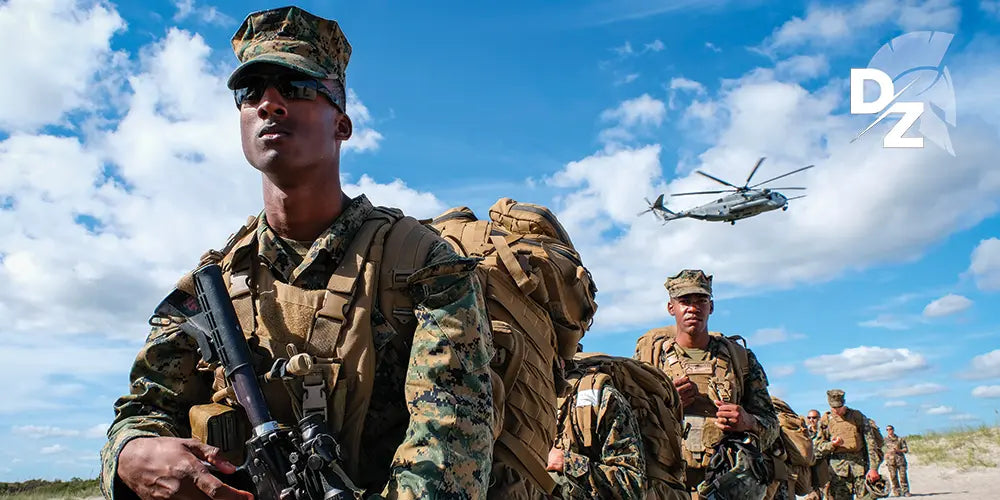
The United States Marine Corps (USMC) is an emblematic unit of the American armed forces, made up of infantry, aviators, sailors, cavalry and more. This diversity, combined with their technical expertise, makes these service members a formidable force.
The Corps is one of the six components of the US Armed Forces:
- the US Army (equivalent of the French Army)
- the US Navy (equivalent of the French Navy)
- the US Air Force (equivalent of the French Air Force)
- the US Marine Corps (USMC, land/air/sea)
- the US Coast Guard
- the US Space Force (equivalent of the “space” component of the French Air and Space Force)
The history of the US Marines
Creation of the Marine Corps
On 10 November 1775, in the midst of the American Revolution, two battalions of marine infantry were created and took the name Continental Marines. It was not until 11 July 1798 that the United States Congress established the Marine Corps.
The United States Marine Corps has a special status, as the only component of the American armed forces to be protected by law. Since 1952, an act of Congress has prohibited its dissolution. It is also impossible to reduce its strength below the equivalent of three ground divisions and three air wings.
Motto, flag and hymn of the US Marines
The motto of the US Marines is “Semper Fidelis” (meaning “Always faithful”), sometimes shortened to “Semper Fi”.
Their hymn is the “Marines’ Hymn”.
The USMC emblem shows a globe on an anchor, surmounted by an eagle with outstretched wings.

Since the First World War and the Battle of Belleau Wood, Chesty the bulldog has been their mascot.
In addition to their code of conduct, the Marines have an oath known as the “Rifleman’s Creed”, partly quoted in the film “Full Metal Jacket”:
“This is my rifle. There are many like it, but this one is mine.
My rifle is my best friend. It is my life. I must master it as I must master my life.
Without me, my rifle is useless. Without my rifle, I am useless. I must fire my rifle true. I must shoot straighter than my enemy who is trying to kill me. I must shoot him before he shoots me. I will...
My rifle and I know that what counts in war is not the rounds we fire, the noise of our burst, nor the smoke we make. We know that it is the hits that count. We will hit...
My rifle is human, even as I, because it is my life. Thus, I will learn it as a brother. I will learn its weaknesses, its strength, its parts, its accessories, its sights and its barrel. I will keep my rifle clean and ready, even as I am clean and ready. We will become part of each other. We will...
Before God, I swear this creed. My rifle and I are the defenders of my country. We are the masters of our enemy. We are the saviours of my life.
So be it, until victory is America’s and there is no enemy, but peace!”
Missions and organisation of the USMC
Combat group specialities
Combat infantry is at the heart of the Marines’ missions, with the aim of seizing and controlling enemy ground. USMC combat groups are made up of several military occupational specialities (MOS: Military Occupational Specialities):
- Infantry Marine: he fights the enemy using a wide range of tactics in very diverse military operations.
- Sniper: a high-precision shooter over long distances, he can neutralise strategically chosen targets to reduce the enemy’s freedom of movement. He is also deployed on reconnaissance, surveillance and intelligence missions.
- Assault tank crew member: aboard an M1A1 tank, he carries out tactical missions, firing and manoeuvres, while helping to maintain the equipment.
- Amphibious Assault Vehicle (AAV) crew member: he supports infantry units by moving men and equipment from sea to land.

The USMC also has one of the largest air forces in the world. Its mission is to support close combat and allow the infantry on the ground to keep advancing. Marine aviation comprises several specialities:
- Aircraft or helicopter pilot: provides the air mobility and support that allow the Marines to act freely on the ground.
- Air traffic controller: responsible for what happens in the airspace. He controls and directs squadrons, Marine aircraft wings and other high-level units.
- Helicopter crew chief: works closely with the pilot. By constantly monitoring the interior and exterior environment, he helps optimise the aircraft’s performance.
- Aviation ordnance technician: helps load and arm aircraft weapon systems, making them ready to strike at any time.
- And also: mechanics, maintenance technicians, aviation supply specialists…
The combat support element handles logistics, intelligence communication and support for moving equipment and ammunition. It includes the following specialities:
- Landing support Marine: the link between Marines at sea and those on the ground. He directs the movement of equipment and personnel in landing zones, ports and beaches.
- Ammunition technician: skilled in all technical aspects of ammunition (use, effectiveness, storage safety)
- Air delivery Marine: parachutes from aircraft to supply the Marines on the ground with the equipment they need.
- Signals intelligence officer: responsible for infiltrating enemy computer systems in order to disable them or gather information from them.
- And also: logistics chief, counter-intelligence specialist, cyber security technician, military police…
Finally, the Marines carry out protection missions for the President of the United States (guard of honour, travel via Marine Helicopter Squadron One) and for American embassies abroad (a strength of 1,770 Marines).
Further reading: the fighter jets of the American armed forces.
Around 200,000 US Marines
The US Marines number around 186,000 active-duty personnel (6% of them women) and 35,000 reservists, divided into:
- 4 Marine divisions: 11 infantry regiments and 4 artillery regiments
- 4 Marine aviation units: six air groups, seven helicopter groups, four control groups and four support groups
- 4 Marine logistics groups
- 9 combat logistics regiments
- 7 Marine expeditionary unit command elements
The Marines’ main feats of arms
In 1985, Ronald Reagan, then President of the United States, said:
“Some people spend their life wondering if they made a difference. Marines don’t have that problem.”
Thanks to their versatility and expertise, the US Marines have taken part in many conflicts and operations. Among the best known:
- The War of Independence, from 1775 to 1783
- The Civil War, from 1861 to 1865
- The First World War, from 6 April 1917 to 11 November 1918, notably the Battle of Belleau Wood, where their tenacity earned them the nickname “Devil Dogs”
- The Second World War, from 7 December 1941 to 15 August 1945, notably the Battle of Iwo Jima
- The Korean War, from 25 June 1950 to 27 July 1953
- The Cuban Missile Crisis, from 24 October to 31 December 1962
- The Vietnam War, from 14 March 1962 to 28 January 1973, notably the Battle of Hue
- The operation to rescue the hostages of the container ship Mayagüez (fighting on the Koh Tang islands in Cambodia) in May 1975
- Operation Desert Storm during the Gulf War, from August 1990 to April 1991
- The humanitarian aid operation Restore Hope (conducted with the UN) in Somalia, from 9 December 1992 to 25 March 1994
- Operation Joint Guardian in Kosovo in 1999
- Operation Enduring Freedom in Afghanistan, from 7 October 2001
- The Iraq War, from May 2003 to 1st September 2010
How to become a Marine in the USA
Requirements for enlisting in the Marines
To join the United States Marine Corps you must be aged between 17 and 29 and hold a “High School Diploma” (the American equivalent of the French baccalauréat). Officer candidates must be aged between 18 and 27, be American nationals and hold a bachelor’s degree (equivalent of the French Master).

The physical tests to become a Marine
All recruits must pass a medical examination and the physical tests, which consist of three events, each scored out of 100:
- Pull-ups or push-ups, as preferred: if the candidate chooses push-ups, he can score a maximum of only 70 points, as the exercise is easier.
- Crunches or plank, as preferred: perform as many crunches as possible in two minutes, or hold the plank position as long as possible (4 min 20 s for 100 points)
- Three-mile run (about 4.8 kilometres): to be completed in under 28 minutes for men and under 31 minutes for women.
In addition, every year Marines retake these tests as well as combat fitness tests:
- Movement to contact: a timed 880-yard (804-metre) sprint testing the Marine’s endurance under pressure
- Ammunition lift: lifting a 30-pound (13.6-kilogram) ammunition can as many times as possible within a set time
- Manoeuvre under fire: a 300-yard (274-metre) course including, among other things, combat, ammunition resupply, grenade throwing and agility…
If they fail either of these two tests, they leave the Marine Corps.
Initial training of the Marines
Recruits are split between two training centres according to where they live:
- Those east of the Mississippi, as well as all women, go to Marine Corps Recruit Depot (MCRD) Parris Island in South Carolina, then to the School of Infantry (SOI) East at Camp Geiger in North Carolina.
- Those west of the Mississippi go to MCRD San Diego in California, then to SOI West at Camp San Onofre, also in California.

The Marines’ initial military training takes place at the MCRD over thirteen weeks. Completely cut off from civilian life, candidates receive both theoretical instruction (USMC history, military life and drill…) and practical instruction (martial arts, weapons training, water combat…) while improving their physical fitness (assault course, swimming, running, strength training).
At the end of their training they take part in a 54-hour exercise during which they put their new shooting and combat skills into practice.
Speciality training
The second phase of training takes place at the School of Infantry.
Marines heading for combat infantry train for 59 days at the Infantry Training Battalion (ITB), where they become able to conduct expeditionary combat operations.
The first two weeks are devoted to learning common skills:
- Combat marksmanship
- Use of grenades
- Identifying and countering improvised explosive devices
- Convoy operations
- Military operations on urban terrain (MOUT)
- Tactical formations
- Land navigation
- Patrol organisation
Each infantry Marine then continues with instruction specific to his chosen speciality. Physical training is paramount and continues to set the pace of his training, with conditioning, martial arts and marches.

The other Marines train at the Marine Combat Training Battalion (MCT Bn) for 29 days. They too follow a common combat programme:
- Combat agility
- Improvised explosive device techniques
- Defending a position
- Convoy operations
- Combat formations
- Assaults
- Patrols
- MOUT
- Use of the radio
- Reporting military intelligence
- Land navigation
- Use of hand grenades and grenade launchers
- Combat marksmanship
At the end of their instruction these Marines, as basic riflemen, are able to carry out operational missions in a combat environment while under enemy fire.
Marine Corps equipment
The Marines’ uniform
The Marines wear a uniform in MARPAT (Marine pattern) woodland, desert, urban or snow patterns.
In combat order they wear a ballistic vest (the outer tactical vest or the modular tactical vest), a lightweight helmet and improved load-bearing equipment (an individual backpack with several accessories, including a hydration system and a water purifier).
They can also carry other individual equipment for
- protection (enhanced combat helmet, protective inserts, gas mask, flame-resistant clothing, ballistic glasses…)
- care (first aid kit, nerve agent first aid kit…)
- carrying (lightweight multi-purpose individual carrying equipment, Gunslinger pack for snipers…)
- specialities (AN/PRC-119 radio, parachute, climbing kits, snowshoes and skis, portable stoves…)

The Marines’ weapons
The Marine Corps has a complete arsenal:
- M9 pistol
- M249 Squad Automatic Weapon
- M14 and M16 rifles
- M40 sniper rifle
- M82A1A special application scoped rifle
- M240 machine gun
- M224 and M252 mortars
- MK19 and M79 grenade launchers
- AT4 rocket launcher
- FGM-148 Javelin anti-tank missile launcher and FIM-92 surface-to-air missile launcher
- M-777, M-198 and M101 howitzers
The vehicles used by the unit
The US Marines’ combat infantry group has three types of land vehicle:
- LAV-25 light armoured vehicle for troop transport/reconnaissance
- M1-A1 battle tanks
- AAV-7 amphibious assault vehicle

The aircraft available to the Marines
USMC aviation comprises three wings serving the Marine expeditionary forces and one reserve wing.
Several types of aircraft are part of it:
- Fighter jets: AV-8B Harrier II, FA-18 Hornet, F-35 Lightning II
- Tanker aircraft: C-130 Hercules
- Transport aircraft: MV-22 Osprey, UC-12 Huron
- Electronic warfare aircraft: EA-6 Prowler
- Combat helicopter: AH-1 Cobra
- Transport helicopters: CH-53 Sea Stallion, UH-1 Iroquois
Naval vessels (US Navy)
The US Marine Corps uses US Navy vessels during its missions, including:
- Wasp-class LHDs (Landing Helicopter Dock) and Tarawa- and America-class LHAs (Landing Helicopter Assault): amphibious assault ships with a flight deck for helicopters or STOVL/VTOL aircraft (short/vertical take-off and landing) and a well deck that can take one or more LCACs.
- LCACs (Landing Craft Air Cushioned): hovercraft landing craft.
- Harpers Ferry- and Whidbey Island-class LSDs (Landing Ship Dock) and San Antonio- and Austin-class LPDs (Landing Platform Dock): ships carrying landing craft, used to land troops and infantry vehicles.
- Newport-class LSTs (Landing Ship Tank): tank landing ships for amphibious operations.