DÉFENSE ZONE
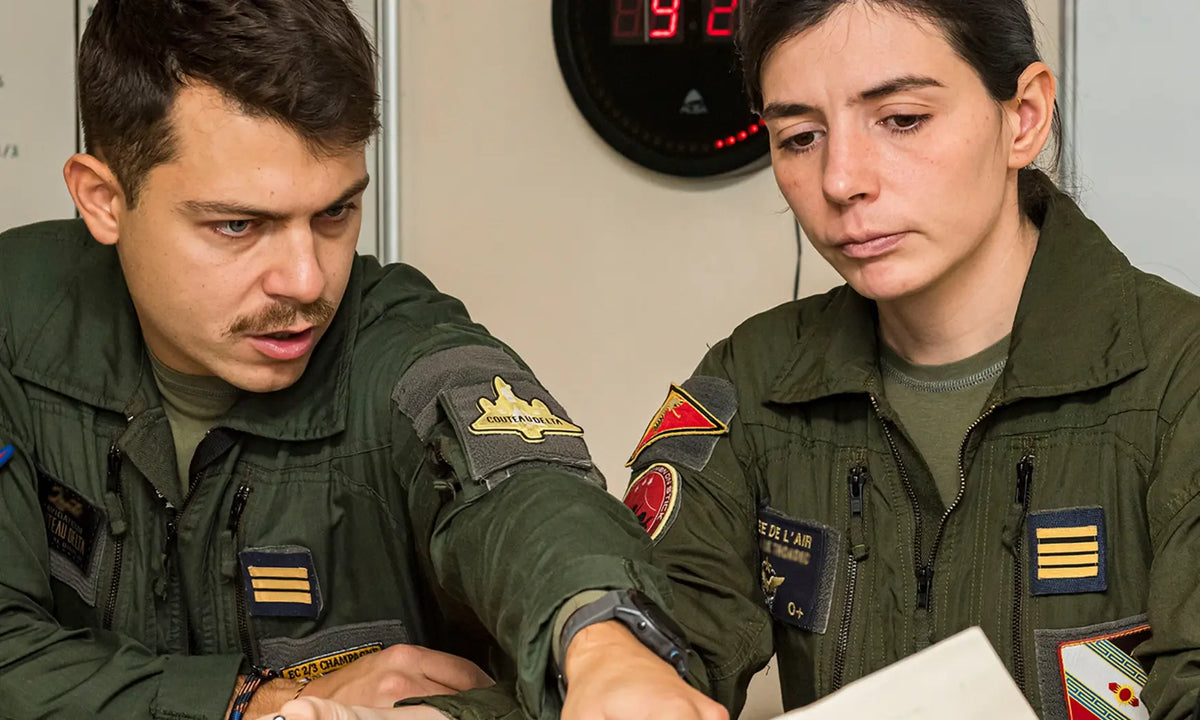
The French military hierarchy is organised into three broad categories: enlisted personnel (militaires du rang, from private to caporal-chef), non-commissioned officers (sous-officiers, from sergeant to major, the most senior NCO rank) and officers (from second lieutenant to général d’armée). The Navy uses its own titles — quartier-maître, second maître, capitaine de vaisseau — but the equivalences between the services are strict. A complete reading guide, with the correspondences and what each level involves.
Enlisted personnel
The foundation of the armed forces — nearly 80% of French Army recruitment: private (soldat, or aviateur in the Air and Space Force, matelot in the Navy) second class then first class, corporal (caporal; quartier-maître de 2e classe in the Navy), senior corporal (caporal-chef; quartier-maître de 1re classe), and caporal-chef de 1re classe. At these ranks, personnel carry out orders and supervise the youngest recruits — and entry is possible without any qualifications.

Non-commissioned officers: the backbone
Sergeant (sergent; second maître in the Navy, sergent in the Air and Space Force), staff sergeant (sergent-chef; maître), warrant officer (adjudant; premier maître), chief warrant officer (adjudant-chef; maître principal) and major. This is front-line leadership: squad leaders, team leaders, experienced specialists. Recruitment is with the baccalauréat, the French secondary-school diploma (NCO schools: ENSOA in Saint-Maixent for the Army, Rochefort for the Air and Space Force, Maistrance for the Navy), or through internal promotion from the enlisted ranks.
Officers
Junior officers: second lieutenant (sous-lieutenant) and lieutenant (enseigne de vaisseau de 2e and 1re classe in the Navy), captain (capitaine; lieutenant de vaisseau). Senior officers: major (commandant; capitaine de corvette), lieutenant colonel (lieutenant-colonel; capitaine de frégate), colonel (capitaine de vaisseau). General officers: brigadier general (général de brigade; contre-amiral), major general (général de division; vice-amiral), then the ranks and titles of lieutenant general (général de corps d’armée; vice-amiral d’escadre) and general (général d’armée; amiral). A French peculiarity: in the cavalry and the historic mounted troops, the form of address “mon capitaine” becomes simply “capitaine”… and Marshal of France is not a rank but a state dignity.

Further reading: joining the army after 30.
What rank tells you — and what it doesn’t
Rank determines authority and pay (see our investigation into military pay in 2026 and the one devoted to officers), but not the role: an experienced chief warrant officer can carry more weight day to day than a young lieutenant, and the armed forces rely heavily on this officer/NCO partnership. Another nuance: at the same rank, responsibilities vary considerably depending on the posting — commanding a platoon in a regiment is not the same as staffing a headquarters office.

FAQ — French military ranks
What is the highest rank in the French military?
Général d’armée (army general; amiral in the Navy). The title of Marshal of France is a dignity, not a rank.
What is the difference between rank and role?
Rank is the statutory grade; the role is the post held (platoon leader, company commander…). One does not automatically follow from the other.
How do you move up from the enlisted ranks to NCO?
Through internal recruitment, based on record, aptitude and training at an NCO school.
Why does the Navy have different ranks?
Historical heritage: the titles differ, but the protocol and pay-scale equivalences are strict.
To see these hierarchies at work in the field, discover our in-depth reports in Défense Zone magazine and our interviews on the podcast — and follow our news.
Sources: French Ministry of the Armed Forces; French Defence Code (general statute of military personnel); pay scales published by Emploi-collectivités.