DÉFENSE ZONE
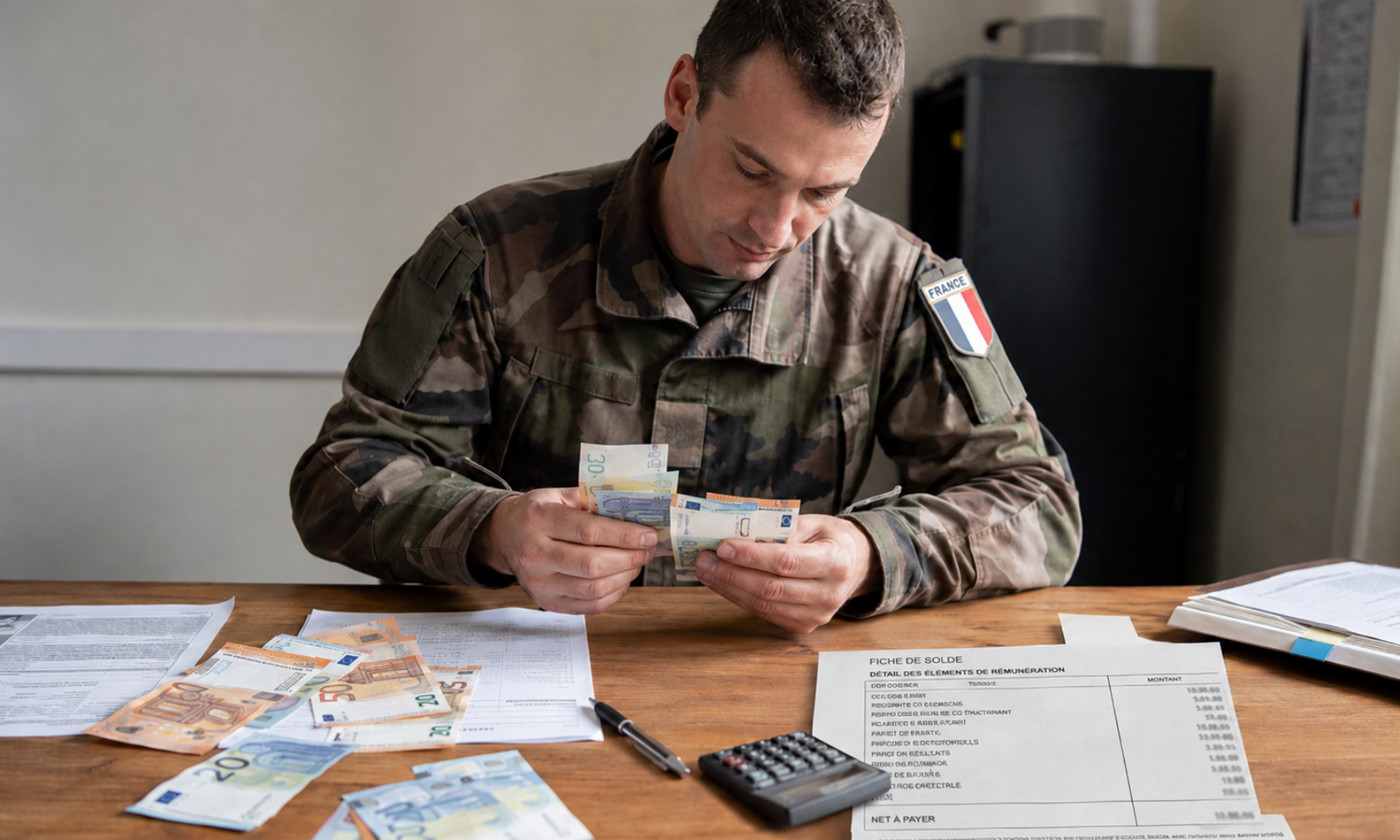
In 2026, an enlisted soldier starts their career on around €1,500 to €1,600 net a month, including the military service allowance, with accommodation and meals provided. With allowances, a young recruit’s actual pay is most often between €1,800 and €2,100 net. On an overseas operation, it can more than double. That is the short answer. But behind these figures, which the official pay scales only half tell, lies a more mixed reality: that of an institution that recruits on a massive scale… and struggles to keep its soldiers.
What the official pay scales say
A service member’s pay is based first and foremost on basic pay, indexed to a pay scale comparable to that of the civil service. In 2026, it stands at around €1,600 gross a month for a private at the start of their contract, around €1,900 gross mid-career, and up to €2,500 gross for a senior corporal (caporal-chef de 1re classe) at the end of their contract. A sergeant starts on around €1,600 net, a young officer on more than €2,000 net.
These gross amounts are misleading if read like a private-sector salary: they say nothing about allowances, which make up a substantial share of actual pay, or about benefits in kind, which significantly change real purchasing power.
Allowances: the real adjustment variable
Since the New Military Pay Policy reform (NPRM), completed in 2023, the allowance system has been completely overhauled. Basic pay is supplemented in particular by the military service allowance (paid to everyone, adjusted according to family situation and posting), the garrison allowance, qualification-related bonuses (parachute, diving, mountain, etc.) and operational absence allowances, which compensate for days spent on exercises or missions.
The result: two soldiers of the same rank can receive noticeably different pay depending on their regiment, their speciality and their tempo of activity. This also explains the differences between the figures published here and there: there is no such thing as “a soldier’s salary”, only individual situations built on a common base.
Overseas operations (OPEX): when pay changes scale
It is on overseas operations that military pay moves into another dimension. The allowance for service abroad (ISSE) amounts to 1.5 times basic pay: a deployed service member therefore receives around 2.5 times their usual gross pay, and this allowance is tax-free. In practical terms, a young recruit on around €1,650 net in garrison can exceed €4,000 net a month in a theatre of operations, according to data cross-checked by websites specialising in military law.
This mechanism, inherited from a dense operational history (traced by Michel Goya in Le temps des guépards (The Time of the Cheetahs), and whose legal and political framework is analysed in Les opérations extérieures de la France (France’s Overseas Operations)), remains one of the main factors that make the job attractive. But it depends, by definition, on the pace of France’s military commitments.
Benefits in kind: the blind spot in comparisons
Comparing a soldier’s pay with the French minimum wage (SMIC) makes little sense if you leave out what the institution covers: free or almost free accommodation on base for single personnel, meals at a token price, 45 days’ annual leave, a 75% discount on SNCF train tickets and specific social security cover. The Ministry of the Armed Forces is keen to highlight these benefits, and rightly so from an accounting point of view, as they automatically increase the disposable income of a young recruit housed at the regiment.
Further reading: a French Army officer’s pay, joining the army after 30 and French military ranks.
The downside: a pay plateau that drives soldiers away
Here is what the recruitment brochures do not say: military pay is now at the heart of a retention crisis documented by the oversight bodies themselves. A French Senate report on the attractiveness of the armed forces notes that departures of service personnel have risen by almost 20% since 2020, and highlights the “plateau effect” of the pay scales: pay progression slows sharply after the first few years, discouraging those who compare it with the private sector or even with the rest of the civil service.
The Court of Audit, for its part, finds that the ministry has not met its staffing targets, because it does not recruit enough and, above all, does not retain its personnel. And the High Committee for the Evaluation of Military Conditions considers that international comparisons are unfavourable to French service personnel. In other words, entry-level pay is reasonable for a young person without qualifications, but it is the rest of the career path that is the problem: a paradox at a time when the updated military programming law provides for a build-up in personnel numbers and 80,000 reservists by 2030.
FAQ: military pay 2026
How much does a new recruit earn in 2026?
Around €1,500 to €1,600 net a month for an enlisted soldier at the start of their contract, including the military service allowance, with accommodation and meals provided. With activity allowances, actual pay often reaches €1,800 to €2,100 net.
How much does a soldier earn on an overseas operation?
Gross pay is multiplied by around 2.5 thanks to the ISSE (1.5 times basic pay), which is tax-free. A young recruit can exceed €4,000 net a month on operations.
Is military pay taxable?
Yes, like a salary, with the notable exception of the ISSE received on overseas operations and operational reserve allowances, which are exempt from income tax.
How much does a reservist earn?
Between €41 and €160 net per day of activity depending on rank, tax-free, according to Service-public.fr.
And in the French Foreign Legion?
A legionnaire starts on around €1,500 net, with board and lodging. We detail the amounts, allowances and progression in our investigation into legionnaires’ pay.
Sources: Ministry of the Armed Forces: military pay; French Senate: report “Pour rendre l’armée plus attractive” (Making the armed forces more attractive); Court of Audit: defence budget implementation note; HCECM: 18th report; Service-public.fr: operational reserve.