DÉFENSE ZONE

Welcome to Défense Zone, the podcast that covers defence and security issues.
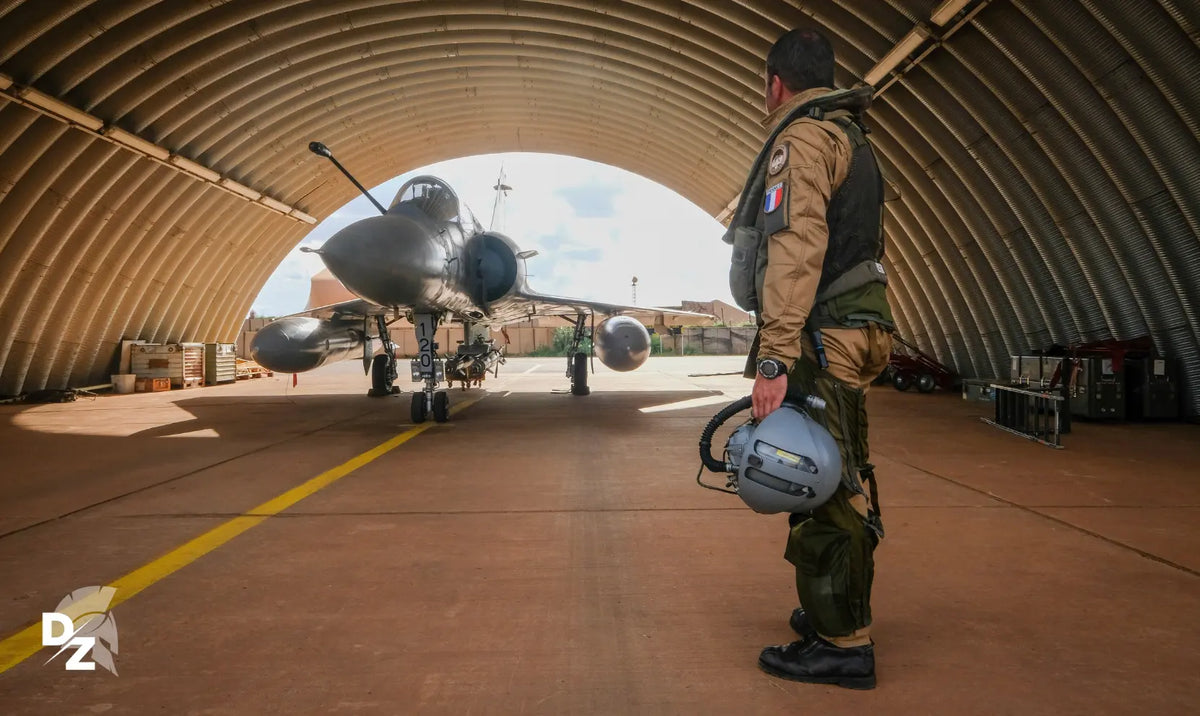
This week, we head to Saint-Dizier to meet one of the mechanics at Air Base 113. With him, we talk about the specific features of a job that is usually given little attention and yet is essential to keeping Rafale aircraft flying. Don’t forget to subscribe to the podcast and to our print magazine on the defense-zone.com website.
Introduction
I’m Staff Sergeant (sergent-chef) Guillaume, from Air Base 113 Saint-Dizier. I’m a weapons mechanic, from the 2320 weapons technician speciality, and more specifically I’m trained to work on the Rafale. Straight after my baccalauréat I went to the armed forces recruitment centre in Corsica, because I’m from Corsica. I took a three-day series of tests in Lyon and then joined the Air Force NCO school in Rochefort.

Becoming a mechanic in the French Air and Space Force
Mechanic training
These two years in Rochefort include initial training covering the whole military side: close-order drill, marching in step, knowing how to present yourself, knowing the ranks around you and the air base environment that awaits you. Then comes specialist training, in this case 2320 weapons technician, where you really cover the general principles of pyrotechnics and armament in the Air Force, and you then specialise according to the job you will do at your future base. The weapons mechanic speciality is varied, because you can work in a conventional munitions depot, in a nuclear depot as here in Saint-Dizier, or in the survival equipment workshop doing only pilot safety (seat, survival pack, flying kit).
Is the training difficult?
No, because you won’t be asked to master everything; you have to specialise. For example, I work on the Rafale, so it’s not my job to go to the depot to assemble a munition; on the other hand, I work with the people who bring me a munition, for example when I’m on an overseas operation (OPEX), so that I can load it onto the aircraft. It’s a big team effort, a long chain where everyone has to do their job properly so that the mission succeeds at the end.
If a mechanic ever has to change base and aircraft, they will have to retrain, which will inevitably be a bit lighter because you already know the aviation environment, you’ve already worked on an aircraft, you’ve already been mentored, you’ve already been trained in safety.

Is it a stressful job?
Handling weapons and having responsibilities isn’t necessarily stressful; I’d say it’s motivating rather, and it puts a bit of pep into our work. You mustn’t be afraid of being stressed, because that’s when you make mistakes. But it’s very motivating; we don’t do conventional mechanics like you might in civilian life. You have to be meticulous, but we work safely: there are safety barriers to lift before weapons can be released.

There’s also an exciting side, especially when you get a call in the morning telling you it’s go time and the aircraft have to be sent. We joined the armed forces for these rather special moments, when you don’t know what’s going to happen, or when you watch the aircraft leave with weapons and we all wonder whether the weapons will come back.
The qualities you need
We are constantly working as a team; we never work alone, or very rarely, so team spirit is very important, because even if someone can’t help you with a task at a given moment, another day they may pull you up on another task. So mutual support is very important, the human relationship, the cohesion between us. You also have to tell yourself that there’s no such thing as a stupid question; as in every job, you have to make mistakes to move forward, to remember them and not make the same mistake again.
The mechanic’s missions
On some missions, we know that if the aircraft leaves for a 5-hour flight, for example, we have 5 hours to prepare weapons, because when it comes back the aircraft will be empty and we have to load the same quantity as at departure. Sometimes the aircraft comes back, lands and leaves again. You have to juggle fairly long waiting periods with short bursts of stress. During the waiting periods, to save time or lighten the workload, we do things while the aircraft is in flight. That way, we don’t have to do them once it has landed, and we only have the aircraft itself to deal with. So if we do all the work upstream and prepare our equipment and weapons, the aircraft lands, we do our debrief (any faults, damage, etc.), we repair if necessary, we fit our equipment and that’s it. On top of that, we have time limits: we’re asked what time the aircraft will be available, because behind us there’s a whole chain of command that has to organise itself to work.
It’s not just weapons, though, but everything linked to pyrotechnics, such as the ejection seat. It’s such a precise piece of equipment, with so many components, that you need a lot of knowledge to master your seat properly, and it’s a speciality: some mechanics do nothing but ejection seats (fitting, removal, etc.). We also have to check the pilot’s survival pack, depending on the mission.

The importance of “managing” a team
Young, somewhat inexperienced people sometimes make mistakes. You have to remember that you were in their shoes; that’s why I say there’s no such thing as a stupid question. We were in their place not so long ago, and what a joy it was to have a team leader who looked after us and trained us; it’s really rewarding and pleasant to have someone who takes an interest in you, especially when you’ve just left school. When I arrived here I was 20, I had just left Corsica, far from my parents, so having a mentor who looks after you is always nice. And we have to pass on our knowledge to others, because one day we won’t be here any more, and it will be their turn to pass it on to the younger ones.
How weapons are changing
Aviation is a field that changes every day, whether it’s the aircraft documentation, the weapons documentation or the aircraft standards. It’s a bit like an iPhone: before there was the iPhone 7, then came the iPhone 8. It’s the same with the Rafale: the standards evolve, so we always have to keep up to date with the documentation and written procedures so as not to miss anything. The head of department’s job is to make sure that new elements are added to the documentation and have been taken on board by the mechanics. What I knew 5 years ago, for example, is no longer relevant today: some things have been removed, others have changed or been replaced.

The special case of nuclear weapons
These are not conventional weapons, so we have to assure the government that we are able to deploy nuclear weapons, always safely, at any time and in any place. If tomorrow the President of the Republic decides to raise the alert level of the airborne component, he knows we can do it because we prove it to him during exercises, but above all we have proved to him that we can do it safely, and that the population around the air base has nothing to worry about: we work without risk, and that is the most important point with nuclear weapons. Mechanically speaking, it’s an operation you learn, and after a year you’re able to do it with your team, because you never do this kind of thing alone. But it’s no more complicated than other operations. We learn and repeat it so much; we know our equipment. That said, we’re still human and there is still that apprehension of telling yourself it’s not trivial, but it must be the same when you’re above a point where you’re going to drop a 150 or 250 kg bomb. But for us, in the way we work, we do the same thing: it’s just one munition among many.

Overseas operations
Team spirit
My last OPEX was in Jordan at the end of 2022. For mechanics, an OPEX lasts 2 months, although it used to be 4 months. We aligned ourselves with the length of the pilots’ OPEX, which has always been 2 months, because we used to have a pilot rotation in the middle of our OPEX and it was sometimes a bit complicated to manage. Imagine leaving for the other side of the world in a small group, and after 2 months the group is split up and part of it replaced; it was complicated. You need that team spirit, that cohesion, to forget that you’re far away and that you may have a wife and children alone at home. That said, in 2023 we can now make video calls from the other side of the world; it’s so simple and still amazing to be able to see your parents or your partner on a screen, it’s lovely.

International exchanges
I’ve had exchanges with many armed forces. In Jordan, on the French camp, I met lots of Jordanians, and I also came across Americans. On other missions, you sometimes deploy with many nations and that’s great. It’s interesting for the cultural exchange, not to mention the military side, which lets you get close to different aircraft; you often get together with your counterparts in the foreign speciality and swap ways of working: for example, I show the Rafale’s cannon, they show their aircraft’s cannon. Obviously, we’re not allowed to go into anything classified, so we exchange within the limits of what we already know and what we can say.
A final piece of advice
Listen to the old hands. They were in our place, they know what we think, they know what we expect, what we hope for, they know we came here to do missions, OPEX, to work on an exceptional machine, to learn as fast as possible. But you can’t learn fast, so they’re also there to keep us on track. The best advice is to listen to the more experienced people in an institution like the armed forces.