DÉFENSE ZONE

For 300 years, the French Defence Health Service (SSA) has adapted to the needs of the armed forces. A joint service, its role is above all to provide medical and surgical support to the French armed forces in all circumstances and in all places. In 2021 it had a workforce of 14,699 people.
History of the French Defence Health Service
The SSA was born at the beginning of the 18th century. The royal edict of 17 January 1708 created the posts of army physicians and surgeons. Signed by Louis XIV, the edict brought coherence to the system for caring for wounded and sick soldiers. For more than a century, several attempts had been made to create a permanent medical service.
After the Battle of Fontenoy in 1745, which left more than 2,000 dead and more than 3,000 wounded, it became clear that mobile units had to be created as close as possible to the fighting in order to treat urgent casualties as quickly as possible. But until the end of the First Empire, care for the wounded remained largely improvised and adapted to the circumstances of the fighting. Military physicians and surgeons proposed many improvements, but they came up against the war commissaries, who were incompetent or even dishonest.
Pierre-François Percy (1754-1825), who would become chief surgeon of the Grande Armée, helped to make surgeons more mobile. He created mobile surgical ambulances and the first companies of nurses. Dominique Larrey (1766-1842), meanwhile, is regarded as the father of emergency medicine. René Nicolas Desgenettes (1762-1837) distinguished himself in the prevention of epidemics. In 1882 and 1889, the health service gained technical and then administrative autonomy. Until then, it had been part of the commissariat. Medical personnel at last had authority over their own resources.

The first months of the Great War were a medical disaster: pre-established medical doctrines were unsuitable and medical resources were quickly overwhelmed. From September 1914, the service reorganised itself. It was during the First World War that medical and surgical triage was born. The wounded were categorised according to the urgency of surgical treatment and of evacuation. By the end of the Great War, the service had mobile surgical units (autochirs) and radiology vehicles, and the first aircraft adapted for air evacuation appeared.
During the Second World War, the French Defence Health Service suffered from the lack of mobility of its medical facilities, which were unsuited to the Blitzkrieg waged by Germany. The medical service was rebuilt within the Free French Forces, but along the lines of the US Army’s system.
The health service had to adapt once again during the Indochina War. Doctors were assigned to every battalion. Lighter surgical units were airlifted and parachuted in. A hierarchical organisation was needed during the Cold War.
In the 21st century, the service adopted a new strategy: bringing technical skills suited to different situations as close as possible to the fighting in theatres of operations, even those far from mainland France, and evacuating the wounded to a hospital as soon as possible.
Organisation of the French Defence Health Service
The French Defence Health Service’s new governance has been in place since 3 September 2018. The new organisation is built around professional chains bringing together the SSA’s five directorates, and a human resources chain with the creation of the human resources management department attached to the central directorate
-
Composition and strength of the French Defence Health Service
In 2021, the SSA had a workforce of 14,699 people. Among them were around 5,000 civilians and 3,000 reservists. The reservists come from the health sector in general and provide reinforcement in the armed forces medical centres, hospitals and any other SSA establishment.

The SSA’s health corps are made up of physicians, pharmacists, dental surgeons, veterinary surgeons, commissaries attached to the health service, military nurses and reserve technicians of the armed forces hospitals (MITHA), volunteers of the French Defence Health Service, and so on.
-
Missions and areas of expertise
The SSA’s main mission is to provide medical support to the French Army, the French Air Force, the French Navy and the Gendarmerie, in all circumstances and in all places. It also takes part in public health efforts and provides medical aid to local populations during overseas operations (OPEX).
The SSA has expertise in prevention, care, medical fitness and assessment, teaching and research (in the medical, pharmaceutical, paramedical, dental and veterinary fields).

SSA personnel may be called upon to work in one of the eight military teaching hospitals, in one of the 17 armed forces medical centres (CMA) in France, in a medical supply establishment, at the biomedical research institute, or sometimes in SSA training schools. They may also be sent on a mission to an overseas theatre of operations.
-
The different directorates
The Central Directorate of the French Defence Health Service (DCSSA), placed under the direct authority of the Chief of the Defence Staff (CEMA), commands the SSA. Surgeon General Philippe Rouanet de Berchoux has been its director since 31 October 2020.
The SSA’s new organisation dates from September 2018. It is now built around professional chains bringing together the SSA’s five directorates, and a human resources chain with the creation of the human resources management department (DépGRH), attached to the central directorate:
- the Directorate of Force Medicine (DMF)
- the Directorate of Hospitals (DHOP)
- the Directorate of Training, Research and Innovation (DFRI)
- the Directorate of Armed Forces Health Product Supply (DAPSA)
- the Directorate of Information Systems and Digital Services (DSIN)
The French Defence Health Service in theatres of operations
On overseas operations, the French Defence Health Service (SSA) organises a continuous, permanent chain of care, from the place where the injury occurs to arrival at a military hospital in France. Medical support to the armed forces is the Service’s priority mission.
-
The French approach
What is specific about the French concept in theatres of operations is placing the surgical team (doctors, surgeons, anaesthetists and intensive care specialists) as close as possible to the fighting, in order to treat the sick and wounded and evacuate them to mainland France as soon as possible.
This proximity aims to give service personnel the best chances of survival and functional recovery. The British and Americans, for their part, choose to prioritise the speed of casualty evacuation.
-
Roles 1 to 4
The SSA supports service personnel from the moment they are injured through to their rehabilitation and reintegration. The medical care of wounded personnel is provided by a chain of care organised into four roles:
- Role 1: the level 1 operational medical unit, or medical post. This is “forward” medical care and the smallest medical facility deployed in theatres of operations. Its medical team (doctor, nurse, medical assistant), whose composition varies with the mission, is embedded in the combat unit. It is trained to operate in isolation and in a hostile environment, and the doctor can provide emergency care and resuscitation. Operating independently, the medical team can support 150 personnel for 15 days.
- Role 2: the level 2 operational medical unit, or forward surgical team. In cases of extreme urgency, it can perform life-saving surgery and resuscitation before the casualty is evacuated. Air-transportable, the forward surgical team can be set up in a tent or a permanent building in under three hours. It has ten hospital beds, an operating theatre and a resuscitation room. Additional modules can be added. It can handle six to eight casualties a day and is designed to support a force of more than 1,000 personnel. It has 12 to 15 medical staff depending on the mission.
- Role 3: the level 3 operational medical unit, or field hospital (HMC). It has one or more operating theatres as well as medical imaging equipment, a testing laboratory, sometimes a dental surgery, and specialised surgical modules for ENT, ophthalmology and neurosurgery. It can be set up in tents, in metal-and-fabric structures, in prefabricated modular technical units or in an existing building. It can accommodate 15 to 60 people in hospital beds.
- Role 4: the level 4 operational medical unit, namely the eight military teaching hospitals (HIA). They are located in mainland France. It is in the HIAs that the casualty receives definitive treatment and rehabilitation. Casualties are evacuated to the HIAs mainly by air, with constant medical care provided during the flight.

-
Medical evacuations
On overseas operations, evacuations between medical units are part of the casualty’s chain of care. The wounded soldier thus receives continuous care, which becomes increasingly specialised along the chain. Medical evacuations are mainly carried out by air, but also by specialised armoured forward vehicles and ambulances.
Forward medical evacuation takes place between the place of illness or injury and one of the operational medical units.

Medical evacuation by air (MEDEVAC) means the casualty can be quickly cared for in medical facilities in the field and admitted to an HIA in mainland France as early as possible. It also avoids overloading the forward surgical teams. The outbound flight is used to resupply them with medical products.
There are two types of MEDEVAC:
- Tactical MEDEVAC: the transport of wounded personnel within the theatre of operations between two operational medical units. It is carried out by French Air Force aircraft (Transall, Casa or Hercules) and by utility helicopters.
- Strategic MEDEVAC: the repatriation of wounded personnel from an operational medical unit to the HIAs in mainland France. It is carried out using French Air Force aircraft (900/Falcon type), which are specially adapted and allow the team to provide intensive care.
Boeing C135 tanker aircraft are also fitted with the MORPHEE system (an intensive care module for patients requiring long-distance evacuation). This allows a medical team to evacuate up to twelve casualties from any theatre of operations on a flight of around ten hours.

As haemorrhage is the main cause of death among the wounded, blood supply is extremely important on operations. But transporting blood is logistically demanding, particularly because of the cold chain. The armed forces therefore use secured freeze-dried plasma (PLYO), produced by the armed forces blood transfusion centre. It is immediately available, effective, universal and safe, and keeps at room temperature.
-
Psychological support
In most theatres of operations, armed forces psychologists and SSA military psychiatrists are present to support service personnel. The psychiatrists help the doctor reach the right diagnosis and course of action when soldiers show signs of post-traumatic psychological disorders. They also carry out their usual duties of assessment, care and advice to the command. They may work with the institutional psychologist, whose work focuses on restoring the operational functioning of the individual and the group.
The doctor, who is responsible for the service member’s medical follow-up throughout their career, monitors them on their return from a mission. The doctor is the first link in the medical and psychological support system. If a serious incident occurs during an overseas operation, a psychiatrist is appointed to set up a military medical and psychological emergency unit and to provide follow-up in liaison with the local force doctor.
The French Defence Health Service’s other missions
In addition to supporting combat troops on operations, the SSA has many missions, in areas where French forces are deployed, but also for the benefit of populations in France and abroad.
-
Medical aid to populations
During overseas operations, the SSA can provide medical aid to local populations (AMP). It also takes part in humanitarian missions decided by the government. It thus helps populations struck by disaster (natural or industrial disasters, epidemics, famine) or populations suffering the consequences of armed conflict. The SSA took part in the relief effort during Operation Séisme Haïti 2010.

During peace-enforcement operations, for example, the SSA’s medical resources are used for the benefit of local populations: care, supply of medicines, consultations, surgical procedures, evacuation of the sick and wounded, and so on. The SSA also takes part in operations to evacuate French nationals from countries in crisis.
-
Contribution to public health
Working with the Ministry of Solidarity and Health, the SSA contributes to public health policy:
- Its eight HIAs, which receive wounded personnel repatriated from overseas operations, are open to everyone covered by social security, even if they have no connection with the Ministry of the Armed Forces. Its military hospital network has a hospital emergency plan (plan blanc) and takes part in government emergency plans (heatwave and pandemic plans)
- It contributes to the fight against epidemics, as the Central Pharmacy of the Armed Forces helps to build up the national stockpile of antiviral tablets
- It contributes to the government emergency plans put in place to deal with CBRN risks (chemical, biological, radiological and nuclear).
The SSA also serves ministries other than the Ministry of the Armed Forces and the Ministry of Health:
- the SSA supports the military personnel of the Ministry of the Interior, including the National Gendarmerie, the Paris Fire Brigade and the Marseille Naval Fire Battalion
- the Ministry for Overseas France
- the Ministry of Transport
- the Ministry for Europe and Foreign Affairs: for humanitarian missions and international military and civil cooperation missions
-
The SSA during the Covid-19 health crisis
In 2020 and 2021, through Operation “Résilience”, the SSA was involved in managing the Covid-19 health crisis, at the request of the President of the Republic, Emmanuel Macron. In particular, a tented intensive care facility was deployed near Mulhouse hospital in March. Patients were also transferred by air, and medical equipment and reinforcements were sent to the overseas territories. In February 2021, around fifty healthcare staff were sent to Mayotte as reinforcements. And in the spring the HIAs were called upon to speed up vaccination.
The SSA “in a critical situation”, according to the Senate
The French Defence Health Service is “in a critical situation”, according to a French Senate report of June 2020. The cause: “the reduction in its resources” in the face of “the increase in its missions”. Over the past ten years or so, the service’s resources have fallen sharply. The rapporteurs note that, in five years, “the SSA has lost 1,600 posts”. They also observe that the service “only keeps running today thanks to its 3,000 reservists”. According to a report by the High Committee for Military Conditions, the SSA is also short of 165 doctors (it has 700 force doctors).
Yet SSA personnel are in heavy demand to support the “intense” commitment of the French armed forces, particularly in the Sahel and in mainland France with Operation Sentinelle. In 2020 they also made a significant contribution to Operation Résilience during the Covid-19 health crisis.

In 2019, 1,966 of its military personnel were deployed on operations and its surgical teams were deployed twice as often as planned. The High Committee notes that “for several years, the SSA has been the organisation where military morale is most fragile”. The SSA struggles to recruit and retain staff, all the more so given the competition from the public sector.
At the end of 2020, the Minister for the Armed Forces, Florence Parly, announced that the SSA’s budget would have increased by €160 million by the end of the Military Programming Law (LPM). Also announced were the order of 20 additional MEDEVAC kits for utility helicopters, the modernisation of the Morphée kit and improved medical evacuation capabilities for tactical transport aircraft. The 2022 finance bill also provides for additional funding for the SSA. In 2021, the SSA had 14,699 personnel and a budget of around €1.5 million.
Recruitment and training
Recruitment into the French Defence Health Service takes several forms depending on the roles chosen by applicants
-
Recruitment of medical professionals
In addition to doctors, the SSA employs many medical professions able to cover the full spectrum of care for service personnel and for the animals of the Ministry of the Armed Forces
-
Recruitment of doctors
Every year, the SSA recruits military doctors through a competitive entrance examination to the École de santé des armées (the armed forces medical school) for school-leavers with the baccalauréat and also, since 2020, for all medical students. The SSA also occasionally recruits state-qualified general practitioners and specialists on contract. Contract doctors must be French nationals, under 40, have a clean criminal record (bulletin no. 2) and have met their national service obligations.
-
Recruitment of pharmacists
A competitive recruitment examination for the École de santé des armées (ESA) is held every year. The SSA also occasionally recruits state-qualified pharmacists.
They can then pursue careers as hospital pharmacists, pharmacists in medical supply establishments, researchers, pharmacists in environmental toxicology, or in the service’s administration.
-
Recruitment of veterinary surgeons
As a general rule, the SSA recruits contract veterinary surgeons from among state-qualified vets. But in some years, an entrance examination to the École de santé des armées (ESA) is held for students currently at veterinary school.

The missions of military vets are varied: veterinary public health missions; care and disease prevention for military animals (dogs and horses); control of the biological environment (combating zoonoses and epizootics, vector control); expertise and advice on food hygiene and safety; animal health control of military animals moving outside mainland France and of animals kept on military sites; research; and so on.
-
Recruitment of paramedical professionals
Military hospitals recruit qualified psychologists and paramedical staff:
- mainly with military status
- but also with civilian status for certain specialities
Military paramedical staff and psychologists are governed by MITHA status (military nurses and technicians of the armed forces hospitals), made up of 13 corps (the same as those of the public hospital service).

Paramedical staff can work in:
- the care stream (healthcare assistant, general and specialist nurse)
- the rehabilitation stream (physiotherapist; and with civilian status: orthoptist, dietitian, speech therapist, chiropodist-podiatrist, occupational therapist, psychomotor therapist)
- the medical-technical stream (radiographer, laboratory technician, hospital pharmacy technician)
- the administrative stream (medical administrative assistant)
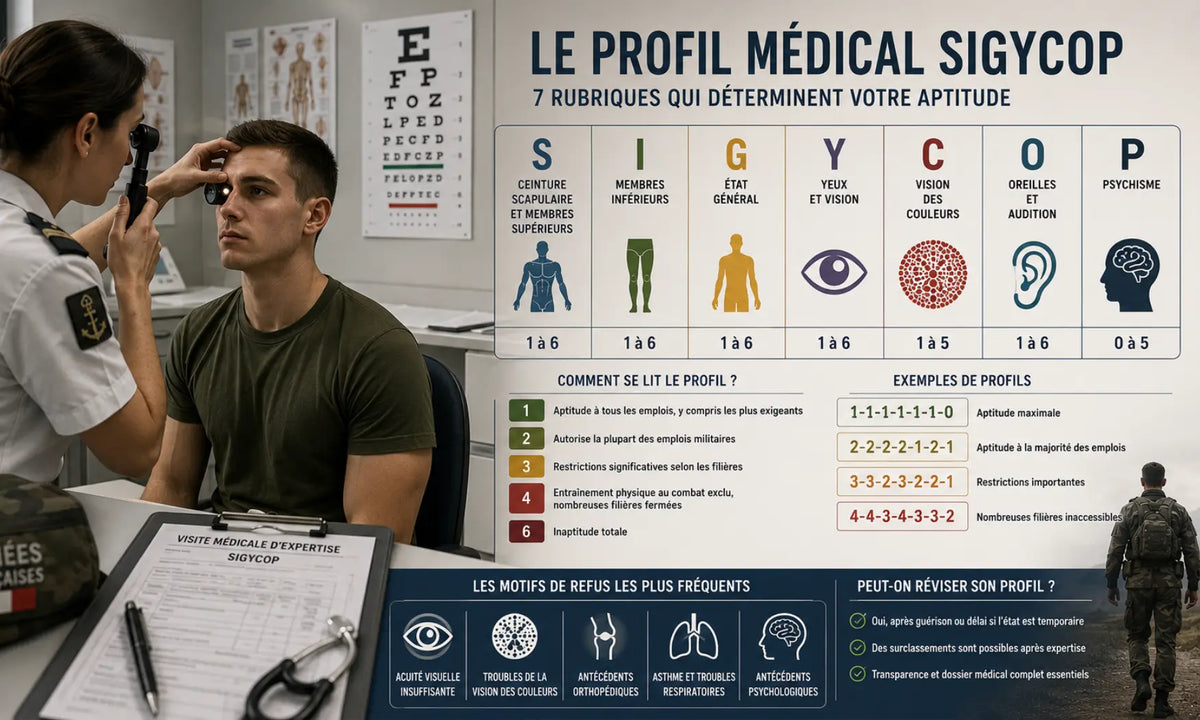
For paramedical staff recruited with military status, you must be a French national, hold the qualification corresponding to the post applied for, be medically fit and have completed the JDC (Defence and Citizenship Day). Military nurse training at the École du personnel paramédical des armées (EPPA, the armed forces paramedical school) is open to people aged 17 to 23.
-
The French Defence Health Service schools
The SSA provides initial training for its doctors, pharmacists, vets and medical centre nurses, as well as the continuing training that supports paramedical staff and practitioners throughout their careers. The SSA trains its students in three schools:

- The École du Val-de-Grâce is responsible for initial and continuing training within the SSA. Considerable emphasis is placed on operational emergency training, which is kept up throughout the career. It oversees the École de santé des armées (which trains doctors and pharmacists) and the École du personnel paramédical des armées (EPPA). One of the departments of the École du Val-de-Grâce provides operational training (medical care in hostile environments, combat rescue, etc.) and training adapted to military environments (land, naval and aeronautical force medicine).
- The École de santé des armées in Bron, in the Rhône, trains officer cadets who will become military doctors, pharmacists and vets. Military students follow the same course as civilian students, but in uniform, and they benefit from enhanced academic support.
Future military doctors also receive medical-military training. In all, 1,800 hours of training are spread throughout their university studies. This training includes placements in units, in general practice and with the fire service, combat rescue, military training from initial to specialised level, military parachute, diving or commando qualifications, English, and so on. Those at the École de santé des armées in Bron also receive officer training.
- The École du personnel paramédical des armées (EPPA) prepares future medical centre nurses for the state nursing diploma (DEI). It is located in Bron, next to the École de santé des armées. The course lasts three years and is outsourced to a civilian nursing training institute (IFSI). During these three years, students also receive military training, medical-military training and medical-operational training. Once they have their DEI, military nurses complete one to four months of specialised service-specific training.
-
Recruitment and training of administrative and technical staff
Officers in administrative roles in the SSA are recruited into the corps of armed forces commissaries. This recruitment is carried out by the armed forces commissariat service.
For NCOs:
- every year, the SSA recruits biomedical equipment installation and maintenance technicians with military status;
- health service administrative secretary NCOs (SASS) are recruited at two years’ higher education level and sign a contract with the French Army.
For enlisted personnel:
- French Defence Health Service volunteers (VSSA) can be stretcher-bearers, assistant secretaries, reception and switchboard staff, drivers, operations staff, assistant storekeepers and research assistants, among others. But they cannot hold medical or paramedical posts. The recruitment conditions are as follows: be a French national, be aged at least 17 and at most 26, have completed the Defence and Citizenship Day (JDC), be medically fit, with or without qualifications. Initial military training lasts seven weeks and professional training takes place in the unit of assignment.
- French Army volunteer enlisted personnel (EVAT) in the “health branch” serve as combat medical assistants and can progress by taking specialist training. The required level is the brevet des collèges (the lower secondary school certificate). They receive military and professional training.

As for the SSA’s civilian personnel, they are employed as civil servants, state workers or contract staff. Civil servants are recruited by competitive examination, and contract staff through unsolicited applications.
Two thirds are assigned to hospitals, where they carry out administrative and technical duties. The rest work in the directorates, medical supply establishments, schools and the research centre.
-
Recruitment and training of health reservists
Reservists are integrated into the SSA’s permanent active units. The corps open to SSA reservists are: physician, pharmacist, dental surgeon, veterinary surgeon, commissary, reserve military nurse and technician of the armed forces hospitals, and SSA volunteer.
Please note that recruitment does not take place through the CIRFAs (armed forces information and recruitment centres). Applicants must contact the recruitment services of their region of residence, whose list and contact details are available on the government website.
The conditions for joining the SSA reserve are as follows: be under 65, have met your military service obligations (JAPD, JDC), be declared medically fit by a military doctor and work in a health profession or a health-related field. Once recruited, reservists undergo military training.