DÉFENSE ZONE
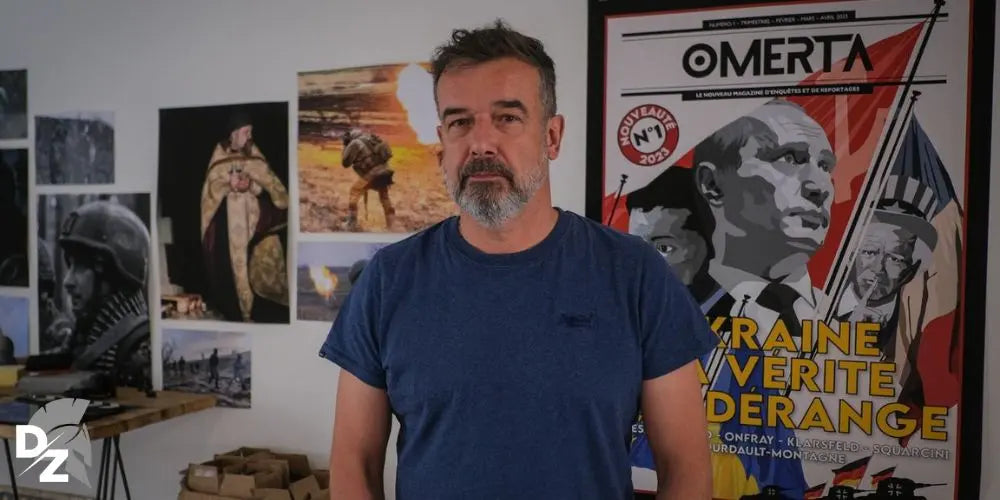
Welcome to Défense Zone, the podcast that covers defence and security issues. This week we meet Régis Le Sommier, a journalist specialising in war zones, editorial director of the media outlet Omerta and former deputy director of Paris Match. With him we talk about media coverage, particularly of the ongoing conflict in Ukraine.
Don’t forget to subscribe to the podcast and the print magazine by visiting the website defense-zone.com.
Introduction
Régis Le Sommier, 54, has devoted more than half his life to journalism, especially in the field. Having spent 27 years at Paris Match, 10 of them as deputy director, he never gave up working in the field. His passion for journalism shows in a “divergent tropism for the field”, as someone once described it. He likes to discuss subjects such as society and geopolitics, always drawing on his experiences and on testimony gathered around the world. Although he recognises the value of encyclopaedic knowledge, what sets him apart is his ability to tell other people’s stories and to draw from them elements that explain points of view, phenomena or changes in society.

The Omerta media outlet
The outlet’s beginnings
With 27 years’ experience at Paris Match, where he worked alongside photographers, Régis Le Sommier developed a narrative approach centred on the image. This method, based on scripting and storytelling, proved adaptable to new digital communication platforms. The idea for Omerta grew out of his wish to apply this approach to another context, in this case the war in Ukraine. Having also covered the war in Afghanistan, he decided to look at that country with Omerta, exploring the realities under Taliban rule. For two weeks, the team immersed itself in the country to document the hopes, the challenges and the different facets of Afghan life, notably the situation of women and drug addicts. The result is a 52-minute documentary that offers an alternative perspective to the mainstream media by exploring an often neglected territory.

An independent and free media outlet
Omerta, an outlet with a clear positioning and a strong identity, stands out for its dual national and international approach. Covering a range of themes such as security and immigration, and exploring international subjects such as Armenia, Lebanon, Saudi Arabia and Chechnya, the outlet is determined to remain free in its editorial choices. With an agile team, Omerta enjoys great flexibility, much like the freedom Régis Le Sommier had at Paris Match. The outlet takes a quarterly magazine approach, derived from its video reports, while also offering a video streaming platform comparable to myCanal or Netflix. This dual model allows Omerta to keep greater editorial freedom, less dependent on pressure from shareholders or advertisers. The small team makes for quick decision-making and a constant ability to reinvent itself. Unlike past experiences with larger media outlets, the absence of hierarchical friction allows greater agility in handling differences of opinion within the team. Overall, Omerta defines itself as an independent outlet offering an openly assumed editorial perspective, while keeping the flexibility needed to explore varied subjects and continually reinvent itself.
Journalism and ethics: beyond political labels
Régis Le Sommier firmly rejects the idea of the “activist journalist”, believing it goes against the true nature of journalism. In his view, a journalist can certainly be committed, but activism, as it is often perceived, implies a partiality that deliberately distorts reality. For him, authentic journalism means being able to express criticism, even of people you like: “When you go to cover a conflict from the Russian side, for example, you must be able to say today that the Russians have flaws, that they sometimes do absurd things, and so on. You have to be able to be critical about that. You should also be critical on the Ukrainian side, not for the same reasons, but in any case try to apply as much as possible the idea of ‘I’m not going to hide things, I’m going to show what I feel, show it and try with my honesty’.”
The journalist insists that political bias in journalism is regrettable, calling the practice “pitiful”. He questions what defines a left-wing or right-wing outlet, pointing out that nowadays these labels are often used simply to express the opposite of an opposing political view. For Le Sommier, reality goes beyond these categories, and human beings are more than the ideas attributed to them. He argues for a journalistic approach that goes beyond political values, highlighting the humanity behind each individual, even those engaged in ideological battles. He encourages journalists to detect these nuances and to describe the world beyond revolutionary or conservative notions.
He quotes Daniel Philippot, one of the founders of Paris Match, who said that “a journalist owns nothing but his honesty.” Le Sommier concludes by expressing his deep conviction that the world is a sum of human errors, with aspects that are both grand and pathetic. For him, this reality is far removed from the political polarities so often put forward, which confirms his vision of journalism.
Field reporting
On the Russian front
Régis Le Sommier discusses what is distinctive about the conflict in Ukraine, stressing its conventional nature with opposing front lines, a marked difference from the asymmetric conflicts of recent years. He refers to the Ukrainian counter-offensive announced for the spring, noting the territorial gains on both the Ukrainian and Russian sides, illustrating a head-on war with a balance of equipment and materiel. The journalist shares his experience of covering the conflict from the start, when he spent around ten days on the Ukrainian side, giving an insight into the rising tensions. He then mentions his visits on the Russian side, notably to Kherson, describing a particular atmosphere in a city with little sympathy for the Russians. His journey continued to Zaporizhzhia, to the power plant, then to Mariupol and finally to the Donbas, giving him a complete picture of the conflict. Le Sommier then talks about his documentary “Front Russe” (Russian Front), made during the autumn, covering the Russians’ activities and conditions on the northern front at Bakhmut. He shares a striking experience alongside Russian fighters, highlighting the reality of their resources and refuting speculation about their lack of equipment and ammunition. He also sheds light on the motivation of Russian soldiers, recalling their conviction that they are defending Holy Russia against what they see as an external threat. He stresses the similarities in living conditions between Ukrainians and Russians, revealing a harsh daily life marked by artillery duels and constant threats, particularly drone attacks. He insists on the persistence of Putin’s rhetoric, which mobilises the idea that the West wants to destroy Russia, an argument that seems to resonate among the soldiers. Le Sommier concludes by rejecting the idea that the Russians are only trying to save their own skins, highlighting deep motivations that persist after more than a year of war.

His analysis of the conflict
For Régis Le Sommier, Russia’s strategic errors in the conflict in Ukraine have been obvious from the start. A rapid attempt to take Kyiv failed, followed by a withdrawal from the Kyiv area. A Ukrainian counter-offensive, orchestrated by General Zalujnil, forced the Russians to evacuate the eastern part of the city. The withdrawal from Kherson was logical from a military point of view, given the supply difficulties. The city was showing signs of food and water shortages. General Surovikin then consolidated the front’s defences by creating minefields, trenches and other fortifications over up to 500 km. This effective defensive strategy allowed the Russians to consolidate their hold on the Donbas. Understanding these complex dynamics is difficult for Westerners, particularly given the different cultural perceptions of terms such as Nazism or Sovietism, which adds a further layer of complexity to the conflict.
The TV studio experts
Régis Le Sommier discusses the idea of “TV studio generals” in the context of the war in Ukraine. He describes these commentators as people who, although they sometimes have military experience, tend to voice passionate and hateful opinions without nuance, taking a firm stand against Russian actions. He stresses that this attitude contributes little to understanding the conflict and can be seen as a waste of time. He also criticises the tendency to speculate about fictitious events, for example regarding Vladimir Putin’s health. He mentions the media noise that surrounded rumours about the Russian president’s health, pointing out that such speculation sometimes serves to divert attention from apparent problems on the Western side, for example those relating to Joe Biden. He warns against the tendency to distort reality and engage in sensationalist narratives instead of focusing on concrete, verifiable facts. Finally, he raises the question of the media’s responsibility in how they cover these subjects, highlighting the need to return to fundamental ethical standards in journalism.
The criticism on his return from the Russian front
Régis Le Sommier expresses his concern about what seems to be growing censorship in the French media. He shares his experience as a journalist, pointing out that some media no longer invite him, perhaps because of his reports on the war in Ukraine and his approach to the daily life of Russian soldiers on the front. He describes the marked change since his early days as a war journalist in Iraq, when he was praised for his reports, compared with the current reception, where he is attacked and suspected by people who have never been through such experiences: “You come back, you’re attacked, it’s horrible, you’re suspected by people who have never known that, by people who have never got their backsides off their chairs, who come and lecture you, call you names on Twitter, that ultra-easy propaganda thing.” Le Sommier mentions the tendency to label some journalists as “pro-Russian” or similar terms, stressing that he simply did his job by reporting facts from the field. He criticises those who spread unfounded accusations, comparing his experience in Afghanistan with working on the Russian or Syrian side: “For years I’ve been going to Afghanistan to see the Taliban, before, when they were in opposition, and now I still manage to keep my access. I have never seen articles saying that I was doing their propaganda, or that I was a jihadist, never. So why does it happen when I go to the Russian side? I find that quite crazy, and it’s always the same clique of individuals, generally people who are often paid, they’re not journalists or experts, they’re people who belong to think tanks, either paid by the Americans or created by the Americans, or guys with neoconservative leanings.” He highlights the pressure and criticism that journalists can face, stressing the importance of remembering the humanity of the people involved in conflicts, even on the Russian side. Finally, he expresses his concern about this change in how war journalists are perceived and the growing difficulty of doing their job in a climate of suspicion and censorship.
Staying informed today
For Régis Le Sommier, “you have to pick and choose”. He suggests an approach to gathering information based on diversifying sources, particularly in the context of the war in Ukraine. He highlights the use of Twitter to access documents not available in the traditional press. However, he warns against believing everything on Twitter and encourages people to check sources. He stresses the importance of checking these sources to get a more accurate picture of events on the ground. He criticises propagandists who distort information to serve their interests and mentions bloggers who exaggerate certain situations. He encourages people to look to more serious institutes, citing the reports of the RAND Corporation, while pointing out that they are aligned with American interests. Finally, Le Sommier recommends reading American newspapers such as the New York Times, the Washington Post and the Wall Street Journal, which he considers provide quality, fact-based information, unlike some French media.

A final piece of advice
“It’s a bit commonplace, but listen to others,” says the journalist, who includes colleagues too, because their judgement can be full of common sense, and because mistakes are possible in a constantly changing world, especially in the media, where responsiveness is crucial. He encourages people to listen to criticism, provided it is not motivated by an intention to cause social harm. The author expresses his keen wish to take part in debates on mainstream channels, particularly about the conflict in Ukraine. He stresses the journalistic importance of including representatives of both sides of the conflict in these debates, regretting that this is not common practice in the mainstream media. This lack of open debate is criticised for narrowing perceptions and open-mindedness about the conflict in question.
You can subscribe to our magazine and receive our latest issue, whose main feature is devoted to the Special Operations Command (COS), access exclusive content and take advantage of equipment and gear offers from our partners. Visit the Premium section.