DÉFENSE ZONE

Introducing the PGHM
History and creation of the specialised mountain units
Although mountain rescue associations emerged as early as the late 19th century, the first state structure was not created until 1958, in the form of a High Mountain Rescue Platoon (PSHM).

The creation of this public service stemmed from a tragic accident in 1956 involving two climbers: the Frenchman Jean Vincendon, aged 24, and the Belgian François Henry, aged 22. On 22 December, the two men began their ascent of Mont Blanc but were caught in a storm and lost at an altitude of 4,000 metres. In the valley, the rescue effort was slow to get organised and struggled with coordination. A first helicopter was sent on a rescue mission but crashed into the mountain because of the bad weather. The two rescuers in the crew sheltered Vincendon and Henry in the wreck of the helicopter, then took the pilot and the mechanic up to a refuge located higher up. A second helicopter managed to evacuate the four crew members from the refuge, but a flight over the crash site showed no sign of life from the two climbers. With the weather still bad, the ground and air assets were forced to turn back; rescue operations stopped on 3 January. Having died of cold and exhaustion, Vincendon and Henry’s bodies were not brought down until March 1957.
The affair caused strong emotion and controversy among the public and mountain professionals. The circular of 21 August 1958 required prefects to organise mountain rescue and tasked the Gendarmerie and the Compagnies républicaines de sécurité (CRS, the National Police’s general reserve) with carrying out this mission, reinforced where necessary by personnel from existing associations. The first Specialised High Mountain Group (GSHM) was thus created in Chamonix, becoming the PGHM, the Gendarmerie High Mountain Platoon, in 1971.
Two major developments marked the improvement of mountain rescue: the systematic use of helicopters from 1962, and the addition of medical teams in the 1970s.
Distribution of the Gendarmerie platoons

The Gendarmerie’s specialised mountain units comprise the Gendarmerie Mountain Platoons (PGM) and the Gendarmerie High Mountain Platoons (PGHM). Together, these bodies represent 21 units and around 280 personnel spread across French territory.
The PGHM alone has 16 platoons located in the following ranges:
- the Pyrenees: Pierrefitte-Nestalas, Bagnères-Luchon, Oloron-Sainte-Marie, Savignac-les-Ormeaux, Osséja
- the Alps: Chamonix, Briançon, Grenoble, Modane, Annecy, Jausiers, Bourg-Saint-Maurice, Saint-Sauveur-sur-Tinée
- Corsica: Corte, Ajaccio
- Réunion: Saint-Denis
The five PGM units are responsible for the Jura, the Vosges and the Massif Central.
Finally, the Gendarmerie National Ski and Mountaineering Training Centre (CNISAG) is based in Chamonix, Haute-Savoie, and has 34 military and civilian staff, including 14 instructors.
The missions of the Gendarmerie High Mountain Platoon
The PGHM carries out administrative police, criminal investigation and military missions.
Mountain rescue
The main mission of the Gendarmerie High Mountain Platoon is mountain rescue. The gendarmes carry out surveillance of mountain areas, and the search for and rescue of people who are missing or have been in accidents.
Its constant presence in the mountains allows it to build ties with regular visitors and mountain professionals, and thus to help inform the public about mountain risks (discussions, prevention campaigns…). This last aspect is carried out in collaboration with mountain rescue organisations and associations such as La Chamoniarde.

Since 1958, the Haute-Savoie PGHM has rescued more than 50,000 people in the course of 40,000 call-outs. Most of these are carried out using the platoons’ air assets, with ground operations accounting for only 6% of call-outs.
The PGHM personnel thus have their own EC-145 helicopters. A doctor and two rescuers are always on board. The rescuers hold professional first-aid qualifications and are also trained to assist medical staff. This specific module authorises them, within the legal framework, to perform certain procedures usually reserved for nursing staff (assisting with infusions, preparing an intubation tray…)
Other PGHM missions
Its role as an administrative police force gives the PGHM responsibility for checking that regulations are properly applied and the power to penalise offences. It also sits on the safety committees for ski areas and refuges, or when a road is opened.
Finally, the high mountain gendarmes are responsible for the judicial follow-up of call-outs. Thanks to their legal expertise and knowledge of mountain regulations, they conduct the investigations that follow an accident in this environment, in order to establish the cause and sequence of the accident and any offences committed
Training of PGHM gendarmes

How to join the PGHM
Gendarmes for the Gendarmerie High Mountain Platoon are recruited from among volunteer non-commissioned officers. So you first need to be a gendarme, to have passed the NCO entrance exam and to have completed the ten months of training at school.
Personnel must be declared medically fit and must have passed the selection tests of the CNISAG, the Gendarmerie National Ski and Mountaineering Training Centre, based in Chamonix. These tests last three days and include a written test of mountain knowledge, physical ski tests (a course of more than 1,000 metres) and technical ones (free descent on and off piste), an avalanche victim search exercise and a climbing test.
The gendarme receives a posting based on their results, the needs of the units and their own wishes. To join a PGHM or PGM, they must also obtain the CEM and the DQTM and then go through another selection phase.
People who already hold, or are working towards, the state high mountain guide diploma can join the PGHM as soon as they leave gendarmerie school.
The Basic Mountain Certificate (CEM)
Several certificates and diplomas are required depending on the gendarme’s role within the platoon. This training is provided by the CNISAG in Chamonix, or by instructors within the platoons themselves.
All personnel in the mountain units hold at least the CEM, the Basic Mountain Certificate (Certificat élémentaire montagne). It lasts four weeks, two weeks in summer and two weeks in winter, and teaches the fundamentals of skiing, climbing and mountaineering.
The first week is devoted to climbing, which requires physical strength, balance and flexibility. After practising indoors, the trainees move on to long natural routes.
The second week is devoted to the “snow school” module at high altitude, to learn various techniques (arresting slides, using ice axes and crampons…) and skills (a night in a refuge, mountaineering, climbing a summit…)
The Mountain Technical Qualification Diploma (DQTM)
The gendarme must have completed 15 mountain routes to sit the Mountain Technical Qualification Diploma (DQTM). This course lasts 17 weeks: six weeks in summer, five weeks in winter and two weeks in autumn.
The knowledge validated by the CEM is checked again, notably the use of the DVA (avalanche transceiver). The trainee is tested on their physical endurance and their skiing technique on all types of terrain. Then comes the theory, with additional knowledge about the mountains, snow (telling crystals apart and their strength…), avalanche triggering, victim search, etc. The practical side perfects techniques on frozen waterfalls and in ski touring, notably for the final raid over several days.
Gendarmes who have passed the DQTM can act as rope leaders, supervise CEM courses and train personnel within their unit. They are also able to support the PGHMs during large-scale operations.
Selection to become a PGHM gendarme
After the DQTM course, gendarmes can sit the selection tests to join a Gendarmerie High Mountain Platoon.
The tests last two weeks and include technical skiing, ski touring, mountaineering in all its forms, climbing, orienteering, courses over varied terrain and knowledge tests.
The gendarme must also provide a list of mountain routes completed and take a motivation interview.
Only around ten gendarmes manage to pass all these stages and join a PGHM or PGM each year.
The different qualifications
After obtaining the CEM and the DQTM and passing the PGHM selection, the gendarme finally joins a platoon.
They then go on to 17 weeks of specific training to refine their rescue techniques (in the mountains and in water), their mountaineering skills and their knowledge of criminal and administrative policing. This training leads to the BSM, the Mountain Specialist Certificate (Brevet de spécialiste montagne).
Officers can take a course leading to the Mountain Rescue Team Leader Certificate (BCCSM).
Finally, the Investigation and Rescue Operations Commander Certificate (BCOES) is intended for unit commanders and their deputies so that they can lead operations.
Specialities within the Gendarmerie High Mountain Platoon
Dog handler in the PGHM

The avalanche dog handler speciality was created within the Gendarmerie in 1970. While the first dogs were trained by the Swiss, pioneers in avalanche dogs, they are now trained at the Gendarmerie National Dog Training Centre (CNICG) in Gramat, in the Lot. The PGHMs and PGMs have only 25 dog teams in France.
The dog handlers are recruited on a voluntary basis from among the NCOs. Applicants must have served at least two years in a regular unit, be medically fit, hold the Technical Aptitude Certificate and be under 35.
Like every PGHM member, the dog-handler gendarme within the platoon must hold the CEM, the DQTM and the BSM.
Training then takes place at the CNICG for 14 weeks, at the end of which the teams are certified on the slopes. It continues at the National Mountaineering and Ski Training Centre (CNEAS) in Chamonix for three weeks.
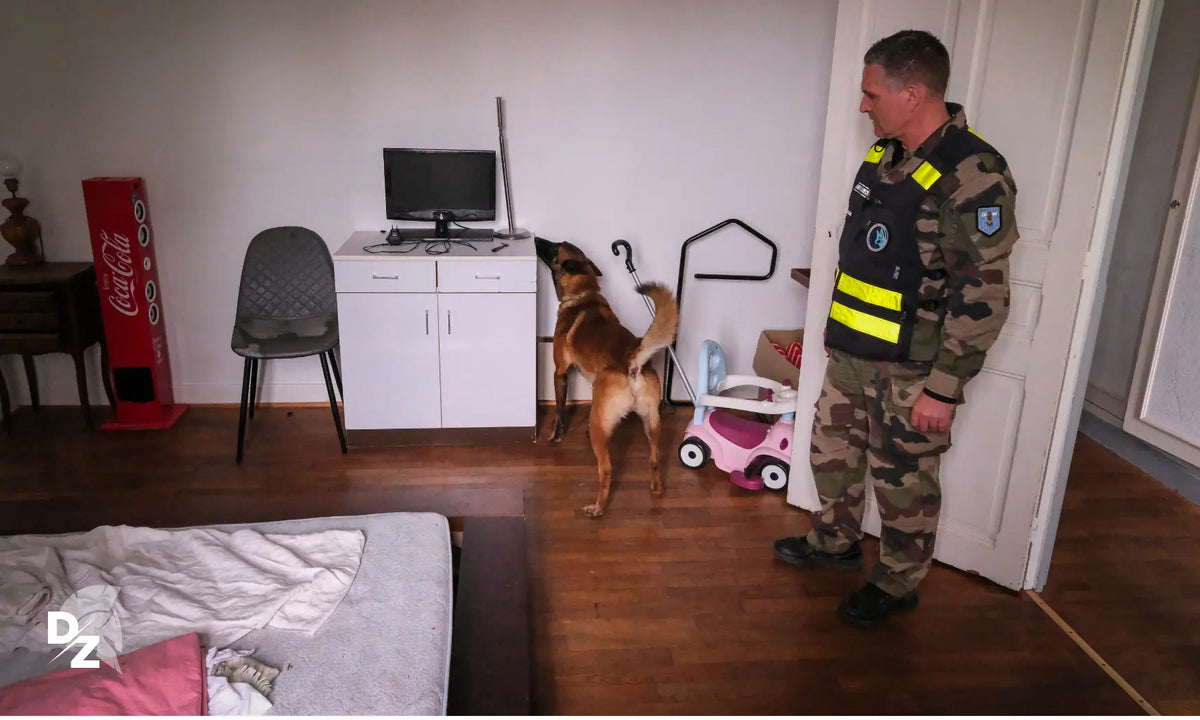
During avalanche victim searches, the dog team is the first to be deployed. The intervention requires speed, since a buried person survives for 15 to 20 minutes on average. The dog is therefore an essential ally. It is let loose on the search area, while always listening to its handler. When it detects a presence under the snow, it barks and starts to dig at the ground, thereby alerting the rescue teams.
PGHM helicopter crew

The entry requirements to become a Gendarmerie helicopter pilot are very demanding. Pilots are recruited from among gendarmes after technical and psychometric tests and a medical examination.
Training lasts 22 weeks at the French Army Light Aviation specialisation school (ALAT), located in Dax. At the end, trainees obtain the ALAT 1st level pilot technical certificate, and officers obtain the ALAT pilot observer certificate.
Recruiting former pilots from the armed forces (Army, Air Force, Navy) is also possible.
The mechanics are recruited from among Gendarmerie NCOs and can choose a speciality: electrical equipment, airframes and engines, and electronic equipment.
As with pilots, recruits can be former military personnel from all three services.
The mechanic course lasts around six months in Bourges and leads to the 1st level mechanics technical certificate (C.T. 1 Mécanique).
Alerting the PGHM in the event of an accident
In the event of a mountain accident, whether you are a victim or a witness, the emergency number to call is 112.
For greater speed and efficiency, give the following information:
- Who?: give your name, a means of contact (mobile phone number, radio…), a description of yourself (colour of clothing, number of people…)
- Where?: give your location as precisely as possible (GPS coordinates, name of the massif/route/summit, altitude…)
- What?: briefly explain what happened (nature of the accident, sequence of events…)
- Who is injured?: give the number of victims and their description (sex, age, injuries)
- Additional information?: specify the weather conditions on site (cloud, wind…), any obstacles, or any other information that will help the pilot.