DÉFENSE ZONE

Welcome to Défense Zone, the podcast that covers defence and security issues through interviews with service personnel, members of law enforcement, political figures and entrepreneurs.
The aim of this audio programme, available on all online podcast platforms, is to open the doors of a usually rather secretive world to the general public, in order to prompt reflection on questions that concern us all, whether political, geopolitical, economic or more broadly societal.
This week, Police Commissioner (Commissaire) Sébastien Malzieu introduces the Compagnies Républicaines de Sécurité (CRS), the French National Police units with multiple missions. They are responsible in particular for public order policing, the subject at the heart of the main feature of our latest issue, available here.
Remember to subscribe to this podcast so you don’t miss the next episodes!
Sébastien is currently in his fourth year as deputy zonal director of the Compagnies Républicaines de Sécurité for the Île-de-France region. He has been a police officer in Paris and its suburbs for several decades, mainly in anti-crime and urban problems units. In his post, he oversees 2,500 police officers spread across a dozen companies. He manages the “preparation of CRS units and their deployment at the disposal of the Prefects”, explains the Commissioner, including “those who come from the provinces to reinforce operations in the capital.”
The missions of the Compagnies Républicaines de Sécurité
The 13,646 CRS police officers are best known for public order policing, but their missions are varied. They also handle the policing of events, whether festive or protests, security operations, reinforcement of police stations, particularly in the suburbs, support for the Border Police, the fight against illegal immigration (Calais, port areas, etc.), support for coastal operations with CRS divers and equipment, conventional rescue (lifeguards, mountain rescuers, etc.) and finally the protection of VIPs. CRS 1 is dedicated specifically to this last mission, together with the SDLP, the protection service.
The training to join the CRS
“All police corps are represented within the CRS: administrative, technical and active personnel, that is to say police officers, assistant police officers, gardiens de la paix (constables), police officers of officer rank and police commissioners,” says Sébastien. He adds that every CRS officer is “first and foremost a gardien de la paix”, a status acquired after training common to all. Young recruits leaving police school with a good ranking can apply to be assigned to a company. They then follow the “first-job adaptation module”, an initial specific three-week course during which the constables learn the techniques, resources and equipment made available to them for their future role. Officers joining one of the nine motorway companies in France also take a specific module covering the high-risk environment in which they will work.
Candidates coming from other active directorates who wish to join the Compagnies Républicaines de Sécurité must take a “CRS specialisation course”, lasting three weeks for public order policing and two weeks for motorway units.

Officers also go through a job adaptation period lasting four weeks.
Finally, CRS officers benefit from “rich and well-developed” continuing training, says the Commissioner. “Every officer has 25 days a year of training”, of several types: collective training, annual refresher courses, shooting, manoeuvres, CRS specialisms, etc.
This training takes place at the Central Training Directorate of the French National Police, but also within the CRS’s own facilities, because of their specific features, which do not concern the other directorates.
Candidates must show “discipline, courage, rigour, a spirit of camaraderie and professionalism”, lists Sébastien. Especially for public order policing, which involves “a particular way of life”, officers must be “able to travel constantly”, as a company is on the move around 200 days a year.
Managing the risks of the CRS job
The deputy zonal director explains that “it is in the DNA of the CRS to be committed on every front where there is a potential, and often real, risk.”
Physical risks
The CRS take over from police stations and departmental public security directorates when major violence is expected during public order operations. They are also found in other extreme situations where there is danger, on motorways or in the mountains, for example.

For Sébastien, these risks can be overcome thanks to “cohesion, solidarity and the group effect”. He also highlights the advantage of having “command permanently integrated within the ranks”, with ranking officers in contact with personnel in the field.
The operational first aid system
This system is inspired by first aid operations carried out by the armed forces and has been adapted for the CRS. Each company has among its personnel two level 2 SOCs (CRS operational first aiders) able to rescue and stabilise casualties. Integrated into operations, they can step in quickly to triage victims, assess the severity of their injuries and provide assistance “to CRS personnel but also to civilians, demonstrators and victims of all kinds”, the Commissioner explains. Most of the time, the injuries are minor; however, officers can be hit by projectiles during public order operations.

This system has existed since 2012 and is part of the annual training followed by officers of the Compagnies Républicaines de Sécurité. It has taken on its full meaning since the terrorist attacks, says Sébastien: “In a situation with many casualties, we can provide firefighters or SAMU (emergency medical service) doctors with a large amount of equipment to treat life-threatening emergencies in a degraded environment. In every company, these operational first aiders are capable of extracting victims under fire.”
Developing equipment
Equipment is adapted and improved over the years: stronger helmets, flame-retardant fabric, the most effective possible compromise between mobility and protection, etc. “There is a constant drive to develop new equipment, new doctrines or procedures. At the CRS Central Directorate we even have a foresight and tactical thinking office.” Every operation, whether public order, road, mountain or sea, systematically undergoes a RETEX (lessons-learned review). This analysis makes it possible to reassess techniques, manoeuvres, the use of resources and how they are made available. Officers do not hesitate to cooperate internationally to exchange know-how.

Psychological risks
An operational psychological support service is deployed for every difficult intervention, “not necessarily violent”, Sébastien points out, “but where there may be a psychological impact, particularly deaths, or which may bring back bad memories.” It is systematically activated for motorway units, which deal with many road accidents, often involving seriously injured people.
This service is also offered to officers’ families, who can be indirectly affected by a difficult situation experienced by the officer.
The legal framework for public order policing
Like equipment, the legal framework for law enforcement is also evolving, as you can discover in detail in our latest magazine. The CRS must therefore adapt their ways of operating and acting to the framework imposed on them by law. “Sometimes we’d like to be able to do lots of things that we can’t do,” says the Commissioner, “but that doesn’t pose any major difficulties, because adapting is the very nature of a service of a democratic state. The key is to know this framework and the possibilities we have, so that we can then use the resources, manoeuvres and techniques to take part in public order operations. The aim is for demonstrations to go as smoothly as possible, by protecting citizens who are demonstrating normally, by allowing them to exercise their freedom to demonstrate, and by acting firmly against the perpetrators of serious violence against demonstrators or law enforcement.”

A CRS officer’s salary
The salary of a police officer in the Compagnies Républicaines de Sécurité is around €1,800 a month at the start of a career. However, daily allowances of €40 a day are added when on deployment, and overtime is also counted and paid. Pay can therefore rise quickly, which attracts some officers. “Others are attracted by the way of life,” adds Sébastien, “others again by this collective life, or simply by the very rich missions, but also by the opportunities for promotion or the specialisms.”

Note that, unlike gendarmes, who sometimes live with their families in barracks or in housing provided for them, CRS officers are civilian personnel and must find their own housing. There is no specific financial aid, but a social assistance scheme exists within the French National Police. It can be called on from the moment officers leave police school, or in the event of a separation, for example.
Advice for a young person who wants to join the CRS
Commissioner Sébastien recommends getting in direct contact with officers in the companies to better understand their missions, talk with them and let them pass on their passion for the job.
To secondary school and university students, his first advice is to pass their baccalauréat or degree, so that they can then pass the entrance exam (gardien de la paix, officer, police commissioner, administrative staff, etc.)

Finally, he points out that certain qualities are essential for this job: “wanting to be useful, wanting to serve, being rigorous and professional, and having discipline.” Sébastien places particular emphasis on this last value, which is fundamental during operations: “Resistance to shocks and resilience come from the fact that personnel are trained, supervised and disciplined. It is in those difficult moments, when personnel are targeted, hit by projectiles or incendiary devices, that discipline matters. Because it is through restraint and the moderate, graduated use of force that the CRS are at their most useful.”
Read our full feature on public order policing in Défense Zone Issue 4 by following this link
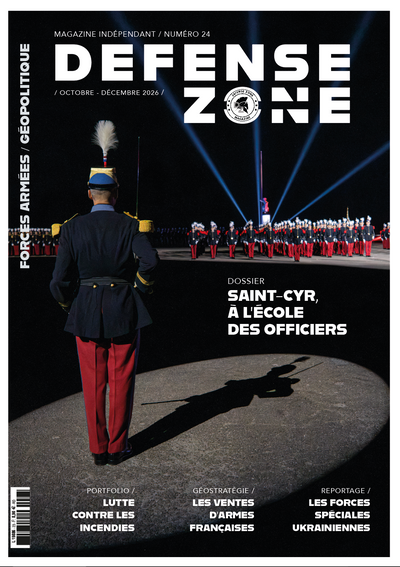
To subscribe to our magazine, receive the print issues, access exclusive content and take advantage of equipment and gear offers from our partners, just click on the image below