DÉFENSE ZONE
Welcome to Défense Zone, the podcast that covers defence and security issues through interviews with service personnel, members of law enforcement, political figures and entrepreneurs.
The aim of this audio programme, available on all online podcast platforms, is to open the doors of a usually rather secretive world to the general public, in order to prompt reflection on questions that concern us all, whether political, geopolitical, economic or more broadly societal.
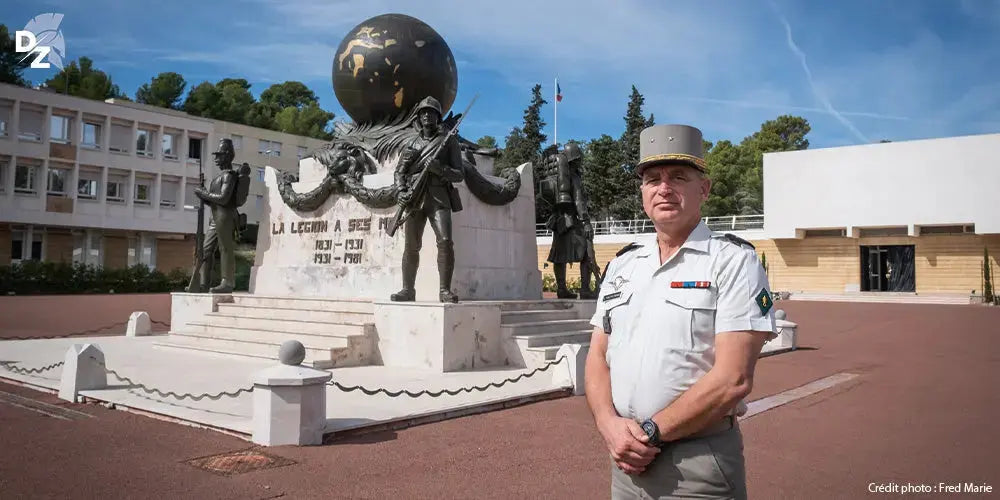
In this podcast we take you to Aubagne, to the home of the French Foreign Legion, to meet the brand-new commander of this legendary French Army institution: General Cyrille Youchtchenko.
Introduction
Could you introduce yourself?
I am General Cyrille Youchtchenko, brigadier general. I have commanded the French Foreign Legion since 1 August 2023. I am starting my 35th year of service. I am a graduate of the École de Guerre (War College) and the NATO Defense College. I hold a master’s degree in defence and security. During my career, I have held various posts: in units of the French Foreign Legion and in human resources on the staff. I have spent a third of my career at school, as a student, a trainee or an instructor.

Memories and particularities of overseas operations
I was in the Central African Republic in 2007–2008 and in Afghanistan in 2009–2010, both times as chief of operations. There were many lessons. If I had to pick three things, beyond the fighting and the organisation of the chief of operations’ work, they would be:
_ Accepting death. I find that in the schools, leaders are not prepared enough to contemplate the loss of human life during an operation. So there is important work to be done on accepting this risk and knowing when to say stop.
_ Managing doctors: where should the doctor be placed within the whole manoeuvre to be best able to help the wounded? If I have no doctor, what is the place of medical orderlies and nurses during a heliborne operation, and how should the extraction on foot of a platoon in difficulty be planned?
_ Managing journalists, who always want to be as close as possible to the fighting. As leaders, we must both ensure their safety and allow them to see what they want, which requires good coordination between the rear base and the front.

The choice to become an officer in the French Foreign Legion
Originally, it was a dream, which gradually came true: first by sitting, after a few years of preparation, the Saint-Cyr entrance exam, then by choosing the infantry, and finally by having the opportunity to serve in the French Foreign Legion. It was a dream that came true, then a discovery, and finally an unshakeable love for these men who gave up everything to join a country that was not theirs, but which they want to serve, sometimes to the point of sacrifice. Even after some thirty years in the Legion, you discover it every day, because every legionnaire has his own story. It is an eternal rediscovery, and you have to hold on to all the fine stories and never be disappointed by the one who falters.
The French Foreign Legion
A discreet but welcoming institution
I think legionnaires are rather protective of their privacy and their internal history. They do not really want to show off their feelings or their daily lives. They are very proud, for example, on Camerone Day, to open the Legion’s doors, or to march down the Champs-Élysées in Paris. For the rest, they prefer to keep their privacy. However, every time I have welcomed outsiders or journalists into a unit or on operations, once trust has been established after a period of observation, legionnaires open up easily. But it is always a question of trust: if it is not established, the legionnaire will close up. If people are natural, competent and straightforward, everything goes very well. The proof is the journalist we hosted for five weeks in Afghanistan: it took him a few days to be accepted, and then he became one of us.

What does the Legion mean to you?
The Legion is 9,000 men who, at some point, decided to join a system in the service of France. They are above all volunteers who agreed to swear loyalty to the French Foreign Legion, and therefore to France, by respecting a certain number of rules. They accepted strict discipline in exchange for a certain humanity. They agreed to better themselves through effort, to speak French and, ultimately, to form a body of seasoned, hardy, solid fighters that advances inexorably and, I think, is capable of great things, provided their leaders show them the way.

There are 9,000 reasons why a man enlists in the French Foreign Legion. What all these stories have in common is a crack, whatever it may be: political, legal, family, parental… There is a crack at some point in their lives. To give themselves a second chance, they volunteer to come to the Legion. Sometimes, some heal this crack after 5, 8 or 25 years, or never.
Can a legionnaire become French after five years of service?
That is correct: after five years of service, a legionnaire can apply for French nationality, provided he has obtained the Certificate of Good Conduct, which we call the CBC. This CBC allows him to submit a naturalisation application and become French. There is one exception to this rule: since 1999, the so-called “by spilt blood” (par le sang versé) law provides that any legionnaire who has previously expressed the wish, if wounded or killed in combat, automatically becomes French. Since this change in the law, many applications have been submitted. I do not have the exact figure, but it is a regular process.

Personally, I believe that once someone embraces the values of the Republic, adheres to a system and betters himself through effort, he deserves to be French. So, without any hesitation, I sign his certificate of good conduct, and he can submit his naturalisation application. For the rest, it is not for me to judge. In any case, the legionnaires who are naturalised have well and truly earned it.
Has the Legion changed?
Of course. The Legion, created on 9 March 1831 by an ordinance of Louis-Philippe, has evolved since then. It has adapted, because it does not control its recruitment. It takes in volunteers from every country and necessarily adapts to the language skills of these volunteers, who were Spanish-speaking, Latin, German, English-speaking, French-speaking or Slavic at one time or another, and who today are shifting somewhat towards recruitment in Asia and South America. What drives these language groups is not the same as for Westerners. So the Legion is constantly adapting to its recruitment. That said, it has a certain number of fundamentals written into the law and into the status of serving under a foreign identity (statut à titre étranger), and these rules change only at the margins. They remain guides for these volunteers who, during the first five years of their military life, have little freedom, until they are integrated and become leaders for the nation. That is to say, at the end of their first contract, or during it for the best, they can become NCOs. At that point, the rules are relaxed: they can marry, have a car, live outside the barracks. Otherwise, legionnaires serving their first contract live in barracks, do not marry and do not have a car. NCOs wear the black kepi, and it is when they receive their stripes that they give up the white kepi, dearly won and worn for a few years, for the black kepi.
How do you explain this unique French success?
Well, I have a rather personal interpretation of this. For me, it is the French style of command, what is taught in the various officer and NCO training schools, that makes it work. It is a happy medium between demandingness and benevolence, even if the term is a little overused today. Let us say demands and humanity, which means that you can ask the impossible of a man as long as you respect his human nature. Well, that is my deep conviction, since many have tried to copy the French Foreign Legion and few have succeeded. So I think it is closely linked to the French style of command.

What proportion of the Legion is French?
In the Legion, the law provides for the enlistment of foreigners under French command. So the vast majority of officers are French. For legionnaires, we enlist only foreigners. If a French person happens to turn up at the doors of a recruitment centre, we say that he serves under a foreign identity (à titre étranger), since I am not allowed to enlist French people in the French Foreign Legion. A French person can come to the Legion, but in that case he will be given a declared identity other than French. After that, the path is the same for him, as long as he serves under a foreign identity. That is why the notion of foreign identity is important to us, since we have a force made up of foreigners. Attracting French speakers is a recruitment objective, because with 147 different nationalities, the cement of cohesion is language. In the Legion there is only one language: French. So the method for teaching French is repetition, and banning foreign languages. You need a certain proportion of French speakers so that each one becomes a little French teacher for each of his foreign comrades. Normally, it is the officers’ role to ensure that only French is spoken in the ranks of the Legion.

During their training, on the farms, they learn between 400 and 500 words, which allows them to understand and carry out a simple order, express a clear thought and get by in the street. It is a method specific to the Legion, based on repetition and demonstration, above all visual. It works well; we have a legionnaire language specific to the Legion. When you leave the Legion to work on the staff as a French officer, there is a short period of adjustment to understand the expressions. But when you see a South Korean say “Davaï”, you know it works.
Recruitment and careers in the Legion
Does France’s withdrawal from certain conflict zones affect recruitment?
To answer your question clearly: in the short term, no, it is not a problem. However, it is possible that in the medium term it may lead to lower recruitment, but personally I doubt it. Retention in the French Foreign Legion has always been a concern. The first writings I have seen date from 1980, when the general commanding the Legion at the time issued a note giving a number of keys to keep and attract legionnaires. So it is a constant concern. The Legion has always trained hard and has always sought out the field, activities, exercises and sporting challenges. If tomorrow we are less present in Africa or elsewhere and a little more in mainland France, we will still go to the training camps and we will train. I do not think it will penalise us. No one can predict the future, and my generation, which joined the army in 1989, could not foresee the fall of the Berlin Wall. Since the Gulf War, we have not stopped carrying out operations. Unfortunately, the world’s upheavals mean that there will be other operations, perhaps not in Africa, but elsewhere. So we must be ready to wage tomorrow’s war, and we train for that.
Why does the Legion attract so many young officers?
Officer recruitment in the French Foreign Legion fluctuates according to deployments, the aura of the leaders and instructors, and the publicity it gets or does not get. Sometimes we get the top graduates, sometimes not, but the essential thing is that an officer who comes to the French Foreign Legion will be trained throughout his career. Normally, we manage to produce very high-calibre captains. What advice can I give him? I know, having commanded the Infantry School, that lieutenants are very well trained in technique and tactics. If he comes to the Legion, he will be appreciated for this technical and tactical knowledge, and from the outset he will be considered competent, even very competent. His NCOs will trust him because he has the knowledge. If he is physically fit, if he is natural and therefore technically very competent, he will have no trouble asserting himself. And if he is humane, he will be an excellent platoon leader.

What human qualities are needed to be a good leader in the French Foreign Legion?
In fact, not only in the French Foreign Legion; I think that, as a general rule, in all units it is essential for the leader to be physically competent and natural. Then he must know all his men intimately in order to bring out the best in them, trust them, lift them up, and above all he must constantly care about their training, help them progress and map out a career path for them. That way they always know where they stand. We must not forget that sometimes, when something is not done well, you have to say so. So punishment is also part of instruction. When it is good, you say so, but when it is bad, you say so too. You have to have the courage to say it. Courage, in peacetime, is being able to tell a man to his face that he is not good, but also to tell him that he has done things well.
How do foreigners see the Legion?
When I met General McChrystal in Afghanistan, he thought we were all two metres tall with bulging muscles. He was surprised to see that the officers were of normal height. So I replied that the muscles were not necessarily in the arms, and that it was above all the brain that got things done. So we have an aura that comes from legends and films, about the selection, the training in Castelnaudary and the equatorial forest training centre in French Guiana, which are something of a rite of passage. So we have an aura, we are considered apart and, in fact, extremely respected. There is also an image of the legionnaire as an ex-convict, someone a little frightening; it is the mythology or legend that persists over the years, despite all the reports we see. This semi-legend persists, and a single news story is enough to revive this legend or myth. And I think that, unconsciously, the Legion lets people talk; it is also a good means of communication. Perhaps it reinforces the mystery, and it is indeed also a communication tool, even if this legend is, in the end, just a legend.
The end of the legionnaire’s contract
The vast majority of legionnaires, once their first contract is over, go home to find their family or start a new one. We have resettlement schemes similar to those of the French Army, slightly adapted, to help our legionnaires. They can apply for a job as soon as they have a residence permit. For those who do not adapt, either we re-enlist them, which is entirely possible, or we have a solidarity scheme to take them in at various homes, depending on their income, their health or their psychological state. These homes, run by officers or former Legion officials, take in legionnaires regardless of means, provided they have served the Legion and hold a certificate of good conduct. We also have a kind of retirement home for legionnaires, where they can stay according to their means. It is an internal system of mutual aid and solidarity for those who, despite all the schemes in place, cannot find work again.
The role of the “Père Légion” (Father of the Legion)
What are your missions?
My first mission is to recruit foreigners so that my units are at full strength and I contribute to the recruitment effort required by the French Army for 2024 and 2025. That is the first challenge: the recruitment challenge. The second challenge is to adapt the French Foreign Legion to the various transformations the French Army is undertaking, and to be a source of proposals so as never to lag behind these changes. The third challenge is respect for the foreign identity status, that is, keeping the Legion alive with its own rules. And finally, the fourth challenge is outreach, to make the Legion better known, but also because we are part of France, an exception. So we must talk about what works well and what is done well in France with the Legion.
Could you tell us about your experience in Djibouti with the 13e DBLE?
Yes, of course, because it was an extremely intense human, professional and family experience. When I was appointed to command this regiment, I imagined it would last two years. And during the year, the staff asked me to bring the regiment back to mainland France before its redeployment to Abu Dhabi. From then on, my concern was to maintain the unit’s cohesion at all costs and to carry out this repatriation in good order. I was very fortunate that everyone embraced the various projects I proposed to them, and that the regiment remained united until its return to mainland France, living through great moments, whether the Camerone celebrations, major infrastructure projects, sporting challenges or even alerts, since at the time there was talk of us going to evacuate people from Yemen, as Yemen was in crisis. So, in fact, right up until boarding the plane back to mainland France, the regiment remained operational and united behind its commander. That is why it remains an extraordinary human and professional experience. And as I was lucky enough to have my family with me at the time, with all my children, we lived through it all together, and it remains a great moment in our family adventure. Today, in fact, all these efforts have been rewarded. Today, the 13th Demi-Brigade of the Foreign Legion (13e DBLE) is 1,300 men based in a magnificent brand-new barracks on the Larzac plateau. And ultimately, I tell myself that this repatriation in good order and discipline may have weighed in the decision to choose the 13th to be deployed there. So it is a source of great joy.

The link with civil society
The Legion has always maintained very close relations with its close friends, town halls and local businesses, and enjoys many friends and benefactors. The latter, while doing business, also provide many services. So it is a constant concern for us to maintain and build excellent relations within the local community with the political authorities, local elected officials, businesses and even journalists.
How are you preparing your first Camerone as commander of the French Foreign Legion?
Indeed, Camerone, which commemorates the battle of 30 April 1863 in Mexico, has become the Legion’s day. Here in Aubagne, in front of the war memorial along the Sacred Way, it is a highly emotional event. It is the day on which every legionnaire renews his oath to serve France with honour and fidelity. It is also the time to remember the Legion’s 41,000 dead, who, by dying for a country that was not theirs, become immortal, since their memory is kept alive throughout the year by legionnaires. This year, I will not reveal the theme of the year to you, as it is still being discussed with my staff. We will choose a theme that will prepare the whole build-up to the Camerone festivities. On that day, we will honour one or more legionnaires who have been particularly deserving at some point in their lives. They will be honoured by carrying the hand of Captain Danjou, which symbolises the oath to serve with honour and fidelity, up the Sacred Way. It will be a grandiose ceremony that will always be sacred, because in the Legion we like both grandeur and the sacred. We will thus pay tribute to a great moment in the history of the Legion.

Find out more
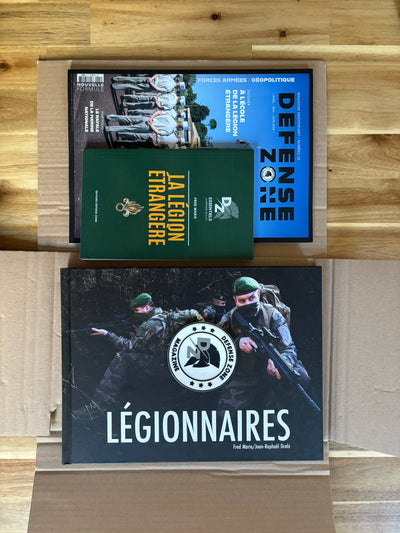
Follow the training of young legionnaires all the way to their deployment on overseas operations in our photo book. You can order it directly on our website.
Find all our articles on the French Foreign Legion on our website. You can also subscribe to our Premium area to receive our very latest issue, whose feature is devoted to the elite units of the internal security forces, access exclusive content and take advantage of equipment and gear offers from our partners. Head to the Premium section.

Read more: General Youchtchenko, the new “Père Légion” (Father of the Legion)