DÉFENSE ZONE
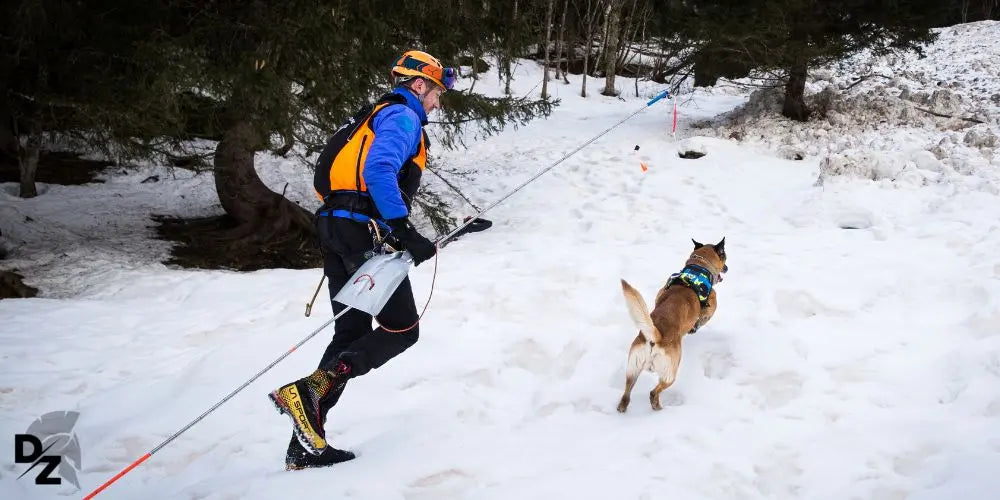
Every year, more than thirty people fall victim to avalanches. In this type of accident, where the chances of survival fall rapidly as time passes, every minute counts. Dogs, whose sense of smell is 15 times more developed than that of humans, are an undeniable asset, used for centuries in mountain rescue, and more recently in the particular case of avalanches. Today, nearly 150 dog teams specialise in this discipline, whether gendarmes, firefighters or civilians.
History of mountain rescue dogs
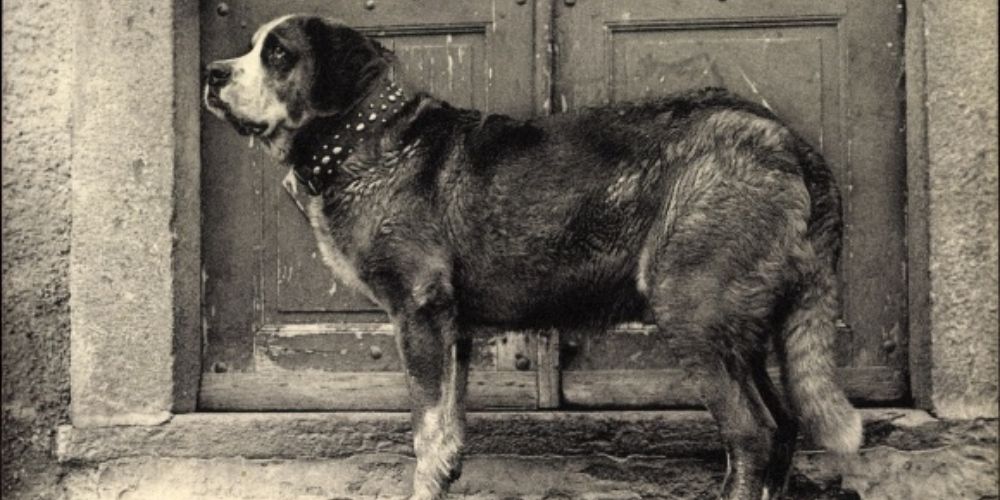
Barry, an Alpine spaniel (the forerunner breed of the Saint Bernard), is the first known mountain rescue dog. Born in 1800 at the Great St Bernard Hospice, between Switzerland and Italy, he saved 40 people during his career. One legend says that one day he saved a half-frozen child by carrying him on his back. Another claims that Barry was shot by a soldier lost in the middle of a storm, who mistook his rescuer for a wolf. This legend is false, however, since we know for certain that Barry retired at the age of 12 and ended his days in the Swiss capital, where he died two years later. His stuffed body now holds pride of place in the Natural History Museum of Bern, in tribute to the work and courage of rescue dogs. But the legend lives on, as shown by the inscription on the memorial dedicated to him at the entrance to the dog cemetery near Paris: “He saved the lives of 40 people… he was killed by the 41st!”
Another emblematic dog is Mohrele, who in 1960 found the body of a priest who had been buried under an avalanche for a year. This case demonstrated the value of training avalanche dogs.
The biggest development in this field remains the tragic accident at Val d’Isère. In 1970, an avalanche engulfed a large chalet and caused the deaths of 39 people. During the same winter, other deadly accidents were recorded, prompting the setting up of a commission to study mountain safety. On 11 October 1971, the National Association for the Study of Snow and Avalanches (ANENA) was created. Among other things, it issues the certification that allows dog handlers and dogs to be employed.
Dog breeds
Like any working dog, an avalanche dog must be playful, because training is based on play and the dog’s desire to search in order to obtain its reward. It must also have good physical abilities, particularly endurance. The avalanche dog must also be sociable, as it may come into contact with the public or other rescuers. Finally, it must be able to show concentration so as not to be distracted by the other people present, the helicopter, machinery, etc.
Among the breeds favoured for this speciality are the German Shepherd and the Belgian Shepherd, in particular the Malinois, breeds often used in other specialities (bite work, defence, search, etc.) for their excellent aptitudes. But an avalanche dog can also be a Border Collie, a Labrador, a White Swiss Shepherd, a Beauceron, etc. However, contrary to popular belief, the Saint Bernard is no longer favoured for this type of mission, as it is too heavy for helicopter winch operations.
Who is responsible for avalanche rescue?
The use of avalanche dogs and their handlers is governed by the departmental mountain rescue plan. Depending on the location, this involves the gendarmerie (PGM/PGHM: gendarmerie mountain/high-mountain platoon), the police (mountain CRS) and/or the firefighters (firefighters’ mountain group, sometimes the hazardous-environment intervention group). Read our web article on mountain rescue, or explore the subject in the pages of our issue 5, illustrated with photos taken embedded with the Chamonix teams.
As for rescue in the event of an avalanche more specifically, responsibility varies according to the geographical zone. Under a municipal rescue organisation plan for the ski area, this type of site is the responsibility of the mayor, who delegates it to the director of the ski patrol service by municipal order. The ski resort must therefore employ, among others, avalanche dog handlers. These are civilians who own their own dogs and come under the department. They therefore operate within the ski area; however, state services may be called in as reinforcements only in the event of a serious alert or major incident.

Mountain areas are the responsibility of the State, as it has greater human and material resources than the mayor. The Prefect implements the departmental mountain rescue plan and calls in specialised units. When infrastructure is not affected (forest, etc.), the gendarmes are in charge of rescue operations.

On the other hand, firefighters are called in when the avalanche hits an urban area (road, building, etc.)
Training avalanche teams
There are two routes to becoming an avalanche dog handler, depending on the corps to which the handler belongs. The dog’s training, for its part, varies slightly but is based on the same methods.
Training gendarme avalanche dog handlers
To enter this speciality, candidates must have completed a year at a gendarmerie non-commissioned officer school, at the end of which they choose their posting (brigade, squadron, etc.). They can volunteer after two years of service, if they are under 35, medically fit and hold their technical aptitude certificate. As they will operate in the mountains in the same way as PGM/PGHM rescuers, they too must hold the Certificat élémentaire montagne (CEM, basic mountain certificate), the Diplôme de qualification technique montagne (DQTM, mountain technical qualification diploma) and the Brevet de spécialiste montagne (BSM, mountain specialist certificate). All these qualifications are detailed in our article on the PGHM.
If all these conditions are met, the gendarme takes the selection tests at the Gendarmerie National Dog Training Centre (CNICG) in Gramat (Lot): an eight-kilometre course in combat fatigues and boots, then a 100 m run with a 30 kg weighted pack, first alone and then a second time with a dog on a lead. If selected, they go on to 14 weeks of initial training, again at the CNICG, during which the instructors assign them a dog, trying to match the personalities of the two members of the future team.

At the end of this training, the dog handler is qualified for “tracking”. A year later, the dog team completes a three-week initial course in Chamonix, at the National Mountaineering and Ski Training Centre (CNEAS). This centre belongs to the mountain CRS, but resources are shared between the police and the gendarmerie. Once qualified, the team is operational for its rescue missions.
Every year, however, it must undergo refresher training so that its skills can be checked.

Training firefighter or civilian avalanche dog handlers
Firefighters and civilians wishing to acquire this speciality must obtain the national avalanche dog handler certificate. This qualification is issued by ANENA (the National Association for the Study of Snow and Avalanches), the only body approved by the Directorate of Defence and Civil Protection.
The certificate is open to mountain professionals (ski patrollers, ski-lift staff, ski instructors, hut wardens, etc.) and to firefighters. Candidates must:
- complete a pre-training course
- hold the PSE1 and PSE2 (team first aid levels 1 and 2)
- own a male dog aged 1 to 4 years, with up-to-date vaccinations
- have a medical certificate of fitness to practise mountain rescue
Admission to the course is based on an application file, and candidates must receive four favourable opinions: from the SIDPC (interministerial defence and civil protection service), their employer, the vet and an ANENA trainer.
The pre-training course lasts 40 hours and costs €550. The training at the end of which candidates attempt to obtain their certificate lasts 88 hours spread over eleven days and costs €2,400. It includes theory (avalanche pack equipment, movement, types of avalanche, etc.) and of course practice (ski touring with skins with the dog, search exercises, etc.).
Once certified, the dog handler must still complete five annual refresher exercises.

Training the avalanche dog
A puppy destined for rescue work can begin some exercises from the age of three months. Its handler can, for example, develop its scent repertoire by having it smell many different odours, or get it used to its future environment (crowds, vehicles, helicopters, etc.). Learning obedience is also important, as the dog will often work autonomously, off the lead, and must therefore listen perfectly to its handler. The gendarmerie trains its dogs at the CNICG in Gramat and then assigns them to gendarme dog handlers. Firefighters and civilian dog handlers, for their part, must pass a 15-day certification course delivered by ANENA with their dog. To take part in this course, the dog must be at least 15 months old.
The dog’s training is always based on play. Its objective is to find its toy (usually a fabric tug it can easily grab in its mouth), which is held by a person simulating a victim. At first, the puppy can see its toy, then the exercise becomes more complex as its training progresses. By the end of its training, the dog is able to detect a human scent buried up to four metres deep under the snow. It also learns to ignore distracting scents (plants, buildings, food, other humans, etc.)

How an avalanche exercise works
The procedure is much the same whatever the dog handler (gendarme, firefighter or civilian). A hole is dug in the snow on the training ground, into which a volunteer “victim” slips, taking the dog’s toy with them.

The hole is then covered over and closed with blocks of snow and/or fresh snow. The dog handler waits at least ten minutes or so before starting the exercise, so that the scents disperse a little. Meanwhile, they let their dog relax, notably to relieve itself, so that the dog is focused during the work phase. Before intervening, in a real case or an advanced exercise, the dog handler must gather information, particularly about the sector and any witness accounts, and find out whether victims have already been found (and may have left a hot spot to which the dog could react), etc. The team then positions itself at the edge of the area and the dog is harnessed (it is often conditioned to associate the harness with work), then released to work autonomously over the search area.

On its own, it can sweep a sector six times faster than a person. If necessary, the dog handler can direct their four-legged teammate to an area to (re)check. As soon as the dog detects a scent, it barks and starts digging with its paws, then backed up by its handler with a shovel.

The dog goes all the way to the “victim” to grab its toy and pull the victim out of the hole.

It then receives its reward by playing with the “victim”.
You can subscribe to our magazine and receive our latest issue, access exclusive content and benefit from equipment offers from our partners.