DÉFENSE ZONE

The Marseille Naval Fire Battalion (BMPM, Bataillon de marins-pompiers de Marseille) is a French Navy unit created in 1939. It has 2,400 men and women and carries out an average of 122,000 interventions a year. It is still the only military unit placed directly under the orders of the city’s mayor.
History of the Marseille Naval Fire Battalion
The history of the firefighters of the Phocaean city goes back to the Middle Ages. It was not until the Second Restoration, on 25 September 1815, that the fire company of the Marseille National Guard was formed. The city had to wait until 1883 to acquire a company of 85 men.
The creation of the BMPM
The Marseille Naval Fire Battalion (BMPM) was created by decree-law on 29 July 1939. It was a decision by the then President of the Council, Édouard Daladier, following the fire at the Nouvelles Galeries department store on 28 October 1938.

That day, a very large fire mobilised reinforcements from all over France, including the Toulon naval fire company. The Nouvelles Galeries was completely destroyed, the fire spread to neighbouring buildings and 73 people died.
The fire also reached the Hôtel Noailles, where members of the government were gathered. On that 28 October, the Radical Party congress was being held in Marseille, and Édouard Daladier was present. The fire led to Marseille being placed under State supervision.
The BMPM’s involvement in the Resistance
During the Second World War, the BMPM carried out significant Resistance activity on top of its missions, which earned it a citation in the orders of the French Navy after the Liberation.
Several naval firefighters played a role in the fight against the German occupier: intelligence passed to the Allies, sabotage to disrupt the enemy… The Marseille naval firefighters also took part in the fighting to liberate the city.

In 1982, the battalion received the French Navy’s 8th colour, in
recognition of the quality of the services rendered and the dedication of its personnel. The motto of the Marseille naval firefighters is the same as that of the French Navy: “Honneur, Patrie, Valeur, Discipline” (Honour, Homeland, Valour, Discipline).
The evolution of the BMPM’s missions
Since its creation, the BMPM’s missions have evolved in line with the city’s demographic and economic development and its urban planning. Since 1962 it has been responsible for fire protection at Marseille-Provence International Airport, at La Timone Hospital since 1976 and at the Hôpital Nord since 1980. Since 1978, in partnership with the SNSM (the French sea rescue society), the battalion has crewed the sea rescue launch “La Bonne Mère de Marseille”. In 1990, it was granted half of the Mobile Emergency and Resuscitation Service (SMUR) of the Marseille hospitals. The civil protection modernisation act of 13 August 2004 gives the BMPM all the prerogatives of a departmental fire and rescue service (SDIS) within its territorial area of responsibility.

Command of the BMPM
The BMPM is a French Navy unit. For operational employment it is placed under the direction of the Mayor of Marseille, and it is almost entirely funded by the City of Marseille (personnel and equipment). The BMPM is the only French military unit directly under the orders of a mayor.
The battalion is commanded by a Navy flag officer who is director of fire and rescue services for the City of Marseille and Navy commander in Marseille (COMAR Marseille). Rear Admiral Patrick Augier has commanded the BMPM since 1 October 2019.

Like the other departmental fire services, the battalion also comes under the Ministry of the Interior and the Directorate General for Civil Protection and Crisis Management (DGSCGC) for operational matters outside Marseille.
Strength and missions of the Marseille Naval Fire Battalion
The BMPM is made up of 2,400 men and women, including around a hundred civilians. They are spread across 28 sites, including 17 fire and rescue centres, so that the naval firefighters can reach any point in their area of responsibility in under ten minutes.
Every year, the BMPM carries out an average of 122,000 interventions (more than 300 a day). Rescue and assistance to people accounts for 81% of missions; the rest consists of firefighting and various other interventions.

The battalion’s missions are the prevention and protection of people, property and the environment within the City of Marseille, the Grand Port Maritime de Marseille, Marseille-Provence Airport and the Calanques National Park. That is an area of 240 km² (including 12,000 ha of woodland) and 847,000 inhabitants. Marseille thus faces almost all the risks listed by the Civil Protection service: urban, maritime, industrial and natural risks, with the exception of avalanches.
The BMPM also takes part in SMUR activities and in the medical regulation of calls to 15 (with SAMU doctors and private doctors), under an agreement with the APHM (the Marseille public hospitals authority).
The battalion also operates outside French territory (see the section “Operations outside France”).
Organisation of the Marseille Naval Fire Battalion
The battalion comprises: 17 fire and rescue centres (CIS) divided into two groups; a technical centre; and a medical centre, home to the BMPM SMUR and the unit medical service (SMU).
It is equipped with 450 emergency vehicles, 16 watercraft including France’s only fireboat, and two water-bombing helicopters available during the summer. Each CIS has an ambulance (Victim Rescue Vehicle) and an urban firefighting appliance (Fire Engine).

Personnel and operational resources are distributed according to the risks identified in the different zones of the Marseille area. This geographical organisation is frequently reassessed and adapted.
Two groups
Since 2008, the BMPM has been divided into two operational groups. They are placed under the direction of a central headquarters and each is commanded by a senior officer:
- the northern group (Plombières fire station and its CIS)
- the southern group (Saint-Pierre fire station and its CIS)

The headquarters houses the emergency call centre (18 and 112) and operations coordination centre, and the City of Marseille fire and rescue operations centre (COSSIM).
The SOS
All Marseille naval firefighters are trained in casualty rescue and in fighting fires (urban, forest and ship fires). In addition to their operational role, each naval firefighter joins one of the specialised operational sections (SOS).
The SOS were created to deal with the risks inherent to the Marseille area. They are made up of trained and equipped personnel and suitable equipment. The SOS naval firefighters are experts in their field.
The seven SOS are as follows:
- SOS AQUA
- SOS DEPOL
- SOS USAR
- SOS GRIMP
- SOS RT
- SOS HELI
- Technical Intervention Group
SOS AQUA
This SOS specialises in maritime interventions. It carries out civil protection missions along the coast, in harbours, on bodies of water and in the Grand Port Maritime de Marseille, as well as search and rescue missions, etc.
SOS AQUA is made up of 158 naval firefighters, including 36 divers and 12 SAVHELI-qualified rescuers able to operate from a helicopter. It has 13 boats. It carries out an average of 260 interventions a year, particularly in summer.
SOS DEPOL
This SOS specialises in fighting pollution and carries out missions to protect the coastline and sensitive sites (on land, rivers and at sea), recover pollutants, and operate heavy pumping equipment to combat flooding. It can also be called in as reinforcement in the event of a major incident elsewhere in France.

It is made up of 205 naval firefighters specialising in catastrophic flooding and in cleaning up sites contaminated by hydrocarbons. It has specific equipment for recovering and storing pollutants, equipment pods for floods… It carries out around 10 interventions each year.
SOS USAR
The USAR section (Urban Search And Rescue), formerly called the rescue and clearance SOS, carries out missions to search for buried victims, rescue people and secure sites in collapsed or unstable structures; to search for missing persons and deal with animal-related risks thanks to its dog teams; and logistic support missions when deployed outside the department.

SOS USAR has 136 naval firefighters, including six dog teams (dog and handler pairs). It is equipped with a rescue and clearance reconnaissance vehicle (VRSD), a dog team intervention vehicle (VICT), a pod carrier and a rescue and clearance equipment transport vehicle (TMSD).
It carries out around 15 interventions a year. The dog teams carry out an average of 200 interventions each year, mainly searches for lost people and captures of dangerous animals.
SOS GRIMP
The GRIMP section (Groupe de Reconnaissance et d’Intervention en Milieu Périlleux, the hazardous environment reconnaissance and intervention group) carries out rescue and assistance missions for people who are injured, lost or in difficulty when traditional means are unsuitable, for example to evacuate a victim down a building façade or from a ship’s hold, or an injured climber on a rock face in the Calanques.
SOS GRIMP is made up of 80 naval firefighters spread across three fire stations. They are called out an average of 120 times a year.
SOS RT
The SOS RT section (Technological Risks) carries out missions in industrial settings and during the transport of hazardous materials: hazard reconnaissance, rescue and decontamination of victims, and protective measures for the safety of people and the environment. SOS RT also has the equipment and trained personnel to deal with CBRN-E risks (Chemical, Biological, Radiological, Nuclear and Explosive)

It is made up of 120 naval firefighters who carry out around 50 interventions a year. SOS RT comprises a Mobile Chemical Intervention Unit (CMIC), two Mobile Radiological Intervention Units and a mobile laboratory (a detection, identification and sampling vehicle fitted with a mass spectrometer).
SOS HELI
The HELI section (Heliborne Interventions) is organised into heliborne intervention detachments (DIH), which tackle forest fires breaking out in hard-to-reach places, and ship fires requiring a rapid response. The teams can be deployed by fast-roping or winching, techniques used by the GIGN (the Gendarmerie’s elite intervention unit) or the French Navy commandos. The BMPM is the only Civil Protection unit with this authorisation.
It is made up of 110 naval firefighters, divided into groups (sticks) of 11 commandos. It notably uses the City of Marseille’s light water-bombing helicopters and/or the French Navy’s heavy helicopters. It also uses the Heliborne Equipment Transport Vehicle and the basket or aerial hose-reel trailer. The equipment includes, among other things, flexible air-transportable tanks of 500 to 1,200 litres.
Technical Intervention Group
The Technical Intervention Group’s mission is to respond to any accident requiring, for example, extrication or the cutting up of special vehicles; to support forest fire appliance columns as reinforcement outside the department; and to maintain and repair the vehicles of the Marseille Naval Fire Battalion, the urban civil protection service and Marine Marseille.
It is made up of 100 technicians and is called out an average of three times a day. It is equipped with vehicles such as off-road technical assistance vehicles (VAT HR), workshop trucks, crane trucks, pod carriers and semi-trailers.
The UMIMM
The UMIMM (maritime medical intervention unit) is the medical arm of sea rescue, making it possible to send a medical team and equipment on board a ship in distress. This makes it possible to set up an advanced medical post at sea (PMA mer). The UMIMM is thus an air-transportable unit that operates as part of State action at sea (AEM), under the responsibility of the Mediterranean Maritime Prefect.
It is made up of three doctor-nurse pairs, two naval firefighters who drive resuscitation ambulances, and a doctor in charge of the unit. All are emergency specialists trained in disaster medicine and qualified for fast-roping.
The unit is equipped with the French Military Health Service (SSA) “disaster” kit: six bags and 12 cases of medical equipment.
The Health and Medical Rescue Service
The Health and Medical Rescue Service (SSSM), or the battalion’s “health group”, under an agreement with the Marseille public hospitals authority (APHM), helps organise emergency medical care in Marseille, as it takes part in the activities of the mobile emergency medical service (SMUR).

The SSSM reports to the Toulon Regional Directorate of the French Military Health Service. It also fulfils the missions of a unit medical service (SMU). It is headed by a chief medical officer of the French Military Health Service.
The BMPM SMUR carries out the following missions: medicalised interventions, medical support for BMPM personnel on operations, medical regulation at the SAMU 13 call centre, taking part in duty on the Civil Protection helicopter based at Marignane, and taking part in State action at sea within the UMIMM.
The SMU carries out occupational medicine, medical care for the unit’s service personnel, and hygiene and prevention missions.
An SSSM detachment can also carry out assistance missions elsewhere in France and abroad.
The summer and winter regimes
The working pattern of the Marseille naval firefighters adapts to seasonal risks and is made up of two regimes:
- the summer regime, from around 15 June to 15 September: the pace of work is more intense during this period because the “forest fire” risk is added to day-to-day operational activity, which requires more personnel to be mobilised. The working pattern is as follows: 24 hours on duty and 24 hours off, then 24 hours on duty followed by 24 hours on call at home or as reinforcement at the fire station, followed by 48 hours off.
- the winter regime, from around 15 September to 15 June: the “forest fire” risk is much lower during this period. The working pattern is 24 hours on duty followed by 24 hours off, then 24 hours on duty followed by 72 hours off.
The “forest fire” risk and the “ship fire” risk
The BMPM’s geographical situation makes it a unique unit that is particularly exposed to two specific types of fire intervention: fires on ships and fighting the forest fires that surround the city and its region.
The “forest fire” risk
From 15 June to 15 September, the battalion’s operational regime changes because the “forest fire” risk is added. This risk is assessed every day according to the weather.

During this period, in the event of a major risk, up to 150 naval firefighters can be added as reinforcements specifically to fight forest fires. They come on top of the 230 naval firefighters on duty for everyday risks.
Personnel known as DIP (Preventive Intervention Detachment), with 2 CCF (forest fire tankers), can thus be positioned in advance to ensure a permanent presence in the hills and respond quickly in the event of fire. DIH personnel can also intervene on forest fires in hard-to-reach places.
In the event of a major risk, the BMPM can rely on its 43 CCFs and on the resources of the Population Protection Group, the Heavy Intervention Group and the Heliborne Intervention Detachment, as well as on two Water-Bombing Helicopters (HBE) crewed by a pilot and an officer from the battalion.
The “ship fire” risk
All BMPM naval firefighters are trained in ship firefighting. The battalion is the national reference for FDN5-level training and has its own training simulator.

Its trained personnel and specialised resources are spread across its two harbour fire stations.
SOS HELI has a “maritime intervention” capability. A light, multi-purpose intervention team (10 DIH firefighters, two RT firefighters, two medical personnel) can be rapidly deployed on board a burning ship to limit the spread of the fire while waiting for reinforcements.
Operations outside France
The Directorate General for Civil Protection and Crisis Management (DGSCGC) can call on the battalion’s naval firefighters for rescue missions in the event of major disasters anywhere in France or abroad.
BMPM reinforcements were thus sent to Indonesia during the 2004 tsunami, to Haiti during the 2010 earthquake and to Lebanon in August 2020, as well as to the south of France during major floods such as those of 2010, 2011 and 2014, and during the fire in the Réunion national park in 2011.

Recruitment of BMPM naval firefighters
To become a naval firefighter, you must meet certain conditions: be aged between 18 and 25 when joining the naval firefighters’ school, be a French national, have completed the Defence and Citizenship Day, hold a car driving licence, be able to swim and have an education level between the brevet des collèges and three years of higher education. It is also essential to have a good command of French and good scientific knowledge. You also need to be in good physical shape and be ready to become a member of the armed forces.
The first step in recruitment is to go to the nearest Armed Forces Information and Recruitment Centre (CIRFA) to get information from an adviser.
You then need to open an application file and attend a motivation interview to show your commitment and highlight your strengths. This interview is followed by various tests: psychometric tests, fitness tests, a heights test, an interview with a psychologist, a medical examination…
The French Navy then examines the candidate’s file and accepts or rejects it. If the file is approved by the Navy, the candidate can follow the training to become a naval firefighter.
Training of BMPM naval firefighters
Naval firefighters enlist on a four-year contract.
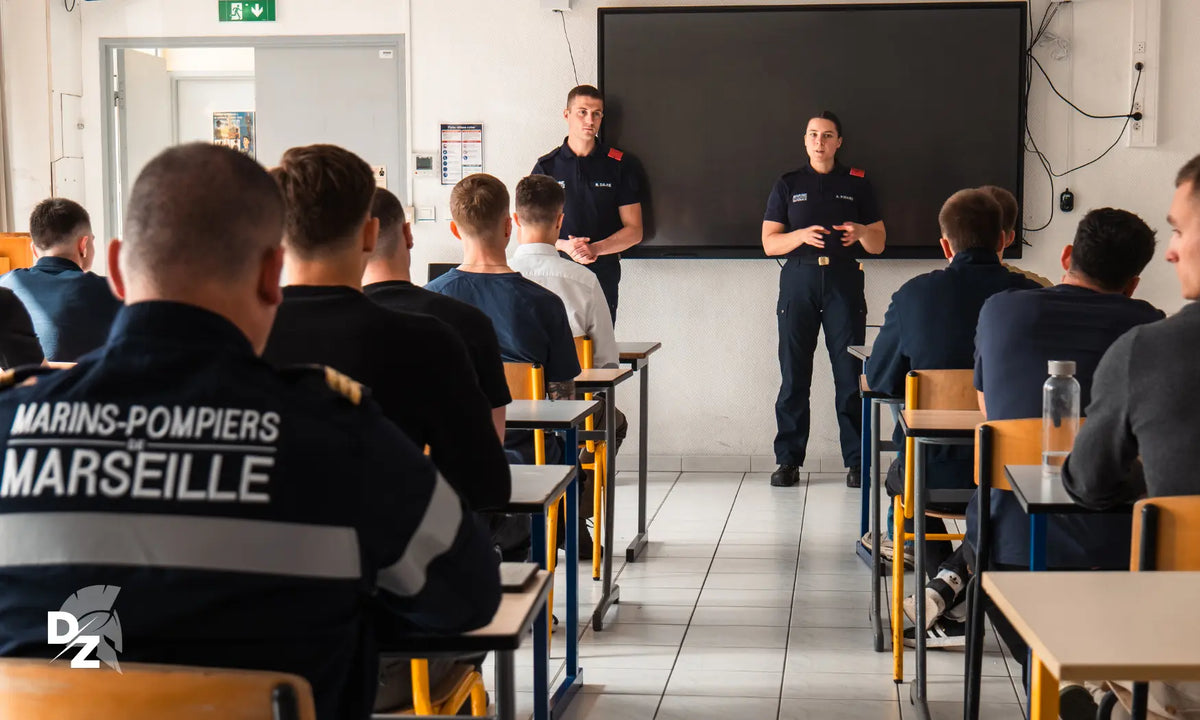
The Navy naval firefighters’ school (EMPM) provides initial and continuing training for the Marseille naval firefighters (MAPOM) and also for those of the French Navy’s naval and naval air bases (MARPO). Initial training takes place at the EMPM’s La Parette site, while continuing training takes place at the La Rose site.
The EMPM is responsible for the theoretical, practical, military and physical training of all naval firefighters, in line with the civil protection framework within a French Navy setting. The school has its own vehicles for practical training and sometimes calls on those of the BMPM.
In 2019, the school trained 507 students, 72% of them MAPOM.
Initial training
This is the entry-level training. To follow initial training, your application must therefore have been selected. But the selection process continues during the first weeks at the EMPM.
Initial training is organised as follows:
- 6 weeks of initial military and maritime training at the Pôle Écoles Méditerranée in Saint-Mandrier, in the Var
- 11 weeks of basic “trade” training at the EMPM’s La Parette site
At the end of these weeks of training, the young crew member is awarded the basic certificate (brevet élémentaire) and joins a duty team as soon as the course ends.
The school thus gives future Marseille naval firefighters basic training (rescue and assistance to people, urban and forest firefighting) adapted to the area and to the battalion’s needs.
In the following months, they then go on to ship firefighting training.
First aid training for battalion personnel is provided by the Municipal First Aid Techniques Training Centre (CMFTPS).
Naval firefighters must also train at the Emergency Vehicle Driving Techniques School (EPTCES). This is essential to carry out their missions effectively and quickly while guaranteeing everyone’s safety. During their training, they also follow the road safety awareness campaign, as the BMPM contributes to road safety at prefecture level.
Continuing training
These are the courses ranging from appliance commander to column commander (excluding officers). Throughout their career, a naval firefighter takes courses and gains proficiency certificates. This allows naval firefighters to rise in rank and responsibility.
The EMPM’s La Rose site hosts all these courses. They follow the civil protection training framework within a French Navy setting:
- BAT (technical proficiency certificate): commander of a single-crew appliance
- BS (higher certificate): commander of any appliance
- BM (mastery certificate): group commander
The CETIS
The Firefighting and Survival Techniques Training Centre (CETIS) opened in 2005. Its site hosts firefighting training and training in survival techniques in extreme environments using simulators.

The courses on offer include:
- training in ship fires and in industrial and urban fires
- evacuation and survival at sea: how to get out of a helicopter cabin after a crash at sea, for example
As the BMPM’s training centre, the CETIS is also where students of the Navy naval firefighters’ school do their technical training.
The CETIS also provides training for companies such as Total and Michelin, and for several departmental fire and rescue services (SDIS).
Marseille naval firefighter cadets
The Marseille naval firefighter cadets programme was created in 2011 to build links with young people in difficulty, at a time when attacks on naval firefighters during interventions were increasing.
Every year, in partnership with the French national education system, 50 young people from schools in difficulty are selected to join the programme. They discover the world of the naval firefighters through various activities organised every week during the school year, including sport, first aid training, fire station visits and citizenship debates. At the end of the year, the cadets take part in the 14 July military parade.

They are then appointed young ambassadors of the Marseille Naval Fire Battalion, and they help reduce acts of violence against firefighters through their prevention work.