DÉFENSE ZONE
Welcome to Defense Zone, the podcast that covers defence and security issues through interviews with service members, law enforcement officers, political figures and entrepreneurs.
The aim of this audio programme, available on all online podcast platforms, is to open the doors of a usually rather secretive world to the general public, in order to prompt reflection on issues that concern us all, whether political, geopolitical, economic or more broadly societal.
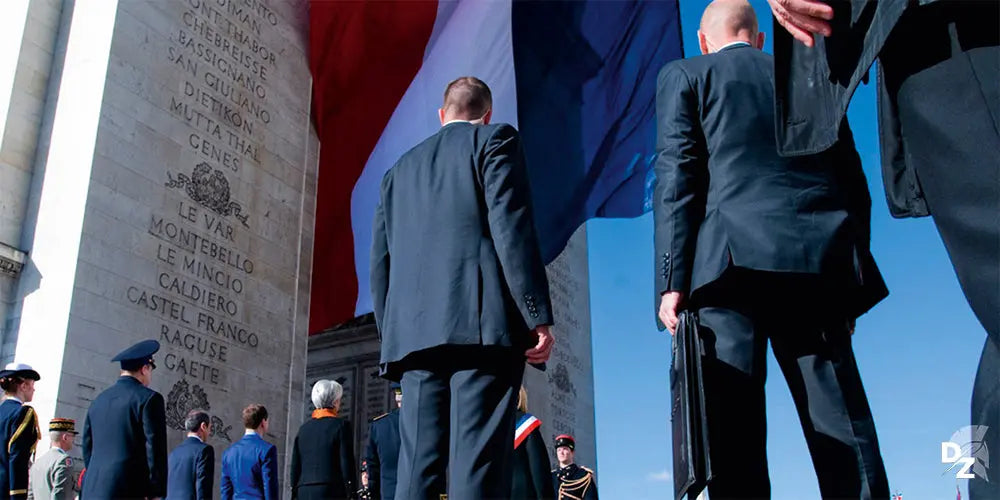
This week Défense Zone met François Bargel, a police superintendent (commissaire) at the SDLP, the French National Police Protection Service. This unit is responsible for the security and close protection of threatened public figures and of foreign guests, particularly during international summits.
Remember to subscribe to this podcast so you don’t miss the next episodes!
Superintendent François’s career
After joining the French National Police Academy (ENSP) in 2009, François Bargel took up the post of deputy head of the community policing service in Montpellier. In 2013 he became head of the public order service in Nice, managing 730 people from various units (dog teams, anti-crime squads, etc.) for different missions (public order, events, crime prevention, reinforcements for the Principality of Monaco, etc.). The skills he acquired during major events enabled him to join the SDLP in 2017.

As head of the temporary missions division, he has secured every international summit, an “extremely intellectually stimulating” experience. He also highlights the opportunities it gives him to “meet people you don’t usually see in a normal police career”, notably international figures such as foreign presidents.
The missions of the Protection Service
The SDLP is a specialised service of the National Police, expert in what is called “360° protection”. It is made up of 1,400 people, each with expertise in one of the following three fields:
- building protection and expertise in building security: the officers’ mission is to secure buildings by revealing their weaknesses after analysis
- resources and mobile assets: this branch handles human resources and manages the service’s mobile assets (vehicles and their security)
-
protection of persons: its staff are responsible for the physical protection on French soil of many people: heads of state, members of French or foreign governments. While the latter move in an already secured environment, the SDLP also protects “people who are genuinely threatened in their daily lives, who don’t have the state apparatus around them”, the superintendent explains.
This type of mission is particularly sensitive because the person threatened, for their beliefs for example, will find themselves with protection officers who are used to “working in a suit” alongside ministers and who have to adapt. You have to “work discreetly, undercover, because our aim is to be seen as little as possible. The best protection is anonymity”, François explains. As well as “scanning the environment” and moving around with the person, the police officer must patiently teach them good practices: use of social media, warnings about geolocation via connected devices, etc.
The Minister of the Interior is the authority who decides which public figures are to be protected, assisted by the counter-terrorism coordination unit, a section of the General Directorate for Internal Security (DGSI) that assesses threats. This may involve cases linked to terrorism, organised crime or public order. François cites, for example, “teachers threatened in Grenoble. The tension was such that there was a physical risk to the people involved, but linked more to debates of ideas within a university than to a terrorist threat as such”.
Every day, 150 protection missions are carried out by the service, a figure that can rise to 180 during summits.
Joining the Protection Service
To be part of the SDLP you must be a police officer and therefore have already passed the initial recruitment exam.

The selection process
A police officer fresh out of training school can join the building protection branch, then, if they show determination and ability, take the tests and become a security driver or protection officer.
A police officer already in post can also apply directly to the sub-directorate for the protection of persons, via a national competitive exam. Selection is made on the basis of applications, then the candidate goes through medical tests and an intense week of more than 23 tests. These assess physical and mental abilities, sociability, language skills and IT skills.
The qualities sought at the SDLP
The superintendent details the qualities expected of a Protection Service police officer: “They must be able to anticipate, to think, to stay alert despite an apparent absence of danger.”
As in any police unit, mutual support is important. You also need to be patient and discreet, and keep a cool head: “it can be heady to suddenly find yourself next to a minister. It’s easy to lose your footing, to forget that you’re a police officer, that you’re part of a hierarchy and not of that public figure’s team. We are not at their service; it is the Republic that asks us to protect them. You always have to keep that in mind to stay effective.” So, faced with a person who holds power, you have to be able to resist social or verbal pressure and know how to say no, “to enter into conflict respectfully in order to enforce the fundamentals of security.”
Finally, the police officer must manage the stress caused by the public figure: “if they left late, it’s not our job to make sure they arrive on time. Our job is to make sure they arrive safely”, stresses the head of division. “Taking risks, going too fast without checking there’s no danger, is the biggest professional mistake we could make.” That is why profiles of people with experience in street policing are of interest, because they have lived through stressful situations linked to terrorism and will be less affected by the stress of a “mere” delay.
The difference between the SDLP and the RAID
The Protection Service and the RAID (the National Police’s elite intervention unit) work together, for example by going abroad together to protect ambassadors.
In France, RAID officers have specific roles within the security arrangements set up by the SDLP. They provide reinforcement on certain trips, or have specific roles in motorcades, summits or events, thanks to their members’ specialities (bomb disposal, dog handling, high-ground marksmanship, etc.). François explains: “We also have specialists, but for example our high-ground marksman is also a protection officer, and we prefer to leave him in that post and entrust the marksman’s task to the RAID, whose expertise is absolute.”
Recently, these reinforcements were needed for the Charlie Hebdo trials. Having joined the SDLP in 2017, François Bargel points out that even though the big waves of attacks had passed, “there were new lone-wolf attacks during the trials. Each time, a terrorist attack leads to excessive media exposure of certain people, and therefore more protection.”
He also points out that there are bridges between the two services, within which certain profiles regularly cross paths.
Coordination with private security
The superintendent is firm: “if we take on a security mission, we are the ones who carry it out. When the state takes charge of someone’s protection, we can’t afford to have a private operator with reflexes, training and procedures different from ours. That is an operational risk we don’t take.”
The SDLP may nevertheless coordinate with private services. If a public figure attends a football match, for example, “the local police are informed; they know we’re coming and that we’re armed. We will also inform the club’s security and cooperate: they handle crowd flows and access, while we take care of close protection. ”
The risks of the profession
“When you join the police, says François, you accept that your physical integrity may be harmed, or even that you may lose your life. Currently, between 10 and 15% of the National Police are injured at any given moment. That shows the physical commitment of all police officers, in all their missions. ”
He adds, however, that members of the Protection Service are not “the most threatened or most in danger, since we are also better trained.” They have the advantage of being able to select and of having weapons and equipment at their disposal. They also know “what they’re going to run into”, unlike a street police officer who may be called to a simple brawl and find themselves facing an armed man.
Also, although the SDLP is as close as possible to the person being protected, the officers’ work consists of “putting measures in place on the periphery so that nothing reaches the public figure”. The probability of a threat getting past all these measures is lower, but “more serious things can happen all of a sudden.”
The SDLP and family life
As far as possible, the work pattern is intense but favourable to staff in terms of family life. They work for a week, doing overtime because protection runs from 7 a.m. to midnight. Then, thanks to the overtime credited, they are off for a week. “Many find it worthwhile personally and for their families, explains François, because in the second week, if they aren’t called back, they can look after their children.”
However, in times of crisis, this system cannot be sustained, and only one or two days off are granted before officers are called back on duty. This intense and demanding pace represents a large volume of hours and can be hard both physically and on family life. That is why it lasts a maximum of eleven consecutive days.
A final piece of advice for candidates
Superintendent François Bargel returns to the qualities expected of SDLP police officers. Qualities that go well beyond physical fitness: “we don’t ask everyone to be top-level athletes.” He concludes the interview by putting things into perspective: “The SDLP is intimidating; people think it will be complicated. It is demanding, but with preparation and by finding out about it, it is far from unattainable. Contact us, we’ll explain how to prepare and we’ll take stock of what this job means to you. ”
Listen to all our episodes here: https://podcast.ausha.co/defense-zone
You can also find them on our YouTube channel by clicking this link or directly on the image