DÉFENSE ZONE
The first aid kit is the most badly bought item of field equipment. People choose it by the number of items announced on the box (“120 pieces!”), whereas the only question that matters is this: what do people die of in the field, and what can prevent it in the first ten minutes?
The answer comes down to very little. Massive limb haemorrhage, airway obstruction, chest wounds. The rest — sticking plaster, gauze pads, sun cream — is a matter of comfort, not survival. A useful kit is therefore short, and its contents are justified line by line.
What must be in it
A tourniquet, reachable with one hand
This is the centrepiece, and the only item that saves lives on its own. A femoral haemorrhage kills in two to three minutes: by the time someone arrives, it is already over. Two criteria matter: that the tourniquet can be applied one-handed on yourself, and that it is stowed somewhere reachable from both sides of the body.
The RapidStop tourniquet meets both requirements. It is useless at the bottom of a pack: that is why the universal tourniquet holder attaches to the belt or the vest, with the tourniquet pre-set, ready for use.


Something to treat a heavily bleeding wound
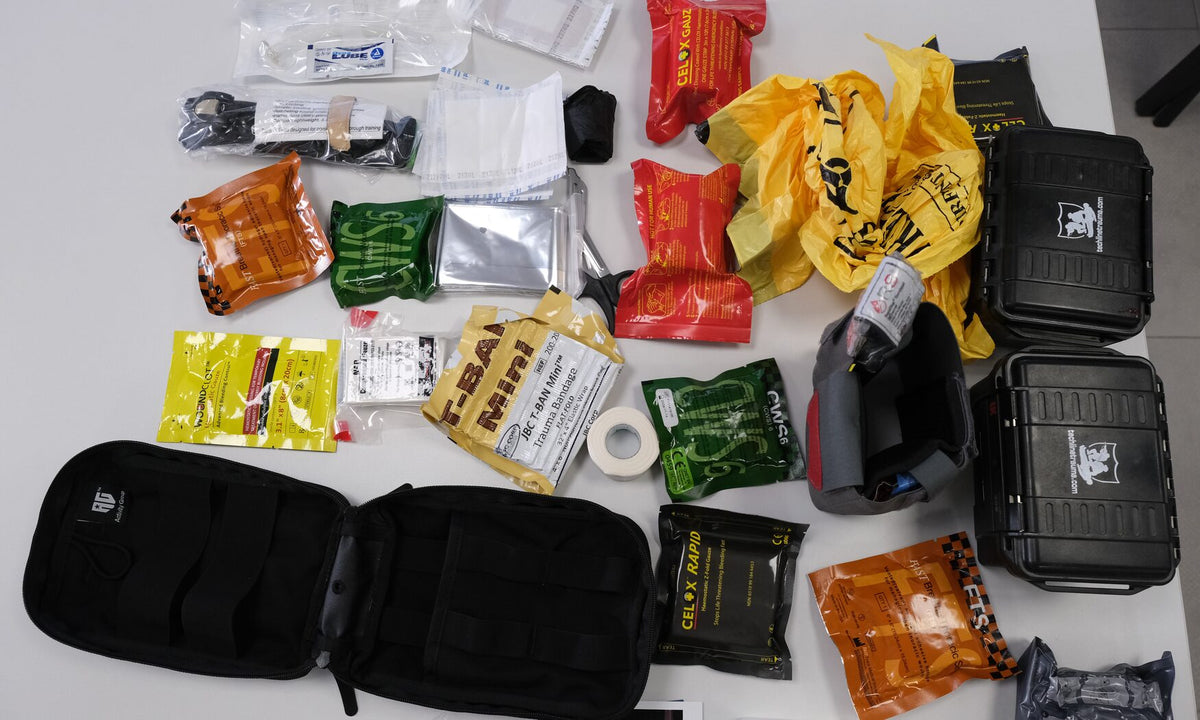
Not all haemorrhages can be tourniqueted. The neck, the armpit and the groin cannot: you then have to compress and pack. Israeli bandage, haemostatic gauze: these are consumables, they expire, and you need to have seen them used at least once.
Something to open and protect the airway
An unconscious casualty often dies from their tongue before dying from their wound. A nasopharyngeal airway costs a few euros and requires only one gesture, provided you have learnt it.
Gloves and a pair of shears
Prosaic, and systematically forgotten. You do not treat through a pair of trousers, and you do not put your hands in someone’s blood without protection.
What has no business being in it
- Supermarket “120-piece” kits. They contain a hundred adhesive plasters and no tourniquet. They treat grazes, not haemorrhages.
- Medicines. Painkillers, antibiotics: mostly outside the legal framework, and of no use in the first ten minutes.
- Equipment you have never used. This is the most important rule on this page. A device never handled in training will not be handled under stress.
Two levels of equipment
The individual kit, carried on you, is for treating your own wound or that of the person next to you. It fits in a pocket. Our basic SMH Medic kit (€100) corresponds to this level: the vital essentials, nothing more. It does not include a tourniquet, which must be added: RapidStop (€65) and tourniquet holder (€20).
The group kit, in the pack or the vehicle, makes it possible to treat several casualties or to hold out longer. The complete SMH Medic kit (€180, free shipping) covers this need, tourniquet and tourniquet holder included. Both kits include a €100 code for the SMH training course. Pairing it with training remains the only sensible way to buy it the first time.


The point that matters more than equipment
A badly applied tourniquet does not tighten enough and worsens the haemorrhage instead of stopping it. Haemostatic gauze applied without compression is useless. Equipment does not make up for a lack of training; it exposes it.
This is what Claude Brunet, who teaches first aid in hostile environments and whom we interviewed, keeps repeating: the skill is learnt, repeated, and quickly fades if it is not maintained. A day of training is worth more than three hundred euros of equipment in a pack. His Essential “Secourisme en milieu hostile” (First aid in hostile environments) (€12) sums up the method.
The rest of the pack
The kit does not live on its own: it is attached in a place known to everyone with you, in a pack whose organisation does not change.
All the equipment can be found in the Equipment and gear collection.
Read also: First aid in hostile environments training, Equipment RETEX: first aid in hostile environments, Claude Brunet, expert in first aid in hostile environments.
Image credits: © Défense Zone. Photographs of our own products.
Questions fréquentes
Que doit contenir une trousse de premiers secours de terrain ?
Un garrot tourniquet accessible d'une seule main, de quoi comprimer et remplir une plaie hémorragique, une canule pour les voies aériennes, des gants et des ciseaux. Le reste relève du confort, pas de la survie.
Un garrot tourniquet est-il vraiment utile ?
Oui. Une hémorragie fémorale peut tuer en deux à trois minutes, c'est-à-dire avant l'arrivée des secours. Le garrot est le seul dispositif qui permet d'y répondre seul, à condition d'être posé correctement et d'être accessible d'une seule main.
Les kits de premiers secours de grande surface suffisent-ils ?
Non pour le terrain. Un kit annonçant 120 pièces contient généralement une centaine de pansements adhésifs et aucun garrot : il traite l'écorchure, pas l'hémorragie.
Faut-il une formation pour utiliser ce matériel ?
Oui. Un garrot insuffisamment serré aggrave l'hémorragie au lieu de l'arrêter, et une gaze hémostatique sans compression ne sert à rien. Un dispositif jamais manipulé à l'entraînement ne sera pas manipulé correctement sous stress.