DÉFENSE ZONE

The French Navy’s only aircraft carrier, the Charles de Gaulle (pennant number R91) is also the only nuclear-powered surface ship in Western Europe. Built under the project management of the Brest naval construction directorate, it officially entered service on 18 May 2001. The Charles de Gaulle is currently the largest European warship, notably thanks to its capacity to deploy 40 aircraft.
History of the aircraft carrier Charles de Gaulle
Until the end of the 1990s, the French Navy had two aircraft carriers with conventional propulsion, using steam boilers (burning fuel oil) to drive the turbines: the Clemenceau and the Foch. Having entered service in 1961 and 1963 respectively, they both left active service in 1997 and 2000 (the Clemenceau was finally dismantled at the end of 2010, while the Foch was sold to the Brazilian Navy in November 2000 until it was dismantled in November 2018). The end of the operational life of these two ships forced the armed forces to launch a new aircraft carrier project well before the withdrawal of the two French carriers.

The construction of the Charles de Gaulle
The idea of acquiring a new aircraft carrier dates back to 1973. Only a few years after the Foch and the Clemenceau entered service, the ministerial decision to order a new aircraft carrier was officially signed on 7 February 1986, with work starting on 24 November 1987.

The choice of nuclear propulsion
Although the need for a new aircraft carrier was quickly identified after the Foch and the Clemenceau entered service (each ship has a service life that is more or less known from the time it is built), it would take many years before work began on the future carrier of the “Royale” (as the French Navy is nicknamed). At first, opinions differed on the dimensions and even the name of the carrier, but the choice of nuclear propulsion was unanimous. At the time, France was seeking to establish its independence in foreign policy and military action. It was also one of the few countries with the technology and engineers able to develop nuclear reactors capable of being installed on a ship or a submarine. This technology gives the ship complete autonomy, both for propulsion and for life on board. The only fuel taken on during port calls or at sea is for the aircraft. It is also a significant energy saving, as the Charles de Gaulle is considered to have saved around 1.5 billion litres of oil in 20 years.
The main stages in the construction of the Charles de Gaulle
- 24 November 1987, first steel plate cut in Brest
- 14 April 1989, structural assembly completed, keel laid and ship placed on the slipway
- 1991, hull construction in the Brest dock
- 11 September 1991, first turbo-alternator installed
- 20 December 1992, first undocking to rearrange the keel blocks
- 7 May 1994, launch ceremony presided over by François Mitterrand
- 14 June 1996, visit by Prime Minister Jacques Chirac to the carrier, officially named “Charles de Gaulle”
- 1 February 1997, commissioned for trials
- 26 January 1999, first sortie at sea
- 5 July 1999, first aviation trials
- 28 September 2000, commissioned by the French Navy
- 17 October 2000, post-trial upgrade (6 months)
- 18 May 2001, admitted to active service, 14 years after the start of construction and the first trials

The construction of the aircraft carrier Charles de Gaulle represents 13 million hours of work, including 2 million devoted to design studies. It is still one of France’s largest construction projects of the last 30 years.
How much does the aircraft carrier Charles de Gaulle cost?
The total budget for building the Charles de Gaulle was around 20 billion francs, or 3 billion euros. By way of comparison, the latest American aircraft carrier (Gérald Ford class) costs 11.7 billion euros. The next French aircraft carrier has already been announced with a minimum budget of 5 billion euros.

Incidents and modifications during the construction of the Charles de Gaulle
The launch of the Charles de Gaulle and numerous problems or incidents marked the construction of the French ship. Nevertheless, for a project of this scale, with new technologies and even new aircraft arriving over the years, the delays are fairly similar to those of other nations with this type of ship. A few incidents or modifications did, however, delay the Charles de Gaulle’s achievement of operational standards.
1992: During the first sea trials, engineers found that the angled deck was too short for landings by E-2C Hawkeyes with degraded arrester wires. For a fairly minimal budget in the end (0.025% of the total construction cost), the flight deck plating and the hull were lengthened by six metres
1999: Detection of a vibration phenomenon at the stern of the ship when travelling at high speed. The cause was the positioning of the rudders, which were then moved slightly to line up with the propellers.
2000: while sailing to the United States, a blade of the port propeller broke, forcing the ship to return to Toulon, its home port. The investigation found a manufacturing error by the supplier. A few months later, the propellers of the Foch and the Clemenceau were used as a temporary replacement, forcing the carrier to sail slightly more slowly (25 knots maximum instead of 27). New 20-tonne propellers, six metres in diameter, made in the United States by Rolls-Royce Naval Marine, were finally fitted in May 2008.
2001: two sailors were poisoned after inhaling hydrogen sulphide during maintenance on a waste-water collection system. One of them remained in a deep coma. His parents took legal action, and nine years later two sailors were given suspended prison sentences.
2009: detection of unexpected wear on the shaft line.
2011: the deck coating was judged too abrasive for the new arrester wire cables. The French Navy decided to use a new paint able to increase the grip of the aircraft’s nose gear when landing on deck.
The main characteristics of the aircraft carrier Charles de Gaulle
The Charles de Gaulle is today considered a medium-sized ship. Smaller than those of the US Navy, it is much larger than the Spanish, Italian or Indian ships.

The dimensions of the Charles de Gaulle
- Length: 261.5 metres
- Beam: 64.36 metres / 31.5 metres at the waterline
- Height: 75 metres
- Draught: 8.5 metres (9.5 at maximum load)
- Displacement: 42,500 tonnes at full load
The propulsion system of the Charles de Gaulle
It is Adyton and Xena (the two nicknames given to the carrier’s reactors) that deliver the 83,000 horsepower needed to propel the ship. Their endurance is around 7½ years between two refuellings. The modest size of the reactors and the absence of fuel tanks for propulsion free up space below deck, and therefore allow additional aviation fuel (3,400 tonnes) and 600 tonnes of ammunition to be carried. It can also carry an additional 1,000 tonnes of diesel to refuel its escort ships.

Its top speed is 27 knots (50 km/h), which it can reach in 7 minutes, allowing faster manoeuvres and therefore increasing its chances of survival in the event of an attack. This speed also allows fully loaded Rafales to be catapulted safely.
Weapons and protection of the aircraft carrier Charles de Gaulle
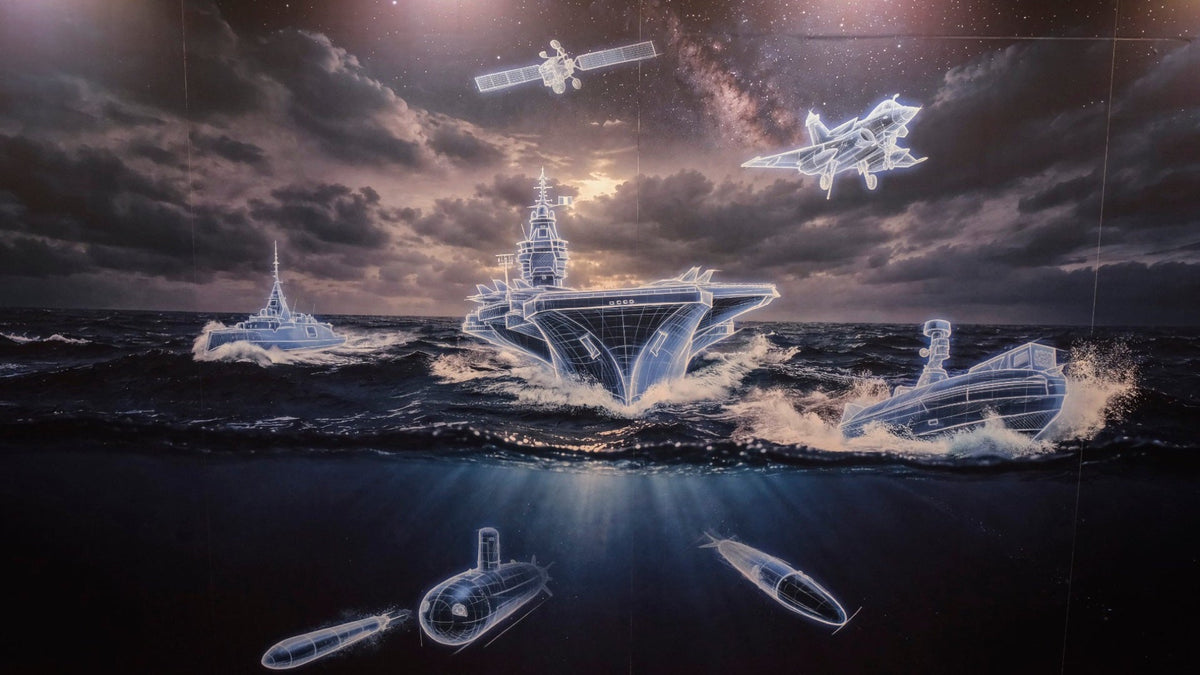
The carrier’s protection does not come from the ship alone, but from a complete environment: the carrier strike group (GAN, see the dedicated chapter). Before they could reach the Charles de Gaulle, aircraft, surface ships or submarines would have to get through many layers of protection.
The Rafale Marine aircraft form the first line of defence, followed by the Aster 30 and 15 missiles (32 missiles in total) of the air-defence frigate (FDA).
The carrier itself has 32 Aster 15 missiles (16 to port, 16 to starboard) providing 360° self-defence against drones, aircraft and cruise missiles up to 30 km away and at an altitude of 13 km. The “Charles” also has 12 Mistral very short-range anti-aircraft missiles and three 20mm Narwhal remotely operated turrets able to fire 800 rounds/minute while tracking moving targets day and night. It is armed with 8 other 20mm F2 guns and 4 12.7mm machine guns.
The carrier’s entire defence is managed by the SENIT 8 command system, which brings together all the surveillance radar systems (short and medium range) and centralises the information from its detection and warning systems as well as those of the carrier strike group’s ships.
The Charles de Gaulle has electronic countermeasure systems, two ARBB33 jammers, 4 Sagaie decoy launchers and a SLAT anti-torpedo decoy.
The ship itself is considered particularly resistant to missile attacks. It is said to be able to keep going even after several hits, thanks to a highly compartmentalised hull and a very advanced firefighting system made up of more than 1,000 detectors.
Life on board the Charles de Gaulle
The aircraft carrier Charles de Gaulle carries around 2,000 people on board: 1,200 sailors, 600 personnel dedicated to the embarked air group (GAE) and 90 sailors who make up the staff.
Further reading: the countries that have an aircraft carrier.
To feed the crew, two kitchens run continuously, staffed by 75 people, including 30 cooks. They have a stock of 315 tonnes of food, enough to be self-sufficient for 45 days. This being a French ship, 500 kg of bread are baked every day and pastries are on the breakfast menu on Sundays.

In addition to sports and leisure facilities, the Charles de Gaulle has a sickbay and a hospital covering more than 600 m2. The sickbay has a dental surgery, a medical analysis laboratory, a radiology room and three consulting rooms. The hospital has a triage and resuscitation room, two operating theatres (orthopaedic and visceral) and a room for severe burns victims. If needed, in addition to the three ship’s doctors and the medical team, the carrier can take on an additional dentist, doctor and nurse anaesthetist, operating theatre nurse, two care nurses and radiographer.
The missions of the Charles de Gaulle
The missions of the aircraft carrier Charles de Gaulle are many. They are mainly combat missions in ongoing operations (Barkhane and Chammal), but also permanent presence missions at sea with the deployment of the carrier strike group, which projects a strong image of the French military presence in any part of the globe.
The carrier strike group (GAN)
A true symbol of a great military power, the carrier strike group is a group of warships organised around an aircraft carrier. It includes:
1 nuclear attack submarine (SNA, Rubis and Suffren class)
2 multi-mission frigates (FREMM, Aquitaine class)
1/2 anti-air frigates (FDA, Horizon class)
1 long-range patrol frigate (La Fayette-class light stealth frigate)
1 replenishment tanker

In addition to the deterrent force and diplomatic influence that the GAN represents, it can be used for land attack thanks to its embarked air group, for the protection of military or commercial sea lanes, for saturating an airspace and for anti-ship or anti-submarine warfare. Moreover, in case of absolute necessity, the Rafale Marine can carry the ASMPA missile with a 300 kt thermonuclear warhead, giving France the ability to launch its nuclear arsenal at any point on the globe with the carrier, but also with the aircraft of the French Air and Space Force and the missiles carried on ballistic missile submarines (SNLE).
The embarked air group of the Charles de Gaulle (GAE)
The number of aircraft making up the embarked air group varies depending on the mission. Since the retirement of the Super Étendard, the standardisation of spare parts, storage space and the aviation hangar has freed up room to embark a few extra aircraft. Today the GAE comprises:
30 Rafale Marine F3-R; its maximum capacity is 36.
2 E-2C Hawkeye airborne early warning aircraft, able to track up to 2,000 targets on their own.
2 NH 90 Caïman Marine helicopters. The TTH version is used to carry troops or equipment. The NFH version handles anti-submarine warfare with sonobuoys and MU90 or Mark 46 torpedoes. For anti-ship warfare, the Caïman is equipped with Exocet MM40 block 3 missiles.
1 AS 365F Dauphin helicopter. Known as “Pedro”, its mission is notably to recover pilots in the event of a crash on take-off or landing.
1 AS 565 Panther ISR helicopter for maritime intelligence missions
Available 24/7, the embarked air group can carry out up to 100 flights a day for 7 days. At full capacity, the Charles de Gaulle can catapult an aircraft every 30 seconds.
The so-called “CATOBAR” catapult system is in service only in France and the United States. This steam catapult system (the carrier has two) allows aircraft to take off fully loaded (fuel, weapons or additional stores such as fuel tanks or intelligence pods) even in heavy weather, without using the aircraft’s fuel to provide the power needed for take-off. This system gives the embarked air group a greater radius of action than any other embarked air group on carriers without this technology.
The Charles de Gaulle: a strategic and diplomatic tool
Following the attacks of November 2015, President François Hollande ordered the Charles de Gaulle to sail. Sending a ship of this size to sea is a strong message to other nations. As the largest European ship in terms of air capability, the carrier above all projects the image of a strong country with a strong military. While some operations could have been conducted from land bases, doing so from an aircraft carrier carries real political weight. The aircraft carrier is an air base that can be deployed anywhere in the world. As the seas are free to navigate, the carrier strike group can position itself quickly near any crisis zone at relatively short notice. For the President of the Republic, the aircraft carrier offers great freedom of manoeuvre without the constraints of certain forward bases, as in 2001, when for the first air missions over Afghanistan, the Mirage IVs based in Gulf countries were not allowed to take off with weapons.

The aircraft carrier is also a tool of international influence and a guarantee of credibility with allies, particularly the Americans. For example, the first “non-American” to head Task Force 50 was Rear Admiral René-Jean Crignola, with the aircraft carrier Charles de Gaulle as his flagship.
The main operations of the aircraft carrier Charles de Gaulle
Outside major technical stoppage periods (ATM), the Charles de Gaulle has taken part in all the major French operations around the world: supporting land operations as in Afghanistan, the Sahel or the Levant, major air operations as in Libya, or missions lasting several months at sea, taking part in many international exercises.
Afghanistan
A few months after entering service, the Charles de Gaulle was deployed to the Indian Ocean for Mission Héraclès. Task Force 473 sailed on 1 December 2001 to conduct operations with its NATO partners over Afghanistan. The mission officially ended with its arrival in Singapore on 2 May 2002. Héraclès remains to this day the longest operational deployment of the Charles de Gaulle.
In October 2010 the carrier returned to the Indian Ocean for Mission Agapanthe, during which it carried out 180 combat missions over Afghanistan. It left the NATO mission Enduring Freedom on 25 December of the same year.
Libya
In application of UN Security Council Resolution 1973, the carrier left Toulon on 20 March 2011 to head for the Libyan coast and take part in Mission Harmattan. While the Navy ship hosted several combat helicopters of French Army Light Aviation, the air group flew 1,350 sorties, including 840 attacks on ground targets. Being close to the coast cut response times to around ten minutes instead of two hours from Corsica. The ship returned to Toulon, its home port, on 12 August 2011.
The fight against the Islamic State
In early 2015, the Arromanches carrier strike group headed for the Persian Gulf to reinforce Operation Chammal in its fight against the Islamic State (IS). In November of the same year, Mission Arromanches II positioned the carrier strike group in the eastern Mediterranean near the Syrian coast. In this capacity, on 7 December it became the first non-US flagship of Task Force 50 to lead all the coalition’s naval air forces. Arromanches III in September 2016 was the Charles de Gaulle’s last participation in the fight against IS before a new major technical stoppage (ATM) in 2018.
The Clemenceau and Foch missions
Since 2019, the carrier strike group has sailed each year for a Clemenceau or Foch mission. TF 473 Clemenceau, from March to July 2019, took the carrier strike group from the Mediterranean to Singapore, with new missions against Daesh as part of Operation Chammal. The mission was repeated the following year during the TF 473 Foch 2020 deployment.
On 3 February 2022, the Clemenceau 2022 mission left Toulon for a mission conducted mainly in the Mediterranean. For the occasion the carrier strike group was made up of a FREMM, a FREMM DA, an FDA, a tanker and an SNA, but also an American destroyer, a Spanish frigate, a Moroccan frigate, and a Greek frigate and submarine. During the two and a half months of the mission, the carrier strike group was to take part in supporting the European Union’s Operation IRINI on enforcing the arms embargo on Libya, Operation Althea to stabilise Bosnia-Herzegovina, and combat missions in support of Operation Chammal.
The next-generation aircraft carrier (PANG)
Having an aircraft carrier places France in the very exclusive circle of major maritime powers. But having only one creates a number of problems, such as its recurring unavailability during 18-month major technical stoppages. As early as 2003 France was already considering building a second ship, but political changes, budget problems and international agreements (at one point it was planned to build it in collaboration with England) postponed the project for many years. It was finally in 2018 that the Minister of the Armed Forces, Florence Parly, announced the launch of a study programme to replace the Charles de Gaulle, whose end of life is expected around 2040. On 8 December 2020, the President of the Republic officially launched the next-generation aircraft carrier programme (PANG).
The PANG’s initial studies and preliminary designs were due to run until 2025, with construction scheduled to be completed in 2036 and entry into service in 2038. The total cost of the programme was then estimated at around 5 billion euros, to which had to be added operating costs of around 10% of the total price per year. Since then, Emmanuel Macron confirmed the launch of the programme in December 2025 and the future carrier was named “France libre” in March 2026. Construction is due to begin in Saint-Nazaire in 2026, with entry into service still targeted for 2038, and public estimates now put its cost at no less than 12.2 billion euros, excluding infrastructure and aircraft.
The ship will be about a third larger, with a mass of 75,000 tonnes and a length of 300 metres. It will be able to accommodate 30 fighter jets and catapult 25 of them per wave. The arrival of the next European combat aircraft, the SCAF (FCAS), heavier than the Rafale (30 tonnes), will require new catapults, and France is turning to the Americans by buying EMALS electromagnetic catapults (ElectroMagnetic Aircraft Launching System), already used on the new aircraft carrier USS Gerald Ford since July 2017. The PANG is due to have three catapults, one of them dedicated to deploying combat drones.
The ship’s propulsion will remain nuclear, but with new-generation reactors able to propel a larger ship. The new K22 reactors will each develop 220 MW, 70 MW more than those of the Charles de Gaulle. Endurance will also be improved, with the reactor core refuelled every 10 years instead of every 7 to 8 today, allowing an availability rate of at least 65% to be maintained throughout its service life.
The PANG project will mobilise nearly 2,000 full-time jobs, including 1,400 at Naval Group and TechnicAtome and 400 at the Chantiers de l’Atlantique in Saint-Nazaire for building the hull.
Other aircraft carriers around the world
There are three main types of ship capable of carrying aircraft.
CATOBAR (Catapult Assisted Take Off But Arrested Recovery) carriers have catapults and arrester wires. Equipped with an axial deck and an angled deck, they operate aircraft fitted with an arrester hook and a reinforced nose gear for take-off. Today only France and the United States have these capabilities. The US fields 10 Nimitz-class ships (330 metres long, 88,000 tonnes displacement, 90 embarked aircraft, crew of 5,000 to 6,300) and 1 new Gérald Ford-class carrier (332 metres, 112,000 tonnes displacement, at a cost of more than 11 billion euros).

STOBAR (Short Take-Off But Arrested Recovery) carriers have a ski-jump bow that allows aircraft to take off (at full power) without a catapult. The drawback of this system is that it significantly reduces the aircraft’s endurance. Landing takes place on an angled deck with an arrester wire system.
- China: 2 ships, Liaojning (Admiral Kuznetsov class) / Shandong (Type 001A)
- Russia: 1 ship, Admiral Kuznetsov
- India: 1 ship, INS Vikramaditya (Kiev class)
STOVL (Short Take-Off and Vertical Landing) carriers, with or without a ski-jump and with or without an angled deck, have no catapult or arrester wires. They are mainly intended for vertical take-off aircraft or rotary-wing or tiltrotor aircraft. Several nations have this type of ship:
- Australia: 2 ships
- Spain: 1 ship
- United States: 9 ships (7 Wasp class, 2 America class)
- Italy: 2 ships
- United Kingdom: 2 ships
Find our portfolio on the aircraft carrier Charles de Gaulle in the latest issue of our magazine by following this link or by clicking directly on the image.

Read more: “Le Charles” on Prime Video: is the series realistic?
Read more: Why a new aircraft carrier?