DÉFENSE ZONE
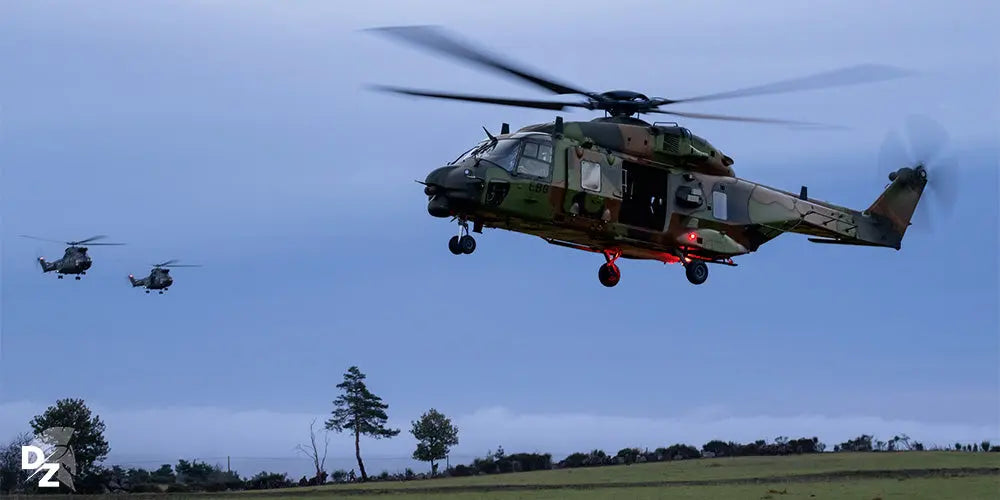
The 4th Air Combat Brigade (4e BAC) is a major French Army helicopter formation with a combined-arms role. Created in July 2016 in Clermont-Ferrand, it is the heir of the 4th Airmobile Division (4e DAM). It reports to the French Army Light Aviation Command (COM ALAT). The 4e BAC commands three of the four combat helicopter regiments. It has 2,650 air combat personnel, 770 reservists and 150 combat helicopters.
History of the 4th Air Combat Brigade
Since the early 1980s, the brigade has gone through five main periods. Since 2016, its headquarters has been in Clermont-Ferrand. And since August 2021, it has been commanded by General Frédéric Barbry.

The five main phases in the brigade’s history
In the 1980s, the French Army wanted to create an anti-tank helicopter force. At the end of 1982, “Force Éclair” was formed. It was from this “Force Éclair” that the Experimental Airmobile Brigade (BAE) was created on 1 September 1983. It was placed under the authority of the 1st Army and its headquarters was in Nancy.
On 1 July 1985, the BAE became the 4th Airmobile Division (4e DAM). Its headquarters remained in Nancy. This new division replaced the 4th Armoured Division. And it was one of the main components of the Rapid Action Force (FAR).
The 4e DAM became the 4th Airmobile Brigade (4e BAM) on 1 July 1999, when the French Army was professionalised and the FAR was disbanded. In 2003, its headquarters moved from Nancy to Essey-lès-Nancy.
The 4e BAM was disbanded on 30 June 2010, when it had 4,400 personnel and 202 combat and manoeuvre helicopters. The three combat helicopter regiments that made it up were placed directly under the Airmobility Division (DIV AERO) of the Land Forces Command (CFT) in Lille.
Then, on 1 July 2016, as part of the French Army’s reorganisation plan, the 4e BAC was created and its headquarters moved to Clermont-Ferrand. The 4e BAC is part of the roll-out of the French Army’s “Au Contact” model. It carries on the traditions and know-how inherited from its predecessors. Its motto is “Supra Optimos”, meaning “above the best”.
COM ALAT and brigadier general
The 4e BAC reports directly to the French Army Light Aviation Command (COM ALAT), a divisional-level command under the “Au Contact” model. This command ensures greater coherence across the 3D environment (training, doctrine, exercises and maintenance). The ALAT, which is heavily committed to overseas operations, thus strengthens its ability to respond to emergencies with effective action.

The 4e BAC has been commanded by General Frédéric Barbry since 1 August 2021. He is the brigade’s fourth commander since its creation in 2016.
The make-up of the 4e BAC
The 4e BAC is made up of 2,650 air combat personnel, 770 reservists and 150 combat helicopters. It commands three of the four combat helicopter regiments: the 1st RHC, the 3rd RHC and the 5th RHC. It also includes the 4th Air Combat Command and Signals Company and a headquarters into which an air combat adaptation group is integrated. These are based in Clermont-Ferrand.

The 1st Combat Helicopter Regiment (1er RHC)
Created in 1977, the 1st Combat Helicopter Regiment (1er RHC) is the New Generation (NG) combat regiment. It is stationed in Phalsbourg, in the Moselle department. It is made up of around 850 air combat personnel and 200 reservists. It is organised into 12 squadrons:
- a command and logistics squadron
- an airfield services squadron
- a maintenance command squadron
- a defence and protection squadron (reservists)
- two attack and destruction helicopter squadrons (Tigre helicopters)
- a reconnaissance and attack helicopter squadron (Gazelle helicopters)
- three manoeuvre and assault helicopter squadrons (Caïman helicopters)
- two helicopter maintenance squadrons
Read our profile of Sergeant Léonard, an operational cabin crew member (MOS) with the 1er RHC.
The 1er RHC was the brigade’s first regiment to be equipped with the new-generation Tigre HAD and Caïman combat helicopters.

It carries out general or air combat missions both in France and abroad. Its missions range from patrol level to combined-arms battlegroup level. The 1er RHC thus conducts reconnaissance, fire support, heliborne insertion of troops in contact, medical evacuation and evacuation of nationals missions. When it is deployed, the regiment brings striking power, responsiveness and reach. Its motto is “Le premier des premiers” (The first of the first).
It carries out domestic and overseas missions over the long term. It thus takes part in operations such as Sentinelle and Héphaïstos. It also took part in the Irma mission in 2017 and Operation Résilience during the first wave of Covid-19 in 2020. But most of its operations are air combat operations. It has taken part, or is still taking part, in Operation Pamir in Afghanistan, Harmattan in Libya, Serval in Mali, Sangaris in the Central African Republic and Barkhane in the Sahel. In the Sahel, it operates combat helicopters continuously, rotating its own crews.

Away from its base, it is able to deploy a self-sufficient detachment of 30 combat helicopters for at least a week, with all the necessary support, to carry out any type of mission in a combined-arms context.
The 3rd Combat Helicopter Regiment (3e RHC)
The 3rd Combat Helicopter Regiment (3e RHC) is based at Étain-Rouvres air base, in the Meuse department. Created in 1977, it has established itself as the night-fighting specialist and is nicknamed the “night regiment”. Its motto is “Toujours plus haut” (Ever higher).

The 3e RHC has around 750 men and women. It is made up of a regimental headquarters and three battalions:
- The support squadrons:
- Command and Logistics Squadron (ECL)
- Airfield Services Squadron (ESA)
- Maintenance Command Squadron (ECM)
- Defence and Protection Squadron (EDP – reservists)
- The reconnaissance and attack helicopter squadrons
- three reconnaissance and attack helicopter squadrons (EHRA1, 2 and 3)
- a reconnaissance and attack helicopter maintenance squadron (EMHRA)
- The manoeuvre and assault helicopter squadrons
- three manoeuvre and assault helicopter squadrons (EHMA1, 2 and 3)
- a manoeuvre and assault helicopter maintenance squadron (EMHMA)
It also includes a defence base support group, a medical service, an armed forces social assistance service, a military fuel service, an ESID (defence infrastructure service establishment) / USID (defence infrastructure support unit), and a CIRISI (joint centre for infrastructure networks and information systems).
Within the ALAT, the 3e RHC is the expert in digitisation and simulation. It is the only regiment equipped with a manoeuvre helicopter – command post kit (HM PC), which turns the cabin of the Puma helicopter into a flying command post. Within the ALAT, it is also the leader in CBRN (chemical, biological, radiological and nuclear) risk and in drone/helicopter cooperation.

On operations, it supports ground troops in a range of missions (gathering intelligence, supporting, reconnoitring, destroying, transporting, evacuating and rescuing). The 3e RHC has taken part, or is still taking part, in Operation Pamir in Afghanistan, Harmattan in Libya, Serval in Mali, Sangaris in the Central African Republic and Barkhane in the Sahel (since 2018). It also provides a detachment for the French forces stationed in Côte d’Ivoire and Djibouti. Every year it takes part in the Jeanne d’Arc mission as part of its partnership with the French Navy. It also takes part in Operations Sentinelle and Héphaïstos, and took part in the Irma mission in 2017 and Operation Résilience in 2020.
The 5th Combat Helicopter Regiment (5e RHC)
The 5th Combat Helicopter Regiment (5e RHC) was created in 1977 and is based in Pau. With its 60 aircraft, it forms (together with the 4e RHFS) the largest helicopter base in Europe. Its motto is “De la terre, par le ciel” (From the land, through the sky).

The 5e RHC is made up of around 900 service personnel, 330 reservists and 40 civilians. It comprises:
- an airmobile support battalion (an air services squadron and a command and logistics squadron)
- a Cougar squadron, two Caïman squadrons and a maintenance squadron
- two Tigre squadrons, a Gazelle squadron and two maintenance squadrons.

The 5e RHC carries out intelligence, armed intervention, manoeuvre and transport missions for all types of troops.
It has been present in every theatre where French forces have been or are deployed. It has taken part in operations in Chad, the Balkans, the Persian Gulf, Somalia, Rwanda, Côte d’Ivoire, Gabon and Djibouti. More recently, it has been deployed on Operation Pamir in Afghanistan, Harmattan in Libya, Serval in Mali (opening the theatre of operations by carrying out the first interventions), Sangaris in the Central African Republic and Barkhane in the Sahel. It also takes part in all domestic missions, including Operations Sentinelle, Harpie and Héphaïstos, and in relief operations for the population after natural disasters (floods and storms).
The Air Combat Adaptation Group (GAAC)
The Air Combat Adaptation Group (GAAC) was created in 2016. It is part of the 4e BAC headquarters, which has around a hundred personnel. The GAAC is made up of combined-arms officers and NCOs. As a rule, an army aviator is included in the team, which is staffed by personnel from the combat arms (infantry, cavalry) and the support arms (artillery, engineers).
Its mission is to ensure optimised joint operational preparation between the three combat helicopter regiments (1er, 3e and 5e RHC) and all land forces units, split between the two SCORPION divisions and the specialist commands.

It is therefore the link between the land forces units designated to train in air combat and the RHCs. Once units have been designated, they interact with the BAC through the GAAC. The GAAC ensures that the RHCs have access to combined-arms capabilities for their operational preparation.
The GAAC helps find partner units for the RHCs’ operational preparation. To do so, it is in regular contact with the divisions and brigades.

The GAAC works closely with regimental detachments, the DAACs (each regiment has a DAAC, which receives the headquarters’ directives via the GAAC and makes sure they are applied). They are the main link between the headquarters and the regiment for combined-arms exercises and manoeuvres.
Since September 2019, the GAAC has had an amphibious cell. For a year, it prepared Exercise Cormoran, which took place in autumn 2021.
The 4th Air Combat Command and Signals Company (4e CCTA)
The 4th Air Combat Command and Signals Company (4e CCTA) is based in the Quartier Desaix of the 92nd Infantry Regiment in Clermont-Ferrand. With a history going back to 1943, it was recreated in 2016 and renamed the 4e CCTA in 2019.
Made up of around 120 service personnel under the command of a captain, the 4e CCTA is divided into a command section, a headquarters support section, two type 3 connection sections and one type 4 connection section.
The 4e CCTA deploys and operates the information and communication systems of the brigade’s various air combat command posts, as in the other combined-arms brigades.

It is able to deploy several types of command post (CP) for the brigade:
- a main CP deployed under canvas, in a modular shelter or in a building
- a temporary CP able to take over from the main command post and allowing command as close as possible to the action for a specific phase of the manoeuvre
With its airmobile expertise in deploying CPs, it can quickly set up a temporary CP in heliborne mode, known as a temporary air combat CP, thanks to manoeuvre helicopters. This type of temporary CP is generally used for a particular phase of an operation.
When deployed in a joint or allied framework, the 4e CCTA must connect its command posts to the higher level and to its subordinate units, and must therefore master the various interconnections between the information and communication systems of the units it may operate with. It also specialises in tactical data links.
It has taken part in several domestic and overseas missions: Desert Storm (Gulf, 1991), Libage (humanitarian mission in Kurdistan, 1991), Trident (Kosovo), APRONUC (Cambodia, 1992 and 1993), Oryx (Somalia, 1993), Turquoise (Rwanda, 1994), Licorne (Côte d’Ivoire) and Pamir (Afghanistan).
Missions and equipment of the 4e BAC
The 4e BAC is a combined-arms brigade with an air combat focus. It is the only combat helicopter brigade. It is currently engaged in an ambitious process of renewing and modernising its equipment.
Missions of the 4e BAC
The 4e BAC organises and supervises the operational preparation and monitors the maintenance of the three combat helicopter regiments and their equipment, the headquarters staff and any unit operating in a combined-arms setting. The brigade also optimises the use and management of helicopters.

Its motto is “supra optimos”, meaning “above the best”. It reflects the single manoeuvre of units on the ground combined with the one above the ground. The 4e BAC also aims to strengthen the coherence of combined-arms actions conducted in air-land combat.
Air combat: one of the French Army’s preferred modes of combat
The French Army regards air combat, which is particularly well suited to today’s conflicts, as an essential function for the success of its operations. And as one of its preferred modes of combat. A combined manoeuvre of airmobility and ground troops, air combat is characterised by its speed and its full integration into combined-arms and joint manoeuvres.

Air combat proves particularly necessary on operations against a determined enemy hiding in desert areas or embedded in urban areas. In such cases, only a manoeuvre combining ground forces and helicopters makes it possible to carry out powerful, dynamic and precise actions to surprise, unsettle and ultimately win the day.
At the end of October 2021, the 4e BAC took part in Baccarat, the French Army’s annual free-terrain air combat exercise. In total, 1,300 service personnel took part in this hardened combat training to prepare for high-intensity warfare. DZ was there and takes you behind the scenes of this preparation for a potential war of the future in this article on Baccarat 2021 and high-intensity warfare and in the summary in this video:
The 4e BAC’s fleet
The ALAT operates more than two thirds of the French armed forces’ helicopters. Its equipment is currently undergoing a process of renewal and modernisation. The 4e BAC currently has 150 combat helicopters.
In 2021, more than half of the 4e BAC’s fleet is made up of new-generation (NG) helicopters such as the Tigre, Caïman and Cougar, and the rest of older-generation helicopters such as the Gazelle and the Puma. All are manoeuvre helicopters, except the Tigre and the Gazelle, which are attack helicopters.

“I have around 150 helicopters, a little over half of them new-generation, with 170 crews,” said a delighted General Frédéric Barbry, commander of the 4e BAC, during Exercise Baccarat in October 2021. “The older generations are useful and effective. They perform less well and have less reach, but they still serve us for intelligence and reconnaissance,” he added.
The number of Pumas is falling. They are gradually being replaced by the Caïman and are due to be phased out by 2028. NG aircraft offer better performance, particularly in bad weather and at night. They will also allow better interaction with the SCORPION land force (the SCORPION programme aims to create a scalable and flexible tactical combat system).
So you don’t miss any of our upcoming articles, you can subscribe to our magazine, receive the upcoming print issues, access exclusive content and take advantage of equipment and gear offers from our partners: just click on the image below