DÉFENSE ZONE
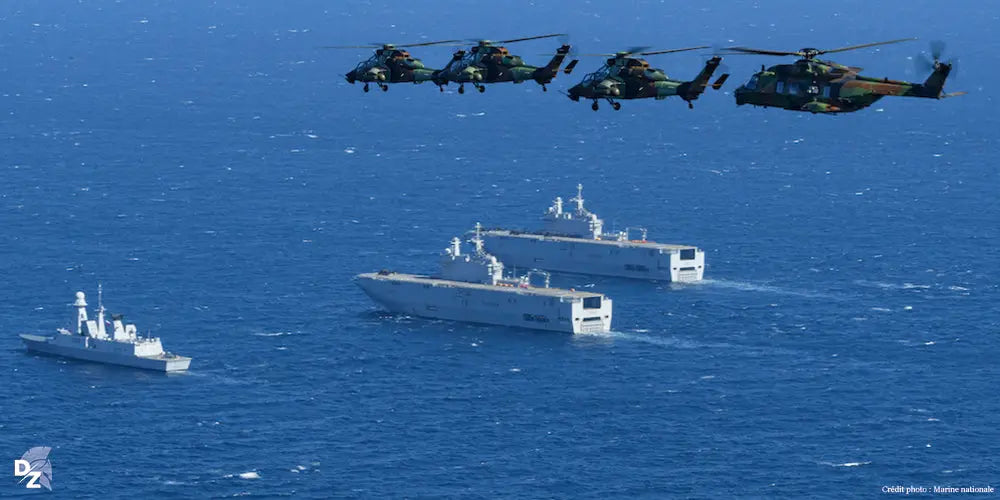
From 27 September to 15 October, the Gulf of Lion was the scene of a major joint exercise: Cormoran 21.
For the first time, an air-mobile naval group (GNAM) was deployed in the Mediterranean under the command of a mixed staff (French Army and French Navy), with 5 ships at sea including amphibious helicopter carriers, 24 helicopters and a detachment of the amphibious engagement support group.
Military amphibious operations
Amphibious operations are not the preserve of modern armed forces. They have existed for centuries, not least because so many civilisations and great cities stood on the coast.
Today the sea remains a major geopolitical issue: in the Mediterranean with, among other things, migration flows; in the China Sea, a theatre of indirect confrontation between Western countries and their allies and the Middle Kingdom; or in the North Sea, where Russian ships regularly come up against those of neighbouring countries, some of them NATO members.
Thanks to its overseas departments and territories, France has the second-largest exclusive economic zone (EEZ) in the world, behind the United States. This position requires it to keep a permanent force at sea and a substantial amphibious capability so that it can intervene as quickly as possible anywhere on the globe, as was the case during Operation Harmattan with the deployment of French ships and helicopters to Libya.

But amphibious operations are complex. Forces must move in complete safety, approach the coast without being detected by the enemy and land by sea and/or air, for lightning strikes or to stay on the ground for the long haul.
Every year, many exercises are organised to master this type of action. Today, the French armed forces are recognised as one of the leading nations in amphibious operations and regularly take part in exchanges with foreign amphibious forces, notably the Americans during the Bold Alligator exercises, or the Italians, whom we covered in a previous article.
A unique amphibious exercise
Cormoran 21 was a unique exercise for several reasons. It was the first time that two amphibious helicopter carriers (PHA), the Tonnerre and the Mistral, had been deployed at the same time on the same exercise. A first, too, in the number of aircraft embarked (24), and finally a first in setting up a single command system, staffed jointly by the French Navy and the French Army within the same cell.

A high-intensity joint exercise
It is now one of the terms most commonly used by the armed forces. Under the direction of the Chief of the Defence Staff, General Thierry Burkhard, French troops are preparing for high-intensity combat. While the concept is not new, it is now on everyone’s mind and in every exercise scenario, and Cormoran 21 is no exception.
This year, the aim of this amphibious operation is to train units in high-intensity action from the sea to the land, in depth and in a context of general insecurity. Operations will be conducted at night to allow helicopters a rapid and discreet approach in order to destroy enemy positions and gather intelligence from the air, or with the support of a detachment of the amphibious engagement support group (GAEA) of the 21st Marine Infantry Regiment (Fréjus).

At the same time, the ships making up Task Group 471.01 must ensure the security of the two PHAs so that helicopters can take off and land and operations can be conducted on board.
The French Navy and French Army forces deployed for Cormoran 21
On board the two PHAs were 24 helicopters of the 4th Air Combat Brigade (4e BAC). It brings together three major units, the 1st, 2nd and 5th Combat Helicopter Regiments (Phalsbourg, Étain and Pau), equipped with Gazelle, Puma, NH90 Caïman and Tigre helicopters. The 4e BAC staff and the GAEA completed the “Army” set-up. On the Navy side, in addition to the Tonnerre and the Mistral, three other ships were tasked with escorting the PHAs: the air-defence frigate (FDA) Forbin, the multi-mission frigate (FREMM) Provence and the replenishment ship Marne. Besides the close defence of the Task Group against intrusion by surface vessels or submarines, the ships were able to provide fire support ashore. In all, Cormoran 21 involved nearly 1,500 military personnel.

Cormoran 21, a multi-objective exercise
For this unprecedented exercise, the “players” had set themselves two main objectives: to work on the doctrine for employing the air-mobile naval group, and to train the GNAM staff to plan and command raids from sea to land in a hardened environment. It was also an opportunity for all participants to go over the basics, whether managing flight decks with so many aircraft, maintaining equipment, logistic support, or conducting operations in a constrained environment, meaning at night with little or no radio communication.

An amphibious operation lasting more than three weeks
After the various modules had embarked, the air-mobile naval group sailed along the French Mediterranean coast according to the progress of the missions and the weather conditions (particularly unfavourable for several days).
After initial individual combat training, the GNAM carried out three raids. The first, in the Montpellier and Béziers areas, aimed to insert the GAEA as close as possible to enemy positions and to provide intelligence on those positions from the helicopters. A few days later, a second raid by 16 aircraft set out to destroy the positions identified and to recover the Fréjus marines. The final action, this time on the Corsican coast, deployed more than 20 aircraft, with high-intensity combat phases and several live-fire training sequences.
Cormoran 2021, a first step for the French Navy and the French Army
Cormoran 21 sketches the outlines of future joint exercises. From now on, it will not be unusual to see more and more manoeuvres conducted jointly by two or even three services in a high-intensity context. They will in a way be the warm-up for Exercise Orion, a division-level manoeuvre scheduled for 2023 that is expected to deploy more than 10,000 troops in the field, including many foreign soldiers.
To subscribe to our magazine, receive the print issues, access exclusive content and benefit from our partners’ gear and equipment offers, click directly on the image below