DÉFENSE ZONE
Welcome to Defense Zone, the podcast that tackles defence and security issues through interviews with military personnel, members of the law enforcement agencies, political figures and entrepreneurs.
The aim of this audio programme, available on all online podcast platforms, is to open the doors of a usually rather secretive world to the general public, in order to provide food for thought on questions that concern us all, whether political, geopolitical, economic or more broadly societal.
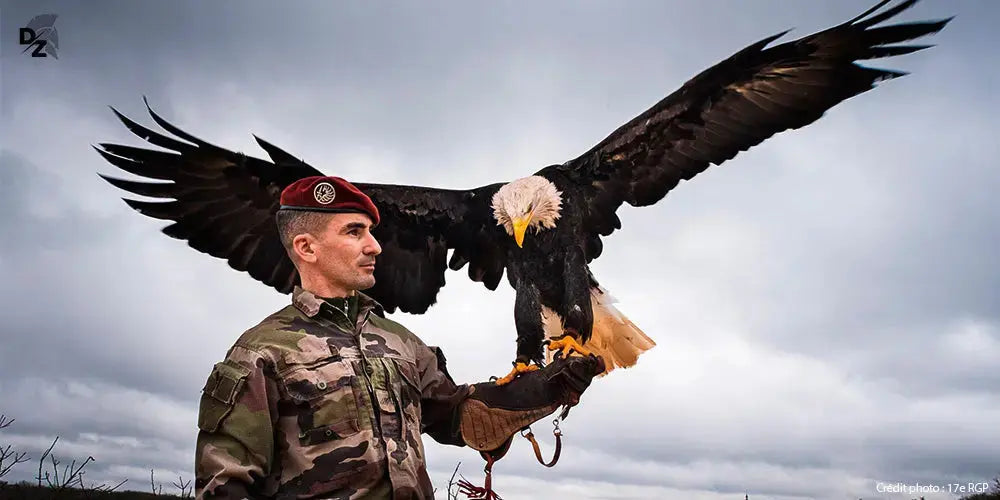
In this new episode, we take you to an unusual meeting with Senior Corporal Fabien, falconer of the 17e RGP (17th Parachute Engineer Regiment) and keeper of the mascot of the only parachute engineer regiment of the 11e BP, which is in his care: Malizia.
Introduction
I am Senior Corporal Fabien, and I have 16 years of service with the 17th Parachute Engineer Regiment. I am currently a mechanic on wheeled armoured vehicles and heavy goods vehicles. On top of that, I have the particular job of looking after our regiment’s mascot: Malizia, a bald eagle. This bird of prey, which is also the symbol of the American administration, or of the Harley Davidson brand for bikers, is an 8-year-old female weighing about 4.5 kg with a 2 m wingspan. She comes from the Rocher des Aigles in Rocamadour and was given to us by our patron, Princess Caroline of Monaco, after the death of Bac Kan, a golden eagle that was our previous mascot.

Why this speciality?
My predecessor was already a mechanic in the regiment, and when he left the institution to become a civilian employee of the Ministry of Defence, he looked for someone to take over. As we worked in the same department, I was in touch with him and I volunteered. There is no appointment within the regiment; it is genuinely voluntary.

When I enlisted in 2007, we were shown round the regiment. We saw the colour guard and our former mascot Bac Kan, a golden eagle. And I said to myself: “one day, I’d like to look after the regiment’s mascot”. Some wanted to join the colour guard, and so on; for me, it was looking after the mascot. That is why, when the post was about to become vacant, I immediately volunteered. I had no qualifications in working with animals; I really come from a mechanical background, with a two-year post-baccalaureate diploma in that speciality. But I had a real interest in this new field and a passion for our mascot. .
Becoming a falconer
I had no skills in the environmental and animal field, so I followed a three-year training course at the Rocher des Aigles in Rocamadour. They taught me the job of falconer and animal keeper.
Day to day, Malizia requires a lot of attention. She has to be fed, flown and cared for, every day of the year. It is a really demanding role, but very rewarding and fascinating. I love animals. I have two Malinois, a horse, a chameleon and a cat. Having a bird of prey is a bonus. It is a different approach to animals, because it doesn’t need stroking like a dog, and it doesn’t come to heel when called. Yet a real bond forms, which is completely different from what you might have with a dog, a cat or even a horse.

As a soldier, my early days as a falconer were still a bit complicated. I had to find my feet and work out how to balance my role as a mechanic, where I have a certain output to deliver, with that of being responsible for the mascot. But after 12 years in this post, I have found my rhythm. My days follow on naturally, even at weekends or during the holidays. I know I have to go to the regiment every day to feed her, come rain, snow or wind.
A representative role
We represent the regiment at ceremonies, parades and guards of honour, and generally at all the official events the regiment takes part in. Malizia is an integral part of the 17th; she represents it and she represents the parachute sappers. When the colour guard is on parade, the mascot is, in most cases, at its side.

Any anecdotes about Malizia?
One year I travelled with Malizia for Monaco’s National Day. I arrive one to two weeks before the ceremony to get Malizia used to things, and one day she decided to fly over the Principality and landed on the roof of Princess Stéphanie’s apartments. We had to go and get her back, but we didn’t necessarily have access to the apartment. In the days leading up to 19 November, she also had me running all over the Principality, including onto one of the prison watchtowers and the cliffs of the port of Monaco. She literally gave me a tour of the whole city, and as it is very steep, it was a real workout! Fortunately the Carabiniers were there to help spot her with the cameras placed all over the city. Even though she wears a small transmitter on her back that lets me locate her, the many buildings interfered with the signal. The aim was to find her quickly to reassure her.

I am also thinking of the International Military Pilgrimage to Lourdes, where I carry Malizia on my arm from 8 a.m. to 8 p.m. One year I ended up with severe tendinitis in my shoulder, but that is the price to pay for these unique moments.
There is also the story of the eve of Saint Barbara’s Day, the sappers’ feast day, when Malizia escaped for 24 hours. When that happens, we have to alert all the relevant municipal and departmental services. That day she missed the ceremony, which somewhat annoyed the commanding officer, but everything ended well. She is still the mascot, and we always forgive her mischief.
Despite all the precautions I can take, Malizia remains a wild animal. You can’t predict her behaviour, even if after a few years you know your bird. In flight she is free; there is no line holding her back. She really does what she wants, but I am her point of reference. She knows me, I spend my life with her, so she has no interest in heading off into an unfamiliar environment where she would be frightened. When she flies at the regiment, she always stays in an area where she can see me. She has better eyesight than I do and prefers to stay where she feels safe. By keeping me as a reference point. The regiment is her home; she always comes back to it.
The regiment and its mascot
I think all the sappers are proud of her; they like talking about her and introducing her to their families. Malizia is the regiment’s mascot, I am the falconer, but she belongs to everyone. I think she brings something extra to our unit. Having a colour with its guard and a mascot, especially a bird of prey, is prestigious. A bird of prey, with its predatory, aggressive side, adds a little something and speaks to the sappers; it is rewarding for them and for the regiment to see Malizia invited to many events.
Mascots in the French Army
I don’t know them all, but I know there are the Spahis and the Tirailleurs with a ram, the 31e RG with a billy goat, the Legion with a mule, and a signals regiment that recently acquired a goat. Every mascot tells a story and carries a message. They all bring added value to their units. I think it’s wonderful that the French Army keeps up this tradition.

Deployments abroad
I’d love to go with her, but Malizia is not an “operational” animal. She really is a mascot, the regiment’s top model. She is there for photos and parades. Personally, I have already been to Chad, Mali, New Caledonia and Mayotte, and I’d like to take her one day on an MCD (short-term mission). Even so, you have to bear in mind that it requires special logistics. You also have to think about the animal’s welfare: she is a mascot, not a toy. You have to be certain of having the necessary veterinary facilities in case she needs care, that she is in good condition to travel, and so on. One destination comes to mind: the United Arab Emirates. It is a country very attached to birds of prey and we have a unit there, so it could be an excellent opportunity for an exchange, but that decision is above my pay grade.
The French Air and Space Force and birds of prey
The airmen use birds of prey to neutralise drones. I wanted to find out more about it, not to do it at the regiment, but to see their manning methods (affaitage, the term used for training birds of prey, editor’s note). But for the moment I don’t have any more information.
Other countries, such as the Netherlands, use golden eagles to attack small drones.
This breed is really suited to it. They are predators through and through, and if they are properly trained, they can easily neutralise small commercial drones. As for Malizia, that is not her role, and a bald eagle is a fishing raptor, so much less suited to this type of mission.
Malizia’s military status
No, she is only a mascot. She has no rank, unlike some canine mascots in dog units, which have military ranks and service numbers. At most, Malizia could receive a private first class distinction, as the commanding officer has the power to award it to her. She has, however, been awarded the National Defence Medal.
Find out more
You can read our article on the 11th Parachute Brigade.
Listen to the interview with the commanding officer of the 17e RGP in one of our previous podcasts.
You can also subscribe to our magazine, whose latest issue has a main feature devoted to the elite units of the French National Police and the French Gendarmerie, and receive our new issue every quarter, access exclusive content and benefit from equipment offers from our partners. Head to the Premium section.