DÉFENSE ZONE

The commandos marine are the special forces of the French Navy, numbering around 700 sailors spread across seven operational units.
History of the commandos marine
Background
The first naval commando was created on 12 November 1942 thanks to Lieutenant Commander Philippe Kieffer, who argued for the value of a unit able to carry out amphibious operations and assaults at sea. The first sailors were trained across the Channel, as the British already had these skills. The 1st company of naval rifle commandos (fusiliers marins commandos) was thus born in 1942, and fought alongside British and American troops during the Second World War. The unit particularly distinguished itself on 6 June 1944 at Ouistreham, when 177 commandos, under the orders of Lieutenant Commander Kieffer, crushed the German defences. Their losses were heavy, but they never gave up. In 1945, the unit was renamed the 1st battalion of naval rifle commandos. A year later, the naval rifle commando school was created at Sirocco, in Algeria, to award the commando certificate and the amphibious certificate. Between 1945 and 1948, six naval commando groups were formed and took the names of officers killed in action: Trepel, Jaubert, de Montfort, de Penfentenyo and Hubert.

Traditions
The commandos marine stand out from other commandos by the colour of their green beret. In tribute to the 177 sailors of the Kieffer commando who stormed Ouistreham, the beret is traditionally presented to new recruits in that town on 6 June.
Another distinctive sign is their badge worn on the left. It consists of a shield, the centre of which is occupied by a brig (a two-masted ship) sailing on waves, a commando dagger and a Cross of Lorraine. At the bottom, a ribbon bears the inscription “commandos marine” with two naval anchors in the folds at each end.

The motto of the commandos marine is “Tue et prends la voile” (Kill and set sail)
Commandos marine killed on operations since the 2000s
Many commandos marine have fallen on operations, notably in Indochina and Algeria. Since the early 2000s, the unit has mourned six deaths:
Loïc Le Page, killed in Afghanistan in 2006
Frédéric Paré, killed in Afghanistan in 2006
Jonathan Lefort, killed in Afghanistan in 2010
Benjamin Bourdet, killed in Afghanistan in 2011
Alain Bertoncello, killed in Burkina Faso in 2019
Cédric de Pierrepont, killed in Burkina Faso in 2019

Missions of the commandos marine
The commandos marine are employed on behalf of Special Operations Command (COS) and operate in three fields of action:
- Offshore operations (maritime counter-terrorism, counter-piracy and action against illicit activities)
- Sea-to-land operations (amphibious operations or reconnaissance and intelligence)
- Special operations on land

To find out more: the best special forces in the world, the frigates of the French Navy, French nuclear submarines and how to join the special forces.
Organisation of the commandos marine
The commandos marine belong to the Naval Rifle and Commando Force (FORFUSCO) and are placed under the authority of an admiral (ALFUSCO), who reports directly to the Chief of the Defence Staff.
The 7 commandos
Among the seven commandos marine, there are five combat units (Jaubert, Trépel, de Montfort, de Penfentenyo, Hubert) and two support units (Kieffer and Ponchardier). With the exception of the Hubert commando, based in Toulon, all are stationed in Lorient.
The five combat commandos share common capabilities in combat, intelligence and infiltration (by land, sea and air). In addition, each unit also specialises in one field:
- The Jaubert and Trépel commandos carry out counter-terrorism and hostage rescue operations (CTLO)
- The de Montfort and de Penfentenyo commandos have special neutralisation and observation teams (ESNO)
- The Hubert commando also carries out CTLO, and notably includes combat swimmers who conduct underwater operations

The Kieffer commando brings together the command of the special forces group and operates specialised support cells such as drone pilots, CBRN specialists and dog teams.
Finally, the Ponchardier commando operates specific operational equipment for insertion by sea, air or land.
How much does a commando marine earn?
A commando marine’s pay is around €1,635 per month, to which is added an air allowance of €700. On operations, he earns around €3,775 per month.
How to become a commando marine
To join the Navy’s elite, selection is tough. Although the classic route is through the naval riflemen (fusiliers marins), all specialities can apply, provided they have completed a preparation course and a pre-selection. The candidates then begin the commando course, or STAC, described as one of the toughest and most selective in the world. It requires endurance, good physical fitness, adaptability, hardiness, but also great mental strength to hold out over time and under pressure.
In our masterclass “Intégrer les commandos marine” (Joining the commandos marine), we welcomed Ismaël, a former physical and mental trainer for the French Navy. For 1 hour 30 minutes, together with Teddy Palassy, a former commando marine, they gave their best advice on how to prepare properly for the STAC and commando training. Benefit from their experience by clicking on the image below:

The STAC takes place at the Naval Rifle School (École des fusiliers marins) in Lanester, and begins with two days of pre-selection, which already see the first candidates eliminated. The sailors continue with a three-week assessment course combining sport, shooting, hand-to-hand combat, obstacle crossing, abseiling, boat handling, knowledge of explosives, etc. They also take part in two weeks of parachuting to earn their parachutist badge.
Only 10 to 20% of candidates pass this training, at the end of which they receive their basic commando certificate and their green beret. They are then posted to one of the commando units and will continue training throughout their career. Indeed, they must constantly improve their knowledge and skills, and must retake the commando course every three to five years to check that they are still fit to serve in this elite unit.
Note that the Hubert and Kieffer commandos recruit only internally, so a sailor wishing to join one must first prove himself in another commando unit. In addition, the combat swimmer speciality (Hubert commando) requires at least five years’ seniority and a seven-month swimmer course in Saint-Mandrier in the hope of obtaining the combat swimmer certificate (which only 5 commandos pass each year).
Materiel and equipment
Equipment of the commandos marine
The commandos marine have many vehicles at their disposal: fast commando transport boats (ETRACO), Zodiacs, Land Rover Defender light tactical vehicles, ACMAT VT4s, dog-team intervention vehicles, and new-generation embarkable multi-purpose commando boats (ECUME NG). The latter can be deployed from frigates and amphibious helicopter carriers, and can even be airdropped from a C130 Hercules.

Weapons of the commandos marine
The equipment of the commandos marine includes a very wide range of weapons: revolvers, semi-automatic pistols (Sig P-226, Glock 17, HK USP, PAMAS G1), the HK P-11 underwater pistol for combat swimmers, assault rifles (HK G3, Sig SG-551, FAMAS, Colt M4), shotguns, the FN Minimi light machine gun, and sniper rifles (FR-F2, MacMillan M-87, PGM Hécate II, Ultima Ratio).

Going further: books, masterclasses, photo posters
To extend your reading, we offer several resources on our website.
First, you can find a series of masterclasses focusing on joining special units and coaching: Défense Zone masterclass: special forces.
Next, for books, we have listed the best books on special forces in our online Bookshop. We have also published a very comprehensive book on the subject in our DZ Essentials collection.
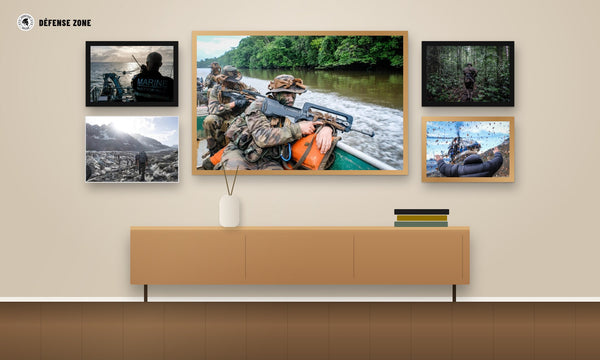
Finally, if you would like to decorate your home with special forces photos, see our special forces photo poster collection.