DÉFENSE ZONE

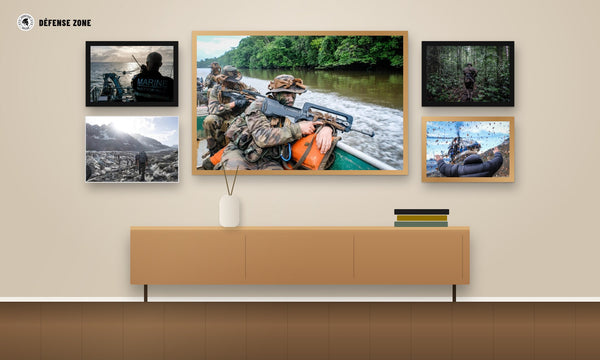
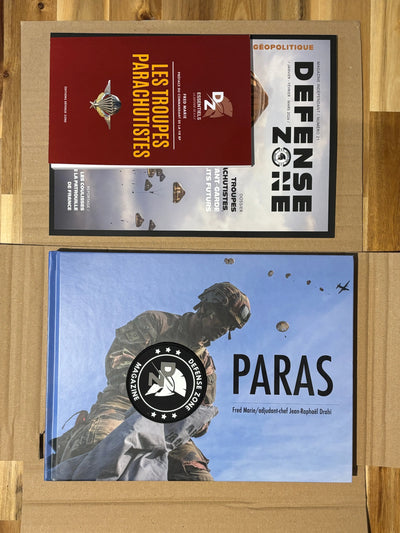
This photo gallery puts French Army paratroopers very much in the spotlight. And for good reason: Fred Marie has been photographing the units of the 11th Parachute Brigade since 2012 for magazine reports.
In 2019, with his partner Jean Raphaël Drahi (chief warrant officer and photographer with the French Army’s information and public relations service, Sirpa Terre), he self-published the photo book “Paras”, which looks back on several years of reporting alongside the men and women who make up this brigade.
This book was printed in 1,500 copies and is now almost sold out. You can, however, order numbered, limited-edition prints of photos from the book in the “Paras” collection.
But let us return to the main subject of this article: the 11th Parachute Brigade.
A French Army unit on permanent alert
The only land forces brigade to maintain a permanent alert of this kind, the 11th Parachute Brigade (11e BP) mans its QRF/TAP (“Quick Reaction Force” of the airborne troops) in rotation from one of its four infantry regiments, reinforced with combined-arms capabilities: command, armour, artillery, engineers, intelligence, as well as specific modules from the 1st Parachute Logistic Regiment (1er RTP), essential for its deployment by air.

In total, the 11e BP can commit a force of nearly 750 men organised in two echelons: a first echelon on 12-hour alert and a second echelon on 48-hour alert.
A true rapid-response brigade, it is permanently ready to carry out the many missions that may be entrusted to it and can intervene at very short notice anywhere in the world.
From Indochina to Mali, the paratroopers’ missions
Historically, paratroopers have taken part in every war France has fought since the Second World War. After the Indochina conflict in the 1950s, the parachute battalions became divisions. But it was not until the late 1990s that the French Army announced the creation of the 11th Parachute Brigade.
In the meantime, paratroopers took part in every conflict: Indochina, the Suez crisis in Egypt, the Algerian War and even Kosovo (under a UN mandate).
More recently, the red berets (and the green berets of the 2nd Foreign Parachute Regiment) have mainly been deployed in Africa and the Middle East: Operation Barkhane in Niger and Mali, Operation Sangaris in the Central African Republic, Operation Chammal in Iraq and then Syria.
We will come back to all these conflicts in future blog articles.
Paratrooper training
Before discussing the regiments that make up the Parachute Brigade in detail, it is important to discuss one of its main components: its training structure.
This is twofold. On one side there is the ETAP, the Airborne Troops School, and on the other the CFIM, the initial training centre for enlisted personnel.

The Airborne Troops School
We will look in detail at this structure, unique in Europe, in a future blog article. What you need to know about this school, based in Pau and created at the end of the Second World War, is that it is a central element of the Parachute Brigade.
It is the compulsory stage for all the airborne troops who will man the brigade. After two weeks of theory classes and practical training to learn how to jump from an aircraft, trainees obtain the coveted “parachutist badge” (brevet parachutiste) after about 6 jumps.
It is important to note that this structure is not reserved solely for French Army soldiers. The ETAP is a compulsory stage for officer cadets of the Saint-Cyr Coëtquidan schools, and it also trains personnel from the other services: the French Navy and the French Air Force.
It is also not unusual to come across gendarmes or soldiers from foreign armies with which France has partnerships.
The initial training centre for enlisted personnel
Before “going through the door” and proudly wearing the parachutist badge, you have to earn the red beret and learn the basics of the soldier’s trade. To do so, future paras must endure the very particular microclimate of Caylus and do their “basic training” in Tarn-et-Garonne.
For 3 months, the young recruits live in the “Lieutenant-Colonel-Normand” military camp and learn the basics: how to use a weapon, how to move, patrol, assault, etc. The teaching provided in this “school” is common to all units of the French armed forces.
Each brigade (with the exception of the special forces) has its own CFIM.
If you would like to see more images on this theme, we recommend the book “Paras”, the last copies of which are available here.

The 8 regiments of the Parachute Brigade
The Parachute Brigade is made up of 8 regiments across south-west France (and in Corsica for the 2nd Foreign Parachute Regiment):
- 1er RCP (1st Parachute Chasseur Regiment), stationed at Quartier Capitaine Beaumont in Pamiers,
- 2e REP (2nd Foreign Parachute Regiment), stationed at Camp Raffalli in Calvi
- 3e RPIMa (3rd Marine Infantry Parachute Regiment), stationed at Caserne Laperrine in Carcassonne
- 8e RPIMa (8th Marine Infantry Parachute Regiment), stationed at Quartier Fayolle in Castres
- 1er RHP (1st Parachute Hussar Regiment), stationed at Quartier Larrey in Tarbes
- 35e RAP (35th Parachute Artillery Regiment), stationed at Quartier Soult in Tarbes
- 17e RGP (17th Parachute Engineer Regiment), stationed at Quartier Doumerc in Montauban
- 1er RTP (1st Parachute Logistic Regiment), 1st Parachute Logistic Regiment (Toulouse-Francazal), stationed at Quartier Colonel Edme in Toulouse.

Mottoes of the Parachute Brigade units
While the paratroopers’ main motto is “Et par Saint-Michel, vive les paras” (And by Saint Michael, long live the paras), Saint Michael being the patron saint of paratroopers, each regiment and military unit has its own motto.
- Airborne Troops School (ETAP): Par le ciel pour servir (Through the sky to serve)
- 1er RHP: OMNIA SI PERDAS FAMAM SERVARE MEMENTO (If you have lost everything, remember that you still have your honour)
- 3e RPIMa: Être et durer (To be and to endure)
- 8e RPIMa: Volontaire (Volunteer)
- 2e REP : More Majorum (In the manner of our elders)
-17e RGP: Sapeur suis, para demeure (Sapper I am, para I remain)
- 35e RAP: Droit devant (Straight ahead)
- 1er RTP: Par le ciel, partout, pour tous (Through the sky, everywhere, for all)
- 1er RCP: Vaincre ou mourir (Conquer or die)