DÉFENSE ZONE
Staying informed is a necessity. Défense Zone monitors the latest developments and news in defence, security and geopolitics for you.
Every Monday, we offer you a selection of the news you should not have missed over the past few days, which you can read in a few minutes.
Enjoy your reading!
🌍 Geopolitics and global strategic balances
The European Union is redirecting its funding to provide lasting support for Ukraine’s defence effort and reconstruction as peace talks become bogged down. These budgetary decisions aim to guarantee direct multi-year financial and military aid to the Ukrainian forces. (Armees.com)
Vladimir Putin publicly reaffirmed his refusal of any territorial compromise on the Donbas in a direct message addressed to two countries bordering NATO. Western chancelleries immediately denounced an uncompromising stance that closes the door to balanced peace negotiations. (Armees.com)
Amnesty International accuses Moscow of recruiting, by force or deception, thousands of foreign nationals from poor countries to fight on the front line in Ukraine. The NGO likens these recruitment networks to human trafficking, exploiting the economic insecurity of unwilling mercenaries. (TF1 Info)
A study in the medical journal The Lancet highlights the health consequences and major risks of radiological accidents caused by hostilities near nuclear facilities in war zones. The report warns of shortcomings in civilian emergency plans in the event of an unforeseen radioactive breach. (Armees.com)
Taiwan has placed its armed forces on heightened alert after the coordinated deployment of more than 50 Chinese navy warships around its territorial waters. The Taiwanese authorities denounce provocative naval manoeuvres aimed at testing the island’s defensive responsiveness. (L'Indépendant)
The financial and material cost of US military operations in the face of tensions with Iran and its proxies is reaching billions of dollars in munitions and continuous naval deployments. Lawmakers are concerned about the rapid depletion of stocks of high-tech interceptors and the pressure on the Pentagon’s budget. (The Hill)
The Egyptian Parliament has approved a legal framework governing the dispatch of defensive military assistance to Saudi Arabia to secure its borders and strategic infrastructure. The arrangement provides for stepped-up joint maritime patrols in the Red Sea and the sharing of radar surveillance data. (Armees.com)
🏛️ Regional security and international policy
Luiz Inácio Lula da Silva has won a fourth presidential term in Brazil, but faces a polarised National Congress dominated by the conservative opposition. This parliamentary configuration will force him to build fragile coalitions to pass his tax reforms and social programmes. (France 24)
At least 50 people were killed in a coordinated attack by gunmen on several villages in north-eastern Nigeria. Security forces have been deployed to secure the area amid a growing number of terrorist and criminal incursions. (Franceinfo)
Ethiopia is negotiating the acquisition of twelve Su-35 air superiority fighters and S-400 air defence batteries from Moscow, altering the regional military balance in the Horn of Africa. This potential deployment is being closely watched by French forces stationed in Djibouti because of its immediate proximity. (Armees.com)
A mobile gendarme was injured in Paris by a Molotov cocktail thrown during unrest on the fringes of a demonstration. Law enforcement made several arrests, while judicial investigations have been opened for aggravated violence. (Franceinfo)
🏭 Economy, budgets and the defence industry
The Pentagon has released its Military Intelligence Program (MIP) budget for fiscal year 2026, which stands at $30.9 billion. These funds will go primarily to space-based collection, cyber defence and the automated processing of sensitive data by artificial intelligence. (Breaking Defense)
The European Union is seeking to mobilise financial markets and private savings via the stock exchange to support massive funding for sovereignty and defence industries. This financial strategy aims to unlock critical capital given the budgetary debt constraints of member states. (Armees.com)
Aeronautical trade tensions between Washington and Brussels have resurfaced after the European Investment Bank granted a €3 billion loan to Airbus, seen as a disguised subsidy against Boeing. The US authorities are threatening to terminate the bilateral truce agreement and impose new tariffs. (La Tribune)
The French arms-related metallurgical industry is suffering from rising energy costs and supply strains on the critical alloys needed for the war economy. Manufacturers are warning about the fragility of the subcontracting chain in sustaining production rates for armoured vehicles and munitions. (Armees.com)
The company Les Forges de Tarbes, a strategic supplier of 155 mm shell bodies for Ukraine, has been placed in receivership by the commercial court. The firm is seeking buyers or fresh capital to preserve its industrial capabilities and honour its military orders. (L'Indépendant)
🤝 Arms contracts and military markets
The United States and Japan have concluded an agreement to set up a joint production line for surface-to-air and anti-ship missiles on Japanese soil. This bilateral industrial partnership seeks to rapidly replenish allied munitions stocks in the Indo-Pacific theatre. (Defence Blog)
Norwegian group Kongsberg has posted a record order book reaching 17.4 billion kroner, driven by massive purchases of NSM anti-ship missiles and NASAMS air defence systems by European armed forces. These commercial results reflect the accelerating rearmament of countries on NATO’s eastern and northern flanks. (Armees.com)
Boeing has secured a $500 million maintenance and support agreement to ensure the sustainment and availability of AH-64 Apache attack helicopters until 2031. The contract covers the supply of spare parts, avionics upgrades and technical assistance to deployed fleets. (Armees.com)
The Netherlands has released an additional €500 million military aid package dedicated to the purchase and delivery of air defence missiles for Ukraine. This package aims to protect Ukraine’s power grid and major cities against Russian air strike campaigns. (Armees.com)
The US Air Force has awarded a $694 million industrialisation contract to launch series production of the ARRW air-launched hypersonic missile. The weapon is intended to give US strategic bombers an ultra-fast strike capability able to penetrate the densest missile defences. (Armees.com)
🛡️ Naval forces and control of the maritime domain
The report by MP Pierre Chenevard recommends ordering a second next-generation aircraft carrier (PANG) as early as 2029 to guarantee the permanent presence at sea of the French carrier strike group. Such early action would optimise industrial costs and avoid a capability gap when the Charles de Gaulle is withdrawn. (Armees.com)
The Euronaval 2026 exhibition highlights the return of symmetric confrontation at sea and the increased vulnerability of surface fleets to supersonic anti-ship missiles and naval drones. Manufacturers are presenting laser self-protection solutions and ultra-rapid-fire weapon systems. (Defense Zone)
The Euronaval 2026 exhibition highlights global naval rearmament, the robotisation of the underwater domain and high-seas strike systems. The event brings together international general staffs and manufacturers around the challenges of high-intensity and littoral warfare. (Defense Zone)
BAE Systems has been awarded a naval modernisation contract for the US Navy littoral combat ship USS St. Louis. The work covers refurbishment of the hull, the onboard electronic systems and the integration of enhanced offensive capabilities. (Defence Blog)
The French Ministry of the Armed Forces has entrusted the Piriou shipyard with building and delivering new RP30 NG intervention tugs for the French Navy. These next-generation vessels will modernise harbour support at the main naval bases in mainland France and overseas. (Zone Militaire / Opex360)
The French Defence Procurement Agency (DGA) has launched a call for tenders to industrialise on a large scale the “Smokers”, its kamikaze naval surface drone designed to saturate enemy defences in littoral environments. The project draws directly on lessons learned from the naval fighting in the Black Sea to equip the French Navy. (Zone Militaire / Opex360)
⚓ Underwater warfare and seabed security
Rear Admiral Cédric Chetaille warns of the growing militarisation of the seabed, described as a genuine “underwater star wars” focused on sabotaging cables and sensors. Control of the deep seabed and underwater surveillance are becoming a major strategic imperative for Western navies. (Le Monde)
Saab is deploying its modular “Ocean Barrier” solution, designed to monitor and secure ports and critical underwater infrastructure against subsea incursions. The system relies on the integration of advanced acoustic sensors and autonomous underwater drones. (Armees.com)
The imminent retirement of the four Ohio-class nuclear-powered cruise missile submarines (SSGN) will deprive the US Navy of 2,080 Tomahawk launch tubes at sea. US military leaders are urgently seeking stopgap solutions on other platforms to maintain their volume of conventional strikes. (Armees.com)
✈️ Air forces and ground-based air defence
The Russian air force has reportedly lost around 13 combat aircraft in the space of a month under pressure from Ukrainian air defence systems and precision strikes on its rear bases. This accelerated attrition of equipment is forcing Moscow to change its engagement profiles and disperse its aircraft. (Defence Blog)
The Polish air force is suffering a critical shortage of instructors and fighter pilots as its new FA-50 and F-35 fleets ramp up. This personnel shortfall makes it harder to meet operational training quotas despite massive investment in aircraft. (Zone Militaire / Opex360)
An Italian Army CH-47 Chinook heavy transport helicopter crashed during a deployment mission in Bosnia and Herzegovina. A technical and military investigation has been opened to identify the cause of the accident and examine the airworthiness of the fleet. (Zone Militaire / Opex360)
Bordeaux start-up Hynaero is teaming up with Leonardo to speed up the design of the Fregate-F100, a modern amphibious water bomber able to carry up to 10 tonnes of water. The programme aims to meet the future renewal needs of Europe’s civil protection fleet in the face of megafires. (Armees.com)
Defence company Anduril has unveiled a modular range of air interceptor missiles designed to saturate enemy swarms and counter cruise missiles at lower cost. The architecture relies on accelerated mass production and software-optimised guidance. (UK Defence Journal)
Bulgaria has joined NATO’s multinational initiative dedicated to strengthening the air defence shield against drones and missiles flying at very low altitude. Membership will allow Sofia to integrate shared firing batteries and speed up the acquisition of electro-optical sensors. (Armees.com)
🪖 Land forces and equipment
Italy has formalised its first tranche of orders for modern main battle tanks to regenerate its armoured cavalry as part of its capability re-equipment plan. The purchase furthers the modernisation of its land forces around an armoured platform interoperable with its NATO allies. (Blablachars)
General Dynamics Land Systems has won a $136 million contract from the US Army to modernise the electrical network and power management of Stryker armoured vehicles. The upgrade aims to integrate future power-hungry sensors, jammers and active protection systems. (Defence Blog)
The replacement of FAMAS assault rifles in the French Gendarmerie (National Gendarmerie) is suffering further budgetary and contractual delays, even though these weapons will reach the end of their operational life in 2030. The directorate must push back its general issue deadlines to prioritise other individual intervention equipment. (Zone Militaire / Opex360)
🤖 Drones, electronic warfare and autonomous systems
The Bundeswehr has begun acquiring the Ukrainian “Bars” missile-drone, capable of striking targets at very long range with great precision. This choice allows the German army to rapidly integrate a combat-proven strike vector at a controlled cost. (Zone Militaire / Opex360)
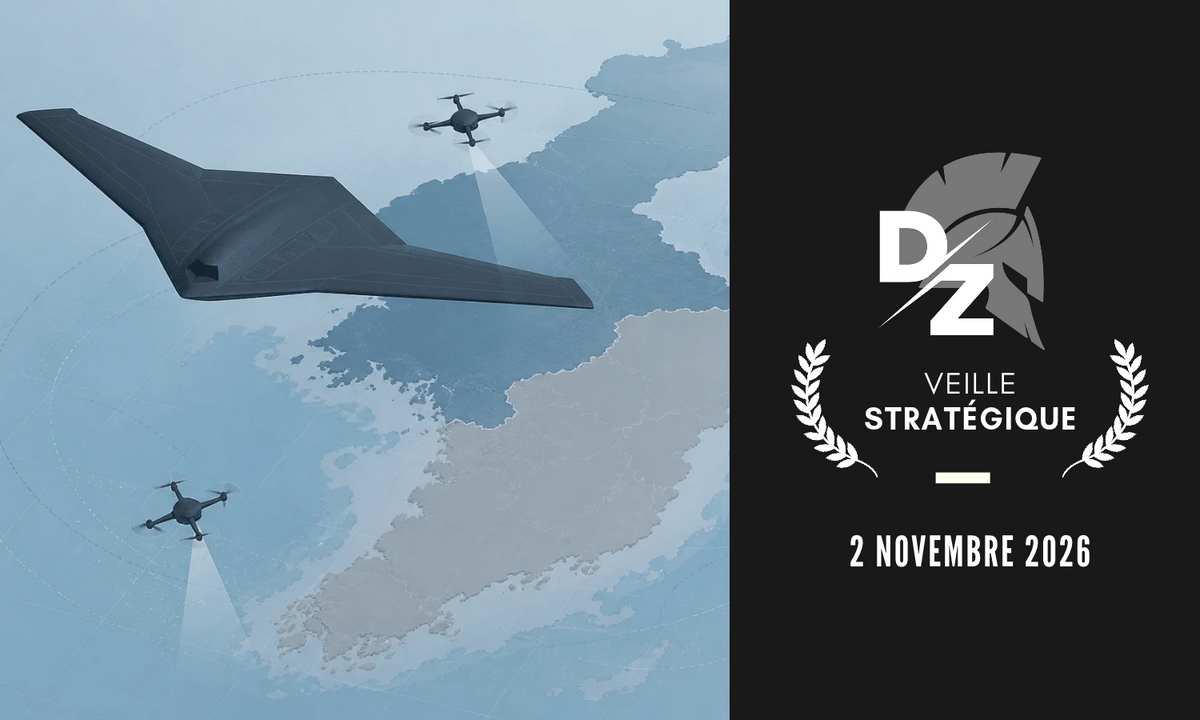
General Atomics is developing the NextGen concept, a stealthy hybrid-electric flying wing dedicated to combined deep strike and tactical reconnaissance missions. This mixed propulsion promises to reduce the thermal signature and significantly increase the range of the unmanned aircraft. (45e Nord)
Northrop Grumman has secured a $56 million contract to improve the avionics and maritime sensor suites of an MQ-4C Triton high-altitude maritime surveillance drone. The investment aims to enhance its intelligence and patrol capabilities in strategic maritime areas. (Defence Blog)
Kim Jong Un oversaw a military demonstration in North Korea featuring new models of suicide drones guided by artificial intelligence. Pyongyang is seeking to modernise its asymmetric capabilities to saturate South Korean and US missile defences. (Armees.com)
A recent study highlights the growing proliferation of cheap, armed civilian micro-drones among African regular armies and armed groups. This spread of technology is upsetting local tactical balances by offering affordable means of reconnaissance and strike. (Armees.com)
Modern armed forces now regard resistance to electronic jamming, GPS-free navigation and AI-driven terminal autonomy as indispensable capabilities for their drone fleets. These technological developments aim to preserve operational effectiveness in highly contested environments. (Breaking Defense)
French SME Asman Technology is preparing the first flight of its DSLR-MK1 electronic warfare drone, designed to jam and gather intelligence on enemy lines at low cost. The aircraft divides the military community over its effectiveness against dense, high-intensity surface-to-air defences. (Armees.com)
NATO’s FUSE 2026 exercise, held in Latvia, simulated the detection of and coordinated response to saturation attacks by swarms of autonomous drones. Allied countries tested the integration of decentralised sensors and the real-time sharing of the tactical picture. (Armees.com)
The French Army’s Technical Section (STAT) is already preparing Standard 3 of the Proteus counter-drone system in order to increase detection range and the speed of automated engagement. This new version incorporates predictive analysis software modules to counter drone swarms. (Zone Militaire / Opex360)
German Army units are field-testing Auterion’s Talon interceptor drone, designed to neutralise enemy attack drones by direct impact or guided interception. The system relies on an autonomous software suite that facilitates detection and collision trajectory. (Defence Blog)
Ukraine’s military innovation cluster Brave1 has allocated a new wave of grants for the urgent development of compact radars and air-to-air mini-missiles designed to counter Russian drones. The scheme favours short engineering cycles so that these systems can be deployed directly on the front line. (Armees.com)
💻 Cyber defence, space and disruptive technologies
The European Union and the European Space Agency have signed contracts to build four additional second-generation (G2) satellites for the Galileo positioning constellation. These spacecraft will offer greater accuracy and better resistance to jamming attempts for military and civilian users. (Aerospatium)
The British Ministry of Defence has made no firm decision on integrating Palantir’s targeting software platform into its joint strike network. Military officials are still assessing the sovereignty of operational data and technological dependence on the American supplier. (UK Defence Journal)
The European Defence Agency is leading the EDSTAR initiative to set common standards for the interoperability of artificial intelligence applied to armoured vehicles and autonomous land systems. The aim is to standardise command and control protocols between the armed forces of member states. (Armees.com)
The US Navy has awarded a $23 million contract to deploy advanced cybersecurity solutions designed to harden the power distribution networks of its combat ships against cyberattacks. The initiative aims to prevent state attackers from hacking or remotely disabling propulsion and weapon systems. (Defence Blog)
The FBI has formally accused cybercriminal groups linked to North Korea of orchestrating a major computer intrusion against the Binance cryptocurrency exchange. These large-scale cyberattacks partly fund the Pyongyang regime’s ballistic and military programmes. (France 24)
CERT-FR has issued an alert bulletin reporting 32 critical vulnerabilities affecting versions 8.0 and earlier of the Suricata network intrusion detection engine. Security system administrators are urged to apply the patches immediately to prevent any remote takeover or denial of service. (Armees.com)
Business opportunities – tender watch
📈 For our defence industry subscribers, our partner Amandine Vassel, a tendering specialist, has identified major contract opportunities.
Feel free to contact Amandine directly on LinkedIn if you would like to improve your strategic watch in this field!