DÉFENSE ZONE
Not long ago, many agreed that Western sanctions would hit the Russian economy hard. It has to be said that their effects are slow to materialise. According to the International Monetary Fund (IMF), Russian growth this year could even exceed that of the European Union and the United States. If Moscow is holding up so well, it is largely thanks to the alliance on which Vladimir Putin has staked everything for almost 20 years. Behind this war between Russia and Ukraine, it is the G7 and the BRICS that are waging a fierce battle alongside their respective allies.
“We are going to bring about the collapse of the Russian economy”, said Economy Minister Bruno Le Maire on 1 March 2022. That does not seem to be the view of the International Monetary Fund, which published new estimates last January. According to the institution, Russia will escape recession with 0.3% this year. In 2024, Moscow should outperform the European Union and the United States. The IMF forecasts 2.1% growth for Russia, against 1% for the United States and 1.6% for the eurozone.

In the first hours of the war, the rouble plunged. However, much to the dismay of the West, the Russian currency quickly recovered to reach a dizzying peak, before stabilising at a level higher than before the war. There are many reasons for this. First, there are the numerous measures adopted by Russia to protect the value of its currency. Russian exporters are required to deposit 80% of their revenues with the Central Bank to exchange them for roubles. Purchases of Russian gas are now made only in roubles. In addition, withdrawing excessively large amounts or exchanging roubles for a foreign currency was quickly banned. And then there is energy. In November 2022, exports of Russian oil, gas and coal brought Moscow 24.6 billion dollars. A sum that has barely fallen since the start of the war. China, it must be said, has doubled its purchases of Russian gas. India’s imports, meanwhile, are now 15 times higher. Of course, energy is not the only strategic sector for the Russian economy. Its industry, which was supposed to be brought to its knees by the embargoes on semiconductors, also plays a major role. Moscow bought 2.6 billion dollars’ worth of these essential materials from Estonia, Turkey or Hong Kong, which, as everyone knows, is under strong Chinese influence.
All these countries are part of the BRICS or their sphere of influence, and they have played a decisive role in the resilience of the Russian economy in the face of Western sanctions.
The de-dollarisation of the global economy
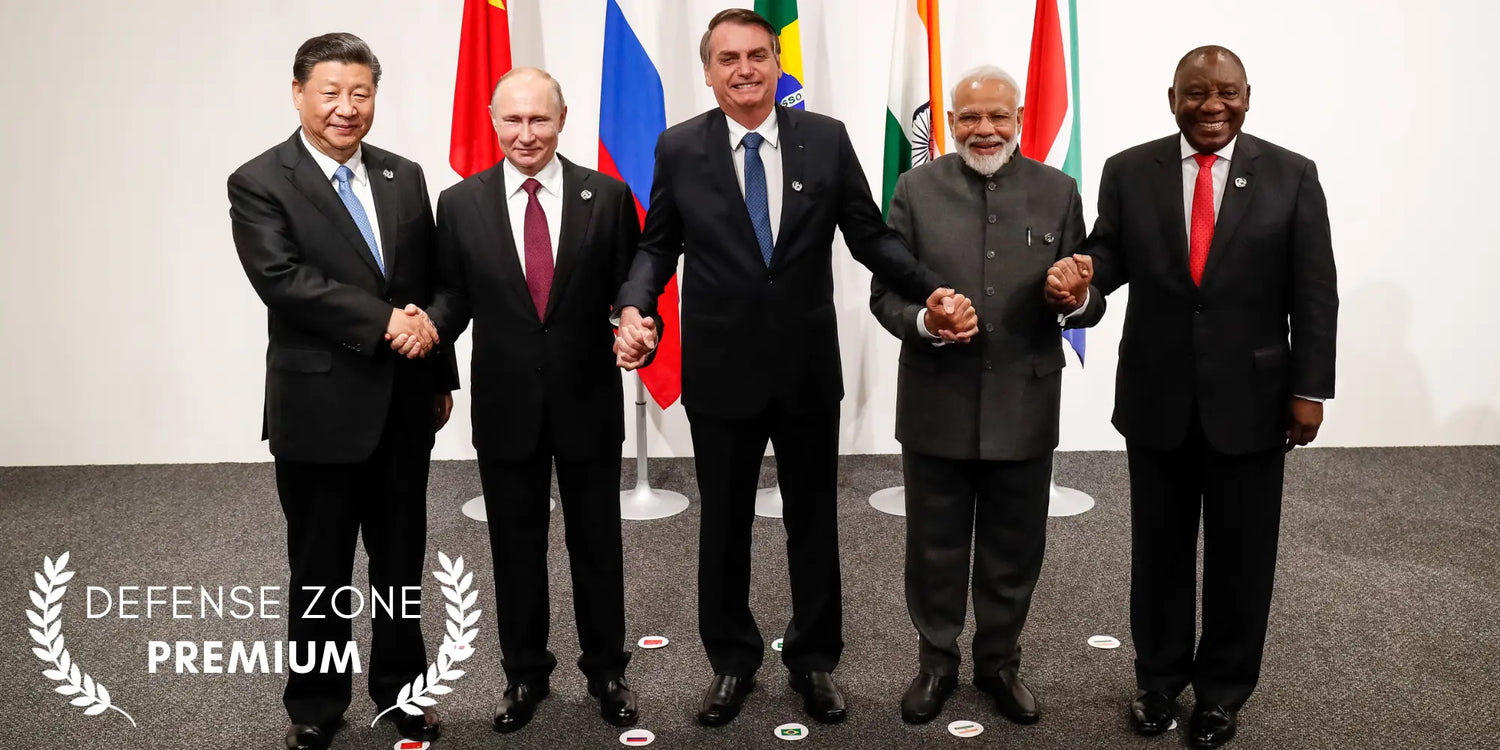
The acronym BRICS refers to the understanding between Brazil, Russia, India, China and South Africa. The term has been used since 2001, but it was above all from 2011, with regular summits and the entry of South Africa, that the BRICS became an official group. Since then, the group has taken the form of a full diplomatic conference, with a rotating presidency and annual summits held in each of the five member states. They coordinate on many fronts: trade issues, defence strategy, civil and arms industry, energy, etc. However, the BRICS do not form a true free-trade bloc. This group of countries, which some still describe as emerging, accounts for more than 40% of the world’s population, 50% of growth and a third of global GDP. The GDP figure is expected to double to reach 50% of world GDP by 2030. Yet the members hold only 15% of the voting rights at the World Bank and the International Monetary Fund. From their point of view, these countries suffer under the domination of the United States and the West. The BRICS’ flagship objective is therefore to create a new multipolar world, in opposition to the hegemony of the G7. Their strategy rests mainly on the de-dollarisation of the global economy.
“A truly multipolar global system”
At their 14th summit last June, chaired by Chinese President Xi Jinping, Russian President Vladimir Putin once again denounced Western countries that use “financial mechanisms to make the whole world responsible for their own economic policy mistakes”, calling on the BRICS to build “a truly multipolar global system”. To achieve this ideal, the five countries set up a supranational bank, the New Development Bank (NDB), which finances infrastructure loans. Created in 2014, it offers lending mechanisms that are an alternative to the structures of the IMF and the World Bank, which the members consider too favourable to the United States. The Asian Infrastructure Investment Bank (AIIB) was created by China at more or less the same time and for the same reasons. Both banks are rated triple A or double A, the two highest confidence ratings that can be given by international rating agencies such as Moody’s or S&P (formerly Standard & Poor’s). As leader of the movement to de-dollarise and challenge the power of the greenback, Russia will gradually eliminate the dollar from its sovereign wealth fund’s coffers in favour of the euro, the yuan and gold. A response to American sanctions and retaliation.
A new common currency
The BRICS aim to create their own common currency. A titanic project that would considerably strengthen the solidity and intensity of trade within the bloc. The idea has been circulating in this part of the world for many years, since sanctions were applied against Iran, then against Russia following its invasion of Crimea. However, the war in Ukraine, the exclusion of Russian banks from the SWIFT system and rising tensions between China and the United States have only strengthened the BRICS’ determination to improve their monetary independence. To prepare for this, the five countries had already begun to use more local currencies in their bilateral trade. For example, India and Russia recently held talks on connecting their RuPay and Mir payment systems. This kind of initiative is nothing compared with creating a new currency as an alternative to the dollar as a reserve currency. When Russia launched its invasion of Ukraine, Western countries immediately froze Russia’s foreign currency reserves. The speed of the Western response surprised Moscow’s central bank, but also the other members of the alliance, particularly China. This new currency would immunise member countries against that kind of risk. It would be based on a basket of local currencies such as the rouble, the yuan, the rupee… An idea Vladimir Putin confirmed at the last BRICS economic forum, held in Beijing on 22 June. “The question of creating an international reserve currency based on a basket of our countries’ currencies is being studied”, he announced.
Worrying consequences for the West
The consequences for the West will be many if this project succeeds. On this side of the globe, it could become more difficult to acquire and process gas, coal or oil. To a lesser extent, this is already part of Europeans’ daily lives and it is one of the causes of the inflation currently hitting households. In addition, G7 countries could find it harder to finance their debt, as the BRICS and their allies would be less inclined to invest in their government bonds. Such economic risks are far from trivial and could seriously destabilise the dollar, as well as the euro, which is closely tied to it.
The BRICS are attracting interest
Argentina, Venezuela, Indonesia, Mexico, Egypt, Iran, Saudi Arabia, Nigeria, Algeria… More than ten countries have officially applied or shown strong interest in this alternative to the G20.
Saudi Arabia
To enlarge the club, China recently reconciled Iran and Saudi Arabia. While Tehran is already a candidate, the agreement signed on 10 March marks a first step towards Riyadh’s application. This Chinese tour de force must not be underestimated. Saudi Arabia’s integration into the BRICS would considerably strengthen these countries’ influence over the Organization of the Petroleum Exporting Countries (OPEC), also known as OPEC Plus since Russia joined it. Signs of this rapprochement have already been seen. Saudi Arabia was largely behind the decision to cut production by two million barrels a day, right under Washington’s nose. On the one hand, it was an excellent way of pushing open the BRICS’ door. On the other, it means that the United States has just lost one of its biggest allies in the Middle East.
India
In the first hours of the war in Ukraine, the United States and Europe turned, in vain, to India. Narendra Modi chose the BRICS camp by joining the International North-South Transport Corridor, a sea, land and air trade route. India can thus carry out transactions paid to the Russians in rupees, at the very moment the Saudis are agreeing to let the Chinese pay in yuan. According to Alain Juillet, former senior head of economic intelligence to the Prime Minister, “this contributes to the de-dollarisation of a world that no longer wants to finance the American deficit, nor suffer the consequences of extraterritorial laws”. In addition, India has long been a major beneficiary of New Development Bank funds. “Of the 30 billion dollars devoted to 80 projects, 21 are based in India and concern infrastructure in the fields of water distribution, transport and energy, for a total of 7.1 billion dollars”, says the Global Times, a Chinese outlet close to the government.
Turkey
Like Russia’s other allies, Erdoğan has not condemned the invasion of Ukraine. Moreover, his country has also sharply increased its imports of Russian gas. Last October, Vladimir Putin and Recep Tayyip Erdoğan met in Astana, the capital of Kazakhstan. It was then the second meeting between the Russian and Turkish leaders in just two months. Vladimir Putin proposed turning Turkey into an energy hub for gas distribution, now that the Nord Stream I and II pipelines linking Russia to Europe are out of service. For his part, Erdoğan pointed out that Turkey can serve as a transit point for shipping Russian fertilisers to the countries that need them most.

Source: Silk Road Briefing
2023, a decisive year
The BRICS will set new criteria for joining the bloc and rule on the admission of new members by the end of 2023, South African Foreign Minister Naledi Pandor announced on Friday 13 January. Her country heads the alliance until January 2024.
In reality, a large number of countries in Asia, Africa and South America are already connected through the New Silk Roads, and their infrastructure projects are financed by the New Development Bank. A network whose reach has been growing much faster since the start of the war in Ukraine. Russia recently consolidated its ties of cooperation with Iran. Tehran has done the same with Venezuela, China and Cuba, China and Nicaragua… The list is long. Moscow and Beijing are developing partnerships of all kinds in Africa, the Middle East and Asia. In an interview with the Global Times, the Argentine ambassador in Beijing states that “the BRICS cooperation mechanisms, notably The New Development Bank, are founded on mutual respect and on a win-win principle”.
The BRICS’ internal contradictions
The BRICS have many detractors among economists and political leaders. Last November, in a column on Europe 1 entitled “BRICS: all that remains is a vintage acronym and a disappointment”, economist Nicolas Bouzou detailed the challenges facing the five countries: “The Chinese economy is stuck in the dead end of its zero-Covid policy, Russia is waging war and pays little attention to economic development […], Brazil has ground to a halt, India is doing best but remains a very poor country”.
All-powerful China
The BRICS are often criticised for having economies and interests that are too disparate. This is the case of Brazil and India, for example. The former champions industrial, export-oriented agriculture, while New Delhi supports its small-scale peasant farming. Another example: India and China are engaged in a trade war that has led New Delhi to impose numerous restrictions on Chinese exports. Not to mention the insidious war the two countries are waging along their common border in the Himalayas.
“While China has established itself as the BRICS’ leading partner, the reverse is not yet true. South Africa, Brazil, India and Russia thus remain marginal partners for China, which moreover has a poorly diversified supplier relationship with them, centred on one or two raw materials”, wrote Sophie Wieviorka, Asia economist at Crédit Agricole, in a research note published last spring. “China’s GDP is greater than the combined GDP of the other four countries”, noted Valérie Niquet, senior research fellow at the Fondation pour la recherche stratégique (FRS), during a seminar organised by the Institut de relations internationales et stratégiques (IRIS) last November. These dissonances are also found in the financial sphere. Several years ago, China was the main driving force behind the creation of new international institutions. These institutions are struggling to live up to expectations, says Valérie Niquet. “The Asian Infrastructure Investment Bank and the New Development Bank, banks run from their official headquarters in Beijing or Shanghai, which were meant to be faster, more efficient competitors to the World Bank or the Asian Development Bank, have so far failed to compete in terms of approvals and disbursements”, she explained at the IRIS seminar.
India plays on both sides
Narendra Modi takes part in person in the BRICS summit. Yet the Indian leader was also present at the end of May 2022 at a meeting of the Quad, a military cooperation alliance between the United States, Japan, Australia and India, whose avowed aim is to counter Chinese military expansion. “The BRICS are like other clubs or forums, and everyone defends their own interests there”, explains Christophe Ventura, research director at IRIS.
India is also distancing itself in the field of defence. The country has recently shown its willingness to move away from Moscow and diversify its arms purchases. Brahma Chellaney, a defence and strategic affairs analyst in New Delhi, said that Russian equipment has served India well in the past, although in recent years it has stepped up its purchases from countries such as the United States, France and Israel. “Defence transition is always a slow, evolving process. You cannot change suppliers overnight”, he explained. India remains, to this day, the world’s largest buyer of Russian arms.
Finally, on 10 March, Washington and New Delhi unveiled a new pact on the development of semiconductors, artificial intelligence and telecommunications. An agreement that touched a raw nerve in Beijing. “We want to deepen our technology relationship with India”, said US Commerce Secretary Gina Raimondo on that occasion, before specifying “that this is not about decoupling, but about keeping our eyes wide open to the fact that China is explicitly trying to access American technology to use in its military, and that we must protect ourselves, as well as our allies and partners, against that possibility”.