DÉFENSE ZONE
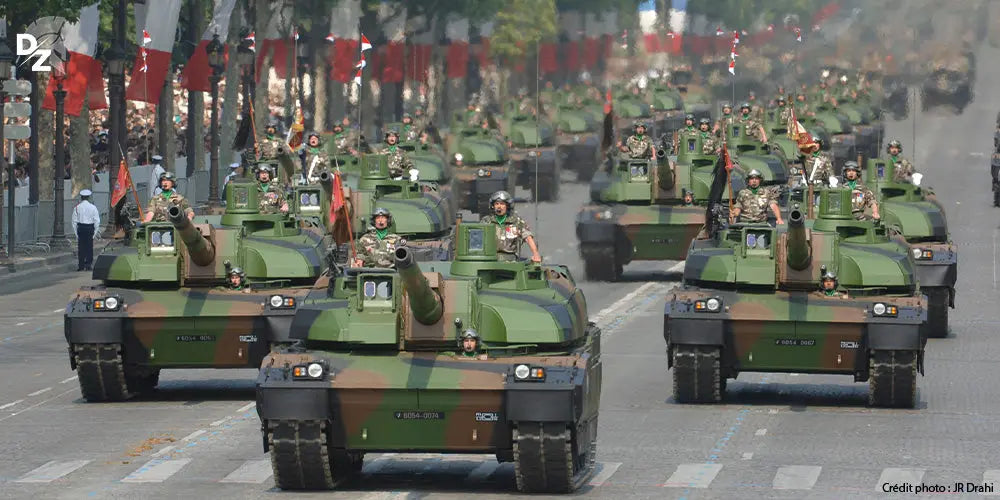
The armoured cavalry branch (ABC) is one of the French Army’s combat arms, bringing together units equipped with armoured vehicles and battle tanks. It is tasked with reconnaissance and intelligence, protection, fire support, assault and destruction missions. The ABC is made up of light units equipped with “wheeled gun” armoured vehicles (AMX-10 RC and Jaguar) and reconnaissance vehicles (VBL), and “heavy” units (Leclerc tanks). Other regiments carry out more specific intelligence and support missions.
The long history of the cavalry
The cavalry is one of the oldest components of the French Army, alongside the artillery and the infantry. In the past, the role of cavalryman was reserved for nobles or the wealthy, who could pay for a horse, its equipment and its upkeep. In the Middle Ages, cavalry was considered a shock arm, but its missions diversified as the art of war evolved: protecting troops, reconnaissance, harassment and exploiting breakthroughs in enemy lines.
To carry out these missions, “the cavalry arm” was traditionally divided into three branches: light cavalry, line cavalry and heavy cavalry, each grouping different regiments. Every French sovereign, from the Ancien Régime to the Restoration and the Empires of Napoleon I and Napoleon III, had cavalry regiments in their military households or imperial guards.

Over the centuries, the French cavalry wrote some of the most glorious pages of France’s military history, particularly under the First Empire. It earned a reputation for bravery and panache through its feats of arms and its greatest figures. However, with the arrival of rapid-fire weapons and motor vehicles, the cavalry was forced to convert, giving up its horses while keeping the spirit of the arm for broadly similar missions.
Since the 1930s, the term has been used to refer to mechanised units equipped with tanks, armoured cars or other armoured vehicles, which took over the missions, titles and traditions of the mounted regiments.
The birth of the armoured cavalry branch
The history of the armoured cavalry branch in France goes back to the First World War, when armoured vehicles were used on the battlefield for the first time and the use of the horse became increasingly limited to transport and reconnaissance.
During the Second World War, despite using more modern tanks, the French army was unable to withstand the German invasion of 1940, and in particular its armoured troops. But it was during the conflict that the armoured cavalry branch was officially born, created on 1st December 1942 in North Africa by General Henri Giraud.
After the Second World War, the French army mainly had American and British tanks, along with a mixed bag of equipment including pre-1940 French vehicles and a few captured German tanks. The M4 Sherman was the French army’s main battle tank, with 1,254 in service until 1960. From 1953, it was replaced by the M47 Patton, 856 of which remained in service until 1970. Because of its poor performance, each battle tank regiment was also given a squadron of AMX-13 tank destroyers armed with Nord SS.11 missiles.

While heavy battle tanks were not used in the various wars of decolonisation from the 1940s to the 1960s, light tanks and reconnaissance vehicles were widely used in French military deployments. At the start of the Indochina War, the armoured cavalry equipment in theatre included Japanese tanks and British armoured vehicles abandoned by those countries’ armies after the Pacific War.
After the defeat in the battle of Route Coloniale 4 (RC 4) in October 1950, more modern armoured assets were deployed, such as M5 Stuarts armed with 37 mm guns, M24 Chaffees, M36 Jacksons, and Sherman tanks fitted with 75 mm, 90 mm and 105 mm guns.
After four years of American military assistance, the French Far East Expeditionary Corps (CEFEO) had 452 tanks and tank destroyers in 1954, as well as 1,985 armoured vehicles, half-tracks and amphibious vehicles. The number of cavalrymen deployed rose from 72 in December 1946 to 2,925 in December 1950, then to 7,391 in December 1951.
At the end of the 1960s, France acquired its new heavy tank: the AMX-30. In all, the ABC operated more than 1,200 of them, the last of which were withdrawn from service in 2018.
In the 1980s, the French army began developing a new battle tank, the Leclerc. Entering service in 1992, the Leclerc was faster and better protected than its predecessors, and equipped with an advanced navigation system and fire-control system allowing it, among other things, to fire on the move. The Leclerc is considered the world’s first 3rd-generation tank.
The missions of the ABC
The missions of the armoured cavalry branch can include reconnaissance and surveillance of terrain, seeking out and destroying enemy forces, supporting ground troops and protecting convoys. The ABC is a strategic arm, able to intervene quickly and effectively in different theatres of operations, whether in France or abroad. It often works in coordination with other arms, such as the infantry or artillery, to carry out its missions.

The ABC is described as a decisive arm because of its capacity for manoeuvre, surprise, shock and fire. Its main missions are:
- Reconnaissance / intelligence: using light, fast vehicles to obtain information on the location and movements of enemy forces.
- Support to dismounted forces: thanks to their mobility and firepower, cavalrymen can stay as close as possible to dismounted forces and provide decisive fire support.
- Shock: the firepower of armoured vehicles makes the difference on the battlefield, whether against enemy armoured troops or infrastructure
- Anti-tank combat: whether head-on or, today, with the new MMP missiles, the cavalry is by its very nature the anti-tank arm
ABC units
Today there are three main types of unit descended from the cavalry: those equipped with heavy tanks, the light cavalry, and more specialised units that came from the ABC but whose missions and equipment no longer involve the use of armoured vehicles.
Heavy cavalry
- The 1st Chasseurs Regiment (1er RCh). Founded in 1651, it went on to have a long and glorious history. Engaged in the great battles of the French army, it was transferred to Thierville-sur-Meuse on 1st January 1998, forming a squadron group within the 1st and 2nd Chasseurs Regiment. On 1st August 2009, it took back the name of 1st Chasseurs Regiment. Today the 1er RCh numbers nearly 900 personnel. Its ranks include 3 Leclerc tank squadrons, i.e. 60 tanks, and 2 reconnaissance and intervention squadrons on VBL.
- The 5th Dragoon Regiment (5e RD). Like all ABC regiments, the 5e RD has a long history. Its creation dates back to 1668. The regiment’s distinctive feature is the joint use of cavalrymen and infantrymen. Disbanded in 2003 while stationed in Valdahon, it rose from its ashes in 2015 at Mailly-le-Camp. Today it is the only combined arms regiment of the French Army in mainland France, with 3 armoured squadrons on Leclerc tanks, 2 infantry companies on VBCI, 1 mixed support company with engineer VABs and 120 mm mortars, and 1 reconnaissance squadron on VBL. The 5e RD provides the opposing force (FOROPS) for the combat training centre (CENTAC). Finally, the 5e RD is the support unit for the SCORPION experimentation, providing personnel and equipment, notably for the evaluation phases of the SCORPION communication system (SICS) and the upgraded Leclerc tank.
- The 12th Cuirassiers Regiment (12e RC). Based in Olivet, the 12e RC was created in 1668 at the wish of King Louis XIV to ensure the protection of his son the Dauphin, hence its name: “Dauphin cavalerie”. Today the 12e RC is made up of 3 Leclerc tank squadrons, 2 reconnaissance and intervention squadrons on VBL, a command and logistics squadron and 2 reserve squadrons.
- The 501st Combat Tank Regiment (501e RCC). Based in Mourmelon, the 501e RCC was the first cavalry regiment to be equipped with the Leclerc tank. As such, it was the first unit deployed on an overseas operation with this major equipment, in Kosovo in 1999. Today the 501 is made up of 3 squadrons on Leclerc tanks (by tradition, the first 2 squadrons keep the name “company”), 2 reconnaissance and intervention squadrons on VBL, a command and logistics company and a reserve squadron.
Light cavalry
- The 1st Parachute Hussar Regiment (1er RHP). Stationed in Tarbes, the 1er RHP is the only regiment to combine the two specialities of light cavalry and paratroopers. Part of the 11th Parachute Brigade, it takes part in all the French Army’s major operations. Its ability to operate in the 3rd dimension, by airdrop or air transport, makes it a unique armoured asset for the rapid-response brigade. Today the 1er RHP is made up of 3 armoured squadrons on AMX-10 RC and 2 reconnaissance squadrons on VBL. It should be one of the next light cavalry regiments to be equipped with the new Jaguar armoured reconnaissance and combat vehicle (EBRC) under the Scorpion programme.
- The 1st Marine Infantry Regiment (1er RIMa). The oldest regiment of the troupes de marine, the 1er RIMa is equipped with AMX-10 RCs. Based in Angoulême, it takes part in all the French Army’s major deployments. Today it mainly comprises 3 armoured combat squadrons, two reconnaissance and intervention squadrons, 1 command and logistics squadron and 1 reserve squadron.
- The Marine Tank Infantry Regiment (RICM). Created from the colonial battalions of Morocco in 1915, the RICM is today the most decorated regiment in France. It wears the triple fourragère (Legion of Honour, Military Medal and War Cross) and has been mentioned in army dispatches nineteen times. Thanks to its great mobility and its anti-tank firepower, the regiment, stationed in Poitiers, can deliver considerable power against an armoured enemy. The RICM is also able to provide significant intelligence and investigation assets. Like the other light cavalry regiments, it is made up of 3 “wheeled gun” squadrons on AMX-10 RC, 2 reconnaissance and intervention squadrons on VAB and VBL, a command and logistics squadron and 1 reserve squadron.
- The 1st Spahi Regiment (1er RS). Based in Valence, the 1er RS is one of the two light cavalry regiments of the 6th Light Armoured Brigade (6e BLB). Guardian of the traditions of the African cavalry, it fields 3 combat squadrons on AMX-10 RC, 1 combat support squadron on VBL, 1 scout and investigation squadron on VBL, 1 command and logistics squadron and 1 reserve squadron.
- The 1st Foreign Cavalry Regiment (1er REC). Stationed at Carpiagne, the 1er REC is the only armoured regiment of the French Foreign Legion and one of the two light cavalry regiments of the 6e BLB. It has 3 armoured squadrons on AMX-10 RC, 2 reconnaissance and intervention squadrons on VBL, 1 command and logistics squadron and 1 reserve squadron. The 1er REC is the first regiment to receive the new Jaguar EBRCs of the Scorpion programme. Find the white-kepi cavalrymen in our book “Légionnaires”.
- The 3rd Hussar Regiment (3e RH). Stationed in Metz, the 3e RH is the light cavalry regiment of the Franco-German Brigade (BFA). As such, it is the only regiment to provide an armoured force in a multinational environment, and therefore a first-entry capability in a European operation. It has 3 armoured squadrons on AMX-10 RC, 2 reconnaissance and intervention squadrons on VBL, 1 command and logistics squadron and 1 reserve squadron.
- The 4th Chasseurs Regiment (4e RCh). Based in Gap, the 4e RCh is the armoured regiment of the 27th Mountain Infantry Brigade. Its personnel hold the dual speciality of cavalrymen and mountain soldiers. It specialises in operations in harsh weather and on steep terrain. Regularly deployed on overseas operations, it served notably for four successive winters in Afghanistan and on several occasions in Mali as part of Operation Barkhane. It has 3 armoured squadrons on AMX-10 RC, 2 anti-tank reconnaissance and intervention squadrons, 1 command and logistics squadron and 1 reserve squadron. In our book “À l’école des soldats de montagne” (At the school for mountain soldiers) you will learn all about the training of the soldiers of the 27e BIM.
The ABC’s specialised regiments
- The 1st African Chasseurs Regiment (1er RCA). Based at Canjuers, the 1er RCA comes under the combined arms training and schools command (COME2CIA). Its mission is to train the drivers and gunners of the light and heavy cavalry, as well as the drivers and gunners of infantry fighting vehicles (VBCI and Griffons). It is also responsible for training the French Army’s armoured and artillery units, notably with the OPERA course (a live-fire course at combined arms sub-group level) at the Canjuers camp. The 1er RCA is also an evaluation centre for the new equipment of the SCORPION programme. As such, since 2019 it has been the training and delivery centre for the Griffon vehicle and, for the past few months, for the Jaguar.
- 2nd Dragoon Regiment (2e RD). Created in 1635, the 2e RD is the oldest regiment in the French cavalry. Today it is the only regiment in the French armed forces specialising in nuclear, radiological, biological and chemical (NRBC) defence. Its missions consist of supporting forces deployed on operations through reconnaissance of potentially contaminated areas and decontamination of troops and equipment. The 2e RD can also be deployed to help civilian populations in France. The regiment has 2 decontamination platoons, 1 vehicle-mounted mobile reconnaissance platoon to mark out specific routes and areas, 1 dismounted reconnaissance and assessment platoon to take samples in a given area, 1 command and logistics squadron and 1 reserve squadron.
- 5th Cuirassiers Regiment (5e RC). Based at Zayed Military City, 65 km from Abu Dhabi, the 5e RC is one of the permanent units of the French forces in the United Arab Emirates (FFEAU). A combined arms regiment, it has a Leclerc tank squadron, an infantry platoon on VBCI, a sub-group of CAESAR guns with a forward air control team, and 1 command and logistics squadron.
- 13th Parachute Dragoon Regiment (13e RDP). Having become a parachute unit in 1953, the 13e RDP became a combined arms intelligence-gathering regiment in 1963. Today the regiment belongs to the Army Special Forces Command. It operates all over the world, directly supporting units deployed in theatres of operations or autonomously. It is the operational intelligence-gathering tool of the Directorate of Military Intelligence (DRM) and can also act on behalf of the Special Operations Command (COS). To find out everything about the 13e RDP, read our full article by following this link.
The ABC’s major equipment
The armoured cavalry branch mainly uses four major pieces of equipment
- The Leclerc tank. In service since December 1993, the Leclerc was the first 3rd-generation armoured vehicle in service with the French armed forces. Armed with a 120 mm main gun, it combines very high mobility with the ability to fire on the move, making it one of the most effective armoured vehicles in the world. Currently, just over 240 tanks equip the French Army in 4 armoured regiments. To find out everything about the Leclerc tank, read our full article by following this link

- The AMX-10 RC. Armed with a 105 mm gun, it can destroy any type of armoured vehicle at up to 2,500 metres. It carries 38 rounds, split between armour-piercing fin-stabilised (dart), shaped-charge and smoke rounds. In service since 1981, 243 are still in service with the cavalry. To find out everything about the AMX-10 RC, read our full article on our website

- The Jaguar. This armoured reconnaissance and combat vehicle (EBRC) will gradually replace the 248 AMX-10 RCs and Sagaies from 2022. This highly versatile vehicle is a militarised 6x6 wheeled vehicle. It can operate in urban or mountain combat. Like the Griffon, it is being developed by a Nexter, Arquus and Thales France consortium. The Jaguar is one of the armoured vehicles of the Scorpion programme, which we discuss in this article.

- The VBL. The light armoured vehicle is an amphibious wheeled vehicle that can take several types of weapon (7.62 mm / 12.7 mm) and can carry out reconnaissance and infiltration missions autonomously, as well as operating around the Leclerc tank as a scout and liaison vehicle.

Training in the cavalry
While cavalry units provide continuous training to the soldiers who make up the unit, all cavalry officers and NCOs must complete initial training at the Cavalry School (EC) in Saumur. The school has three main missions:
- Training officers and NCOs of the armoured cavalry branch. All young ABC officers and NCOs are trained in the armoured combat speciality at the EC. Captains also return to Saumur to prepare for their future command as squadron commanders.
- Providing continuous training for officers and NCOs, notably with the help of the various simulation resources with which the school is equipped
- Carrying out research on armoured combat tactics and strategy in order to develop forward-looking thinking and technology watch in the use of ABC units in future combat, notably as part of the Scorpion programme.
The armoured cavalry branch on overseas operations
The deployment of the French Army’s armoured cavalry regiments on overseas operations is generally decided according to operational needs and the objectives assigned to each mission.
The missions of the armoured cavalry regiments are many, ranging from reconnaissance and surveillance to protecting troops and convoys, as well as interdiction, area control and fire support missions. They can be deployed as autonomous units or integrated into a multinational or joint force. ABC missions can be conducted in coordination with other units, such as special forces, infantry or artillery.
ABC units are found in all the major deployments of the French armed forces, notably during the first Gulf War, in Afghanistan, Côte d’Ivoire, Kosovo, the Central African Republic, Lebanon and Mali.

Depending on the terrain and the missions, “heavy” and “light” units operate either their major equipment or vehicles better suited to the terrain. In Africa, it is common to find personnel who usually serve on Leclerc tanks operating lighter armoured vehicles such as the ERC 90 Sagaie, VABs or VBLs.
Since entering service with the French Army, the Leclerc tank has been deployed twice: in 1999 in Kosovo and in 2006 in Lebanon.

To subscribe to our magazine and receive our very latest issue, whose main feature is devoted to nuclear deterrence, access exclusive content and take advantage of equipment and gear offers from our partners, head to the Premium section.

Read more: Royal Scots Dragoon Guards: the armoured elite of the British cavalry (DZ#19)